

THE NEAR-SURFACE LAYER OF THE OCEAN
1
u
u
u
p
u
w
t
x
z
x
U
w
w
w
w
w
w
w
w
,
(1.86)
1
w
w
w
u
w
g
t
x
z
z
U
U
w
w
w
w
w
w
w
w
,
(1.87)
0
u
w
x
z
w
w
w
w
.
(1.88)
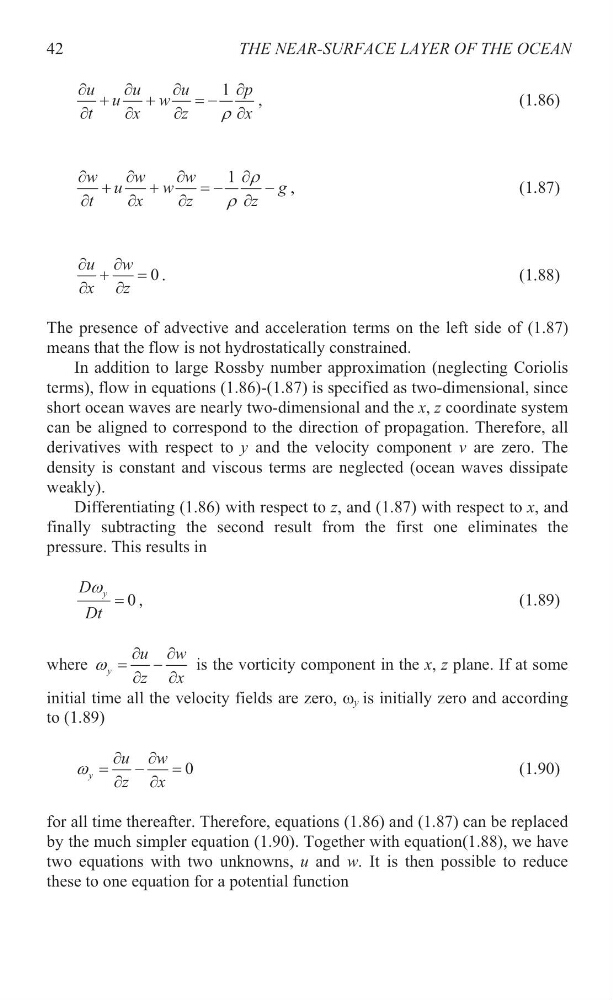
The presence of advective and acceleration terms on the left side of (1.87)
means that the flow is not hydrostatically constrained.
In addition to large Rossby number approximation (neglecting Coriolis
terms), flow in equations (1.86)-(1.87) is specified as two-dimensional, since
short ocean waves are nearly two-dimensional and the x, z coordinate system
can be aligned to correspond to the direction of propagation. Therefore, all
derivatives with respect to y and the velocity component v are zero. The
density is constant and viscous terms are neglected (ocean waves dissipate
weakly).
Differentiating (1.86) with respect to z, and (1.87) with respect to x, and
finally subtracting the second result from the first one eliminates the
pressure. This results in
0
y
D
Dt
Z
,
(1.89)
where y
u
w
z
x
Z
w
w
w
w
is the vorticity component in the x, z plane. If at some
initial time all the velocity fields are zero, Z y is initially zero and according
to (1.89)
0
y
u
w
z
x
Z
w
w
w
w
(1.90)
for all time thereafter. Therefore, equations (1.86) and (1.87) can be replaced
by the much simpler equation (1.90). Together with equation(1.88), we have
two equations with two unknowns, u and w. It is then possible to reduce
these to one equation for a potential function
42
1
u
u
u
p
u
w
t
x
z
x
U
w
w
w
w
w
w
w
w
,
(1.86)
1
w
w
w
u
w
g
t
x
z
z
U
U
w
w
w
w
w
w
w
w
,
(1.87)
0
u
w
x
z
w
w
w
w
.
(1.88)
The presence of advective and acceleration terms on the left side of (1.87)
means that the flow is not hydrostatically constrained.
In addition to large Rossby number approximation (neglecting Coriolis
terms), flow in equations (1.86)-(1.87) is specified as two-dimensional, since
short ocean waves are nearly two-dimensional and the x, z coordinate system
can be aligned to correspond to the direction of propagation. Therefore, all
derivatives with respect to y and the velocity component v are zero. The
density is constant and viscous terms are neglected (ocean waves dissipate
weakly).
Differentiating (1.86) with respect to z, and (1.87) with respect to x, and
finally subtracting the second result from the first one eliminates the
pressure. This results in
0
y
D
Dt
Z
,
(1.89)
where y
u
w
z
x
Z
w
w
w
w
is the vorticity component in the x, z plane. If at some
initial time all the velocity fields are zero, Z y is initially zero and according
to (1.89)
0
y
u
w
z
x
Z
w
w
w
w
(1.90)
for all time thereafter. Therefore, equations (1.86) and (1.87) can be replaced
by the much simpler equation (1.90). Together with equation(1.88), we have
two equations with two unknowns, u and w. It is then possible to reduce
these to one equation for a potential function
42