

THE NEAR-SURFACE LAYER OF THE OCEAN
1.5.4 Rain-induced heat flux
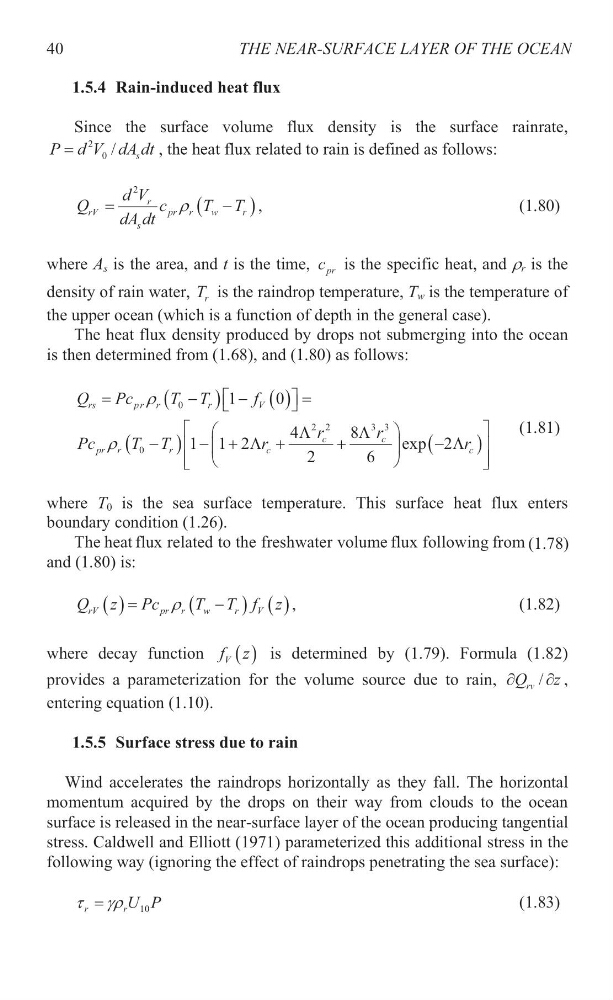
Since the surface volume flux density is the surface rainrate,
2
0 / s
P d V dA dt , the heat flux related to rain is defined as follows:
2
r
rV
pr r
w
r
s
d V
Q
c
T T
dA dt
U
,
(1.80)
where A s is the area, and t is the time, pr
c is the specific heat, and U r is the
density of rain water, r
T is the raindrop temperature, T w is the temperature of
the upper ocean (which is a function of depth in the general case).
The heat flux density produced by drops not submerging into the ocean
is then determined from (1.68), and (1.80) as follows:
0
2 2
3 3
0
1
0
4
8
1 1 2
exp 2
2
6
rs
p r r
r
V
c
c
pr r
r
c
c
Q
Pc
T T
f
r
r
Pc
T T
r
r
U
U
ª
º
¬
¼
ª
º
§
·
/
/
/
/
«
»
¨
¸
«
»
©
¹
¬
¼
(1.81)
where T 0 is the sea surface temperature. This surface heat flux enters
boundary condition (1.26).
and (1.80) is:
rV
pr r
w
r
V
Q z Pc
T T f z
U
,
(1.82)
where decay function
V
f z is determined by (1.79). Formula (1.82)
provides a parameterization for the volume source due to rain,
/
rv
Q
z
w
w ,
entering equation (1.10).
1.5.5 Surface stress due to rain
Wind accelerates the raindrops horizontally as they fall. The horizontal
momentum acquired by the drops on their way from clouds to the ocean
surface is released in the near-surface layer of the ocean producing tangential
stress. Caldwell and Elliott (1971) parameterized this additional stress in the
following way (ignoring the effect of raindrops penetrating the sea surface):
10
r
r U P
W JU
(1.83)
40
The heat flux related to the freshwater volume flux following from (1.78)
1.5.4 Rain-induced heat flux
Since the surface volume flux density is the surface rainrate,
2
0 / s
P d V dA dt , the heat flux related to rain is defined as follows:
2
r
rV
pr r
w
r
s
d V
Q
c
T T
dA dt
U
,
(1.80)
where A s is the area, and t is the time, pr
c is the specific heat, and U r is the
density of rain water, r
T is the raindrop temperature, T w is the temperature of
the upper ocean (which is a function of depth in the general case).
The heat flux density produced by drops not submerging into the ocean
is then determined from (1.68), and (1.80) as follows:
0
2 2
3 3
0
1
0
4
8
1 1 2
exp 2
2
6
rs
p r r
r
V
c
c
pr r
r
c
c
Q
Pc
T T
f
r
r
Pc
T T
r
r
U
U
ª
º
¬
¼
ª
º
§
·
/
/
/
/
«
»
¨
¸
«
»
©
¹
¬
¼
(1.81)
where T 0 is the sea surface temperature. This surface heat flux enters
boundary condition (1.26).
and (1.80) is:
rV
pr r
w
r
V
Q z Pc
T T f z
U
,
(1.82)
where decay function
V
f z is determined by (1.79). Formula (1.82)
provides a parameterization for the volume source due to rain,
/
rv
Q
z
w
w ,
entering equation (1.10).
1.5.5 Surface stress due to rain
Wind accelerates the raindrops horizontally as they fall. The horizontal
momentum acquired by the drops on their way from clouds to the ocean
surface is released in the near-surface layer of the ocean producing tangential
stress. Caldwell and Elliott (1971) parameterized this additional stress in the
following way (ignoring the effect of raindrops penetrating the sea surface):
10
r
r U P
W JU
(1.83)
40
The heat flux related to the freshwater volume flux following from (1.78)