

Chapter 7: APPLICATIONS
which compares well to 969 mm from the disdrometer, 963 mm from the
capacitance rain gauge, and 1031 mm from the optical rain gauge. Though
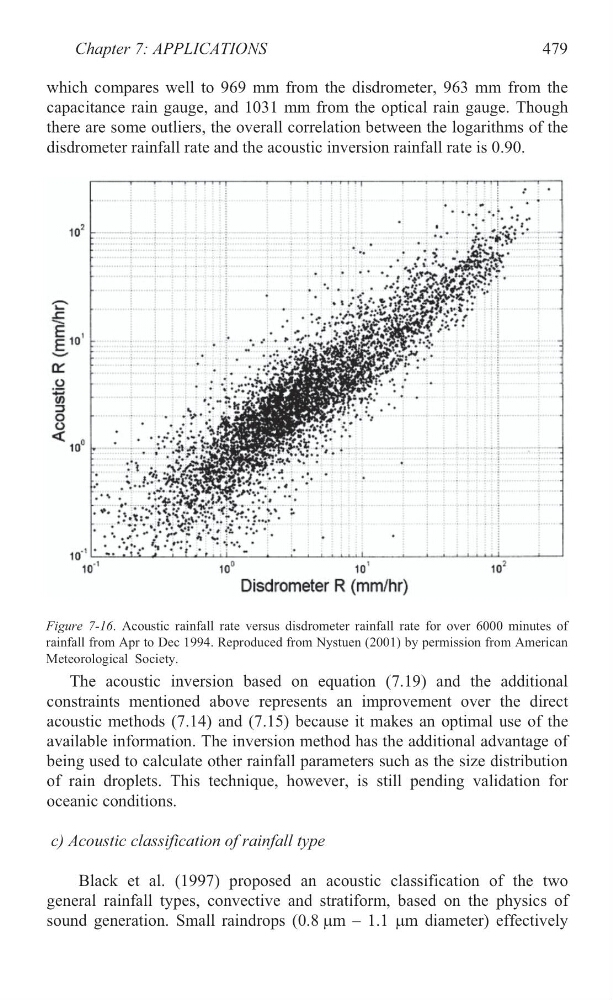
there are some outliers, the overall correlation between the logarithms of the
disdrometer rainfall rate and the acoustic inversion rainfall rate is 0.90.
The acoustic inversion based on equation (7.19) and the additional
constraints mentioned above represents an improvement over the direct
acoustic methods (7.14) and (7.15) because it makes an optimal use of the
available information. The inversion method has the additional advantage of
being used to calculate other rainfall parameters such as the size distribution
of rain droplets. This technique, however, is still pending validation for
oceanic conditions.
c) Acoustic classification of rainfall type
Black et al. (1997) proposed an acoustic classification of the two
general rainfall types, convective and stratiform, based on the physics of
sound generation. Small raindrops (0.8Pm – 1.1 Pm diameter) effectively
479
Figure 7-16. Acoustic rainfall rate versus disdrometer rainfall rate for over 6000 minutes of
rainfall from Apr to Dec 1994. Reproduced from Nystuen (2001) by permission from American
Meteorological Society.
which compares well to 969 mm from the disdrometer, 963 mm from the
capacitance rain gauge, and 1031 mm from the optical rain gauge. Though
there are some outliers, the overall correlation between the logarithms of the
disdrometer rainfall rate and the acoustic inversion rainfall rate is 0.90.
The acoustic inversion based on equation (7.19) and the additional
constraints mentioned above represents an improvement over the direct
acoustic methods (7.14) and (7.15) because it makes an optimal use of the
available information. The inversion method has the additional advantage of
being used to calculate other rainfall parameters such as the size distribution
of rain droplets. This technique, however, is still pending validation for
oceanic conditions.
c) Acoustic classification of rainfall type
Black et al. (1997) proposed an acoustic classification of the two
general rainfall types, convective and stratiform, based on the physics of
sound generation. Small raindrops (0.8Pm – 1.1 Pm diameter) effectively
479
Figure 7-16. Acoustic rainfall rate versus disdrometer rainfall rate for over 6000 minutes of
rainfall from Apr to Dec 1994. Reproduced from Nystuen (2001) by permission from American
Meteorological Society.