

THE NEAR-SURFACE LAYER OF THE OCEAN
,
,
,
u
s
d
E
z
R
z
E
z
O
O
O
,
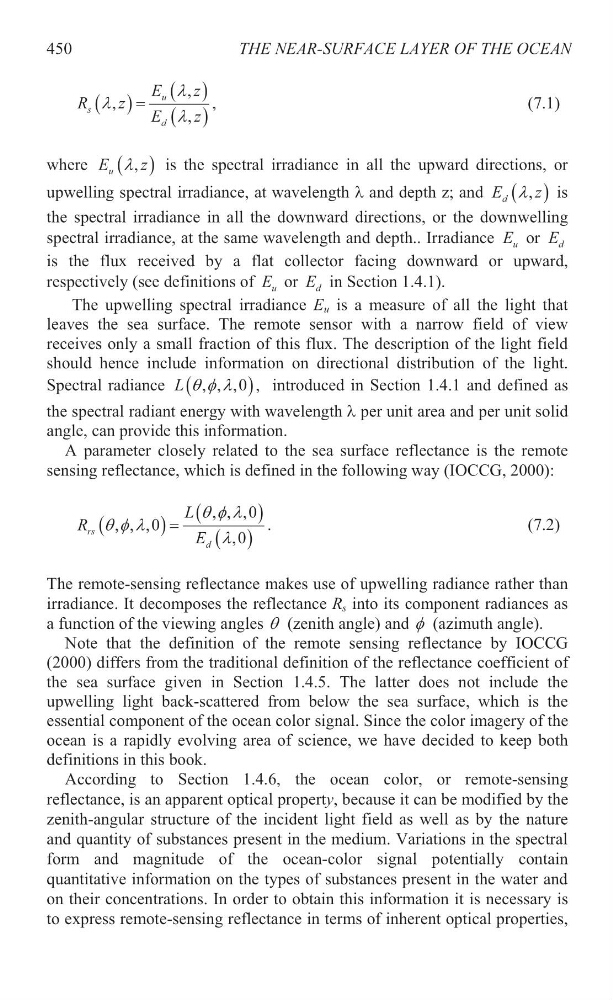
(7.1)
where
,
u
E
z
O
is the spectral irradiance in all the upward directions, or
upwelling spectral irradiance, at wavelength O and depth z; and
,
d
E
z
O
is
the spectral irradiance in all the downward directions, or the downwelling
spectral irradiance, at the same wavelength and depth.. Irradiance u
E or d
E
is the flux received by a flat collector facing downward or upward,
respectively (see definitions of u
E or d
E in Section 1.4.1).
The upwelling spectral irradiance E u is a measure of all the light that
leaves the sea surface. The remote sensor with a narrow field of view
receives only a small fraction of this flux. The description of the light field
should hence include information on directional distribution of the light.
Spectral radiance
, , ,0
L T I O , introduced in Section 1.4.1 and defined as
the spectral radiant energy with wavelength O per unit area and per unit solid
angle, can provide this information.
A parameter closely related to the sea surface reflectance is the remote
sensing reflectance, which is defined in the following way (IOCCG, 2000):
, , ,0
, , ,0
,0
rs
d
L
R
E
T I O
T I O
O
.
(7.2)
The remote-sensing reflectance makes use of upwelling radiance rather than
irradiance. It decomposes the reflectance R s into its component radiances as
a function of the viewing angles T (zenith angle) and I (azimuth angle).
Note that the definition of the remote sensing reflectance by IOCCG
(2000) differs from the traditional definition of the reflectance coefficient of
the sea surface given in Section 1.4.5. The latter does not include the
upwelling light back-scattered from below the sea surface, which is the
essential component of the ocean color signal. Since the color imagery of the
ocean is a rapidly evolving area of science, we have decided to keep both
definitions in this book.
According to Section 1.4.6, the ocean color, or remote-sensing
reflectance, is an apparent optical property, because it can be modified by the
zenith-angular structure of the incident light field as well as by the nature
and quantity of substances present in the medium. Variations in the spectral
form and magnitude of the ocean-color signal potentially contain
quantitative information on the types of substances present in the water and
on their concentrations. In order to obtain this information it is necessary is
to express remote-sensing reflectance in terms of inherent optical properties,
450
,
,
,
u
s
d
E
z
R
z
E
z
O
O
O
,
(7.1)
where
,
u
E
z
O
is the spectral irradiance in all the upward directions, or
upwelling spectral irradiance, at wavelength O and depth z; and
,
d
E
z
O
is
the spectral irradiance in all the downward directions, or the downwelling
spectral irradiance, at the same wavelength and depth.. Irradiance u
E or d
E
is the flux received by a flat collector facing downward or upward,
respectively (see definitions of u
E or d
E in Section 1.4.1).
The upwelling spectral irradiance E u is a measure of all the light that
leaves the sea surface. The remote sensor with a narrow field of view
receives only a small fraction of this flux. The description of the light field
should hence include information on directional distribution of the light.
Spectral radiance
, , ,0
L T I O , introduced in Section 1.4.1 and defined as
the spectral radiant energy with wavelength O per unit area and per unit solid
angle, can provide this information.
A parameter closely related to the sea surface reflectance is the remote
sensing reflectance, which is defined in the following way (IOCCG, 2000):
, , ,0
, , ,0
,0
rs
d
L
R
E
T I O
T I O
O
.
(7.2)
The remote-sensing reflectance makes use of upwelling radiance rather than
irradiance. It decomposes the reflectance R s into its component radiances as
a function of the viewing angles T (zenith angle) and I (azimuth angle).
Note that the definition of the remote sensing reflectance by IOCCG
(2000) differs from the traditional definition of the reflectance coefficient of
the sea surface given in Section 1.4.5. The latter does not include the
upwelling light back-scattered from below the sea surface, which is the
essential component of the ocean color signal. Since the color imagery of the
ocean is a rapidly evolving area of science, we have decided to keep both
definitions in this book.
According to Section 1.4.6, the ocean color, or remote-sensing
reflectance, is an apparent optical property, because it can be modified by the
zenith-angular structure of the incident light field as well as by the nature
and quantity of substances present in the medium. Variations in the spectral
form and magnitude of the ocean-color signal potentially contain
quantitative information on the types of substances present in the water and
on their concentrations. In order to obtain this information it is necessary is
to express remote-sensing reflectance in terms of inherent optical properties,
450