

THE NEAR-SURFACE LAYER OF THE OCEAN
1.4.6 Attenuation of solar radiation in the ocean
Similar to moist air, the attenuation of solar radiation in seawater
involves both absorption and scattering. The absorption consists mainly of a
conversion from radiant energy to heat, with some of the absorbed radiant
energy being involved in chemical reactions such as photosynthesis. In
reality, the portion of solar energy penetrating into the oceans and involved
in photosynthesis is usually only of order 0.1%. The scattering of solar
radiation consists of changes in the direction of photons without losing
energy. This process increases the path length of photons between the sea
surface and the depth under consideration. As a result, scattering leads to
increased absorption and an additional energy loss.
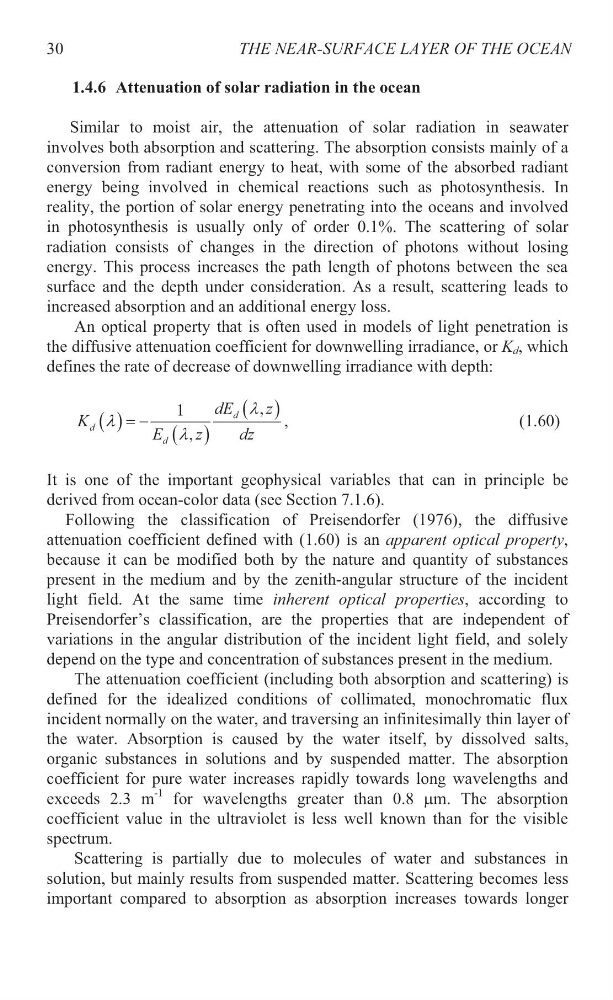
An optical property that is often used in models of light penetration is
the diffusive attenuation coefficient for downwelling irradiance, or K d , which
defines the rate of decrease of downwelling irradiance with depth:
,
1
,
d
d
d
dE
z
K
E
z
dz
O
O
O
,
(1.60)
It is one of the important geophysical variables that can in principle be
derived from ocean-color data (see Section 7.1.6).
Following the classification of Preisendorfer (1976), the diffusive
attenuation coefficient defined with (1.60) is an apparent optical property,
because it can be modified both by the nature and quantity of substances
present in the medium and by the zenith-angular structure of the incident
light field. At the same time inherent optical properties, according to
Preisendorfer’s classification, are the properties that are independent of
variations in the angular distribution of the incident light field, and solely
depend on the type and concentration of substances present in the medium.
The attenuation coefficient (including both absorption and scattering) is
defined for the idealized conditions of collimated, monochromatic flux
incident normally on the water, and traversing an infinitesimally thin layer of
the water. Absorption is caused by the water itself, by dissolved salts,
organic substances in solutions and by suspended matter. The absorption
coefficient for pure water increases rapidly towards long wavelengths and
exceeds 2.3 m
-1 for wavelengths greater than 0.8 Pm. The absorption
coefficient value in the ultraviolet is less well known than for the visible
spectrum.
Scattering is partially due to molecules of water and substances in
solution, but mainly results from suspended matter. Scattering becomes less
important compared to absorption as absorption increases towards longer
30
1.4.6 Attenuation of solar radiation in the ocean
Similar to moist air, the attenuation of solar radiation in seawater
involves both absorption and scattering. The absorption consists mainly of a
conversion from radiant energy to heat, with some of the absorbed radiant
energy being involved in chemical reactions such as photosynthesis. In
reality, the portion of solar energy penetrating into the oceans and involved
in photosynthesis is usually only of order 0.1%. The scattering of solar
radiation consists of changes in the direction of photons without losing
energy. This process increases the path length of photons between the sea
surface and the depth under consideration. As a result, scattering leads to
increased absorption and an additional energy loss.
An optical property that is often used in models of light penetration is
the diffusive attenuation coefficient for downwelling irradiance, or K d , which
defines the rate of decrease of downwelling irradiance with depth:
,
1
,
d
d
d
dE
z
K
E
z
dz
O
O
O
,
(1.60)
It is one of the important geophysical variables that can in principle be
derived from ocean-color data (see Section 7.1.6).
Following the classification of Preisendorfer (1976), the diffusive
attenuation coefficient defined with (1.60) is an apparent optical property,
because it can be modified both by the nature and quantity of substances
present in the medium and by the zenith-angular structure of the incident
light field. At the same time inherent optical properties, according to
Preisendorfer’s classification, are the properties that are independent of
variations in the angular distribution of the incident light field, and solely
depend on the type and concentration of substances present in the medium.
The attenuation coefficient (including both absorption and scattering) is
defined for the idealized conditions of collimated, monochromatic flux
incident normally on the water, and traversing an infinitesimally thin layer of
the water. Absorption is caused by the water itself, by dissolved salts,
organic substances in solutions and by suspended matter. The absorption
coefficient for pure water increases rapidly towards long wavelengths and
exceeds 2.3 m
-1 for wavelengths greater than 0.8 Pm. The absorption
coefficient value in the ultraviolet is less well known than for the visible
spectrum.
Scattering is partially due to molecules of water and substances in
solution, but mainly results from suspended matter. Scattering becomes less
important compared to absorption as absorption increases towards longer
30