

THE NEAR-SURFACE LAYER OF THE OCEAN
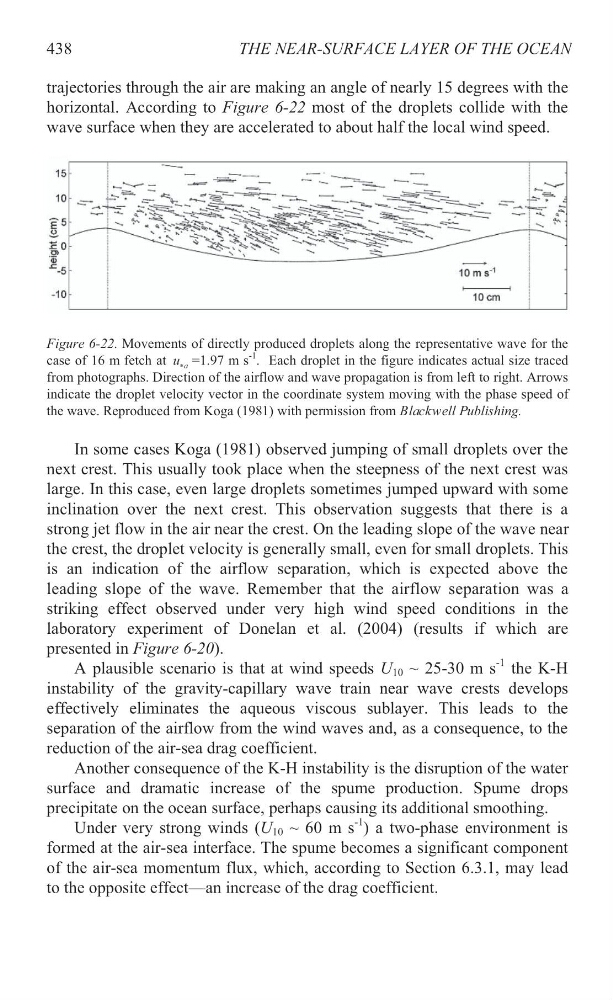
trajectories through the air are making an angle of nearly 15 degrees with the
horizontal. According to Figure 6-22 most of the droplets collide with the
wave surface when they are accelerated to about half the local wind speed.
Figure 6-22. Movements of directly produced droplets along the representative wave for the
case of 16 m fetch at a
u =1.97 m s
-1 . Each droplet in the figure indicates actual size traced
from photographs. Direction of the airflow and wave propagation is from left to right. Arrows
indicate the droplet velocity vector in the coordinate system moving with the phase speed of
In some cases Koga (1981) observed jumping of small droplets over the
next crest. This usually took place when the steepness of the next crest was
large. In this case, even large droplets sometimes jumped upward with some
inclination over the next crest. This observation suggests that there is a
strong jet flow in the air near the crest. On the leading slope of the wave near
the crest, the droplet velocity is generally small, even for small droplets. This
is an indication of the airflow separation, which is expected above the
leading slope of the wave. Remember that the airflow separation was a
striking effect observed under very high wind speed conditions in the
laboratory experiment of Donelan et al. (2004) (results if which are
presented in Figure 6-20).
A plausible scenario is that at wind speeds U 10 ~ 25-30 m s
-1 the K-H
instability of the gravity-capillary wave train near wave crests develops
effectively eliminates the aqueous viscous sublayer. This leads to the
separation of the airflow from the wind waves and, as a consequence, to the
reduction of the air-sea drag coefficient.
Another consequence of the K-H instability is the disruption of the water
surface and dramatic increase of the spume production. Spume drops
precipitate on the ocean surface, perhaps causing its additional smoothing.
Under very strong winds (U 10 ~ 60 m s
-1 ) a two-phase environment is
formed at the air-sea interface. The spume becomes a significant component
of the air-sea momentum flux, which, according to Section 6.3.1, may lead
to the opposite effect—an increase of the drag coefficient.
438
the wave. Reproduced from Koga (1981) with permission from Blackwell Publishing.
trajectories through the air are making an angle of nearly 15 degrees with the
horizontal. According to Figure 6-22 most of the droplets collide with the
wave surface when they are accelerated to about half the local wind speed.
Figure 6-22. Movements of directly produced droplets along the representative wave for the
case of 16 m fetch at a
u =1.97 m s
-1 . Each droplet in the figure indicates actual size traced
from photographs. Direction of the airflow and wave propagation is from left to right. Arrows
indicate the droplet velocity vector in the coordinate system moving with the phase speed of
In some cases Koga (1981) observed jumping of small droplets over the
next crest. This usually took place when the steepness of the next crest was
large. In this case, even large droplets sometimes jumped upward with some
inclination over the next crest. This observation suggests that there is a
strong jet flow in the air near the crest. On the leading slope of the wave near
the crest, the droplet velocity is generally small, even for small droplets. This
is an indication of the airflow separation, which is expected above the
leading slope of the wave. Remember that the airflow separation was a
striking effect observed under very high wind speed conditions in the
laboratory experiment of Donelan et al. (2004) (results if which are
presented in Figure 6-20).
A plausible scenario is that at wind speeds U 10 ~ 25-30 m s
-1 the K-H
instability of the gravity-capillary wave train near wave crests develops
effectively eliminates the aqueous viscous sublayer. This leads to the
separation of the airflow from the wind waves and, as a consequence, to the
reduction of the air-sea drag coefficient.
Another consequence of the K-H instability is the disruption of the water
surface and dramatic increase of the spume production. Spume drops
precipitate on the ocean surface, perhaps causing its additional smoothing.
Under very strong winds (U 10 ~ 60 m s
-1 ) a two-phase environment is
formed at the air-sea interface. The spume becomes a significant component
of the air-sea momentum flux, which, according to Section 6.3.1, may lead
to the opposite effect—an increase of the drag coefficient.
438
the wave. Reproduced from Koga (1981) with permission from Blackwell Publishing.