

largest droplets might elude detection during the measurements conducted at
some distance from the sea surface.
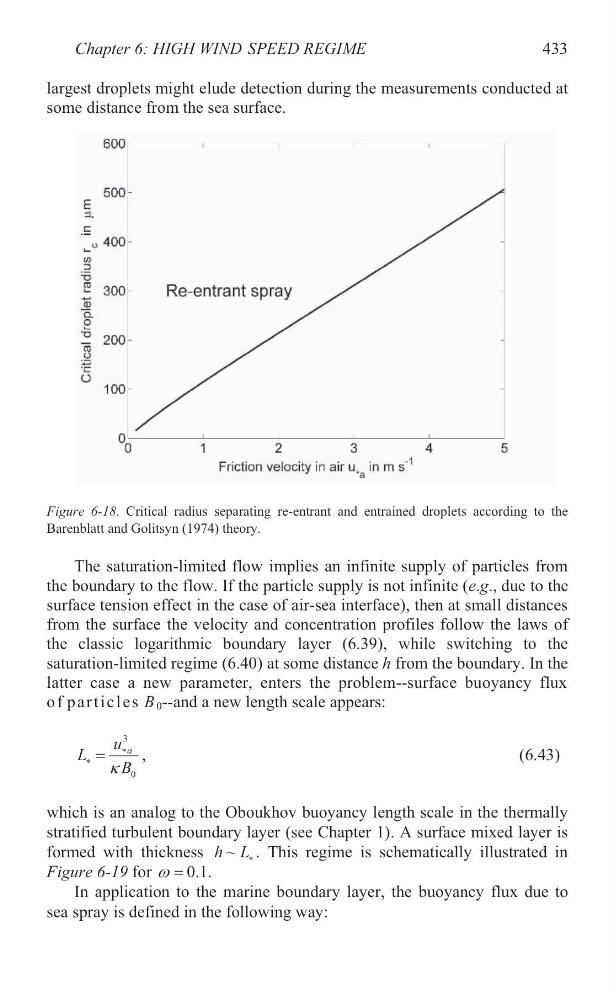
Figure 6-18. Critical radius separating re-entrant and entrained droplets according to the
Barenblatt and Golitsyn (1974) theory.
The saturation-limited flow implies an infinite supply of particles from
the boundary to the flow. If the particle supply is not infinite (e.g., due to the
surface tension effect in the case of air-sea interface), then at small distances
from the surface the velocity and concentration profiles follow the laws of
the classic logarithmic boundary layer (6.39), while switching to the
saturation-limited regime (6.40) at some distance h from the boundary. In the
latter case a new parameter, enters the problem--surface buoyancy flux
of particles B 0 --and a new length scale appears:
3
0
a
u
L
B
N
,
(6.43)
which is an analog to the Oboukhov buoyancy length scale in the thermally
stratified turbulent boundary layer (see Chapter 1). A surface mixed layer is
formed with thickness ~
h L . This regime is schematically illustrated in
Figure 6-19 for
0.1.
Z
In application to the marine boundary layer, the buoyancy flux due to
sea spray is defined in the following way:
Chapter 6: HIGH WIND SPEED REGIME
433
some distance from the sea surface.
Figure 6-18. Critical radius separating re-entrant and entrained droplets according to the
Barenblatt and Golitsyn (1974) theory.
The saturation-limited flow implies an infinite supply of particles from
the boundary to the flow. If the particle supply is not infinite (e.g., due to the
surface tension effect in the case of air-sea interface), then at small distances
from the surface the velocity and concentration profiles follow the laws of
the classic logarithmic boundary layer (6.39), while switching to the
saturation-limited regime (6.40) at some distance h from the boundary. In the
latter case a new parameter, enters the problem--surface buoyancy flux
of particles B 0 --and a new length scale appears:
3
0
a
u
L
B
N
,
(6.43)
which is an analog to the Oboukhov buoyancy length scale in the thermally
stratified turbulent boundary layer (see Chapter 1). A surface mixed layer is
formed with thickness ~
h L . This regime is schematically illustrated in
Figure 6-19 for
0.1.
Z
In application to the marine boundary layer, the buoyancy flux due to
sea spray is defined in the following way:
Chapter 6: HIGH WIND SPEED REGIME
433