

THE NEAR-SURFACE LAYER OF THE OCEAN
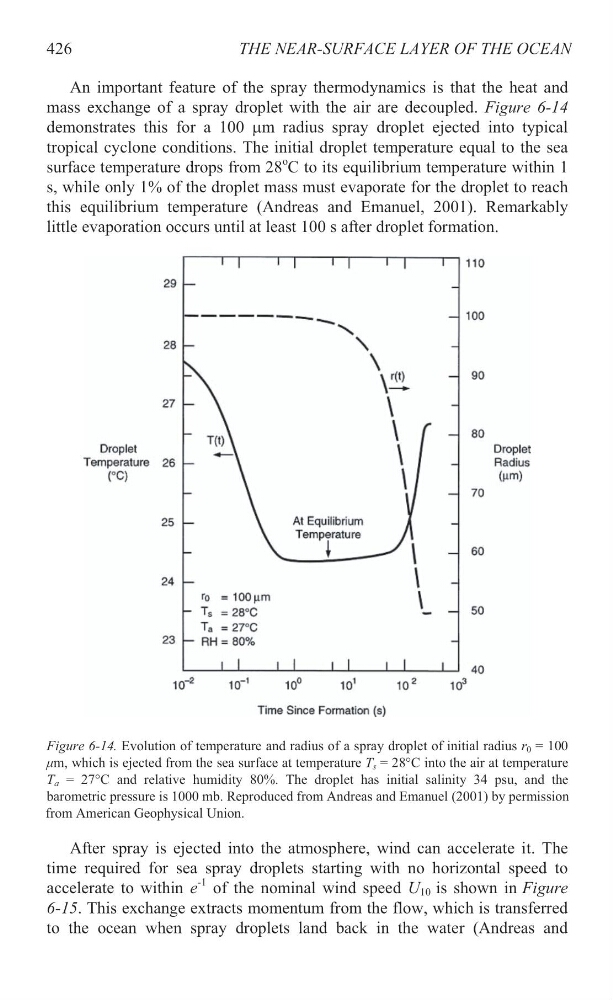
An important feature of the spray thermodynamics is that the heat and
mass exchange of a spray droplet with the air are decoupled. Figure 6-14
demonstrates this for a 100 Pm radius spray droplet ejected into typical
tropical cyclone conditions. The initial droplet temperature equal to the sea
surface temperature drops from 28
o C to its equilibrium temperature within 1
s, while only 1% of the droplet mass must evaporate for the droplet to reach
this equilibrium temperature (Andreas and Emanuel, 2001). Remarkably
little evaporation occurs until at least 100 s after droplet formation.
Figure 6-14. Evolution of temperature and radius of a spray droplet of initial radius r 0 = 100
ȝm, which is ejected from the sea surface at temperature T s = 28°C into the air at temperature
T a = 27°C and relative humidity 80%. The droplet has initial salinity 34 psu, and the
After spray is ejected into the atmosphere, wind can accelerate it. The
time required for sea spray droplets starting with no horizontal speed to
accelerate to within e
-1 of the nominal wind speed U 10 is shown in Figure
6-15. This exchange extracts momentum from the flow, which is transferred
to the ocean when spray droplets land back in the water (Andreas and
426
barometric pressure is 1000 mb. Reproduced from Andreas and Emanuel (2001) by permission
from American Geophysical Union.
An important feature of the spray thermodynamics is that the heat and
mass exchange of a spray droplet with the air are decoupled. Figure 6-14
demonstrates this for a 100 Pm radius spray droplet ejected into typical
tropical cyclone conditions. The initial droplet temperature equal to the sea
surface temperature drops from 28
o C to its equilibrium temperature within 1
s, while only 1% of the droplet mass must evaporate for the droplet to reach
this equilibrium temperature (Andreas and Emanuel, 2001). Remarkably
little evaporation occurs until at least 100 s after droplet formation.
Figure 6-14. Evolution of temperature and radius of a spray droplet of initial radius r 0 = 100
ȝm, which is ejected from the sea surface at temperature T s = 28°C into the air at temperature
T a = 27°C and relative humidity 80%. The droplet has initial salinity 34 psu, and the
After spray is ejected into the atmosphere, wind can accelerate it. The
time required for sea spray droplets starting with no horizontal speed to
accelerate to within e
-1 of the nominal wind speed U 10 is shown in Figure
6-15. This exchange extracts momentum from the flow, which is transferred
to the ocean when spray droplets land back in the water (Andreas and
426
barometric pressure is 1000 mb. Reproduced from Andreas and Emanuel (2001) by permission
from American Geophysical Union.