

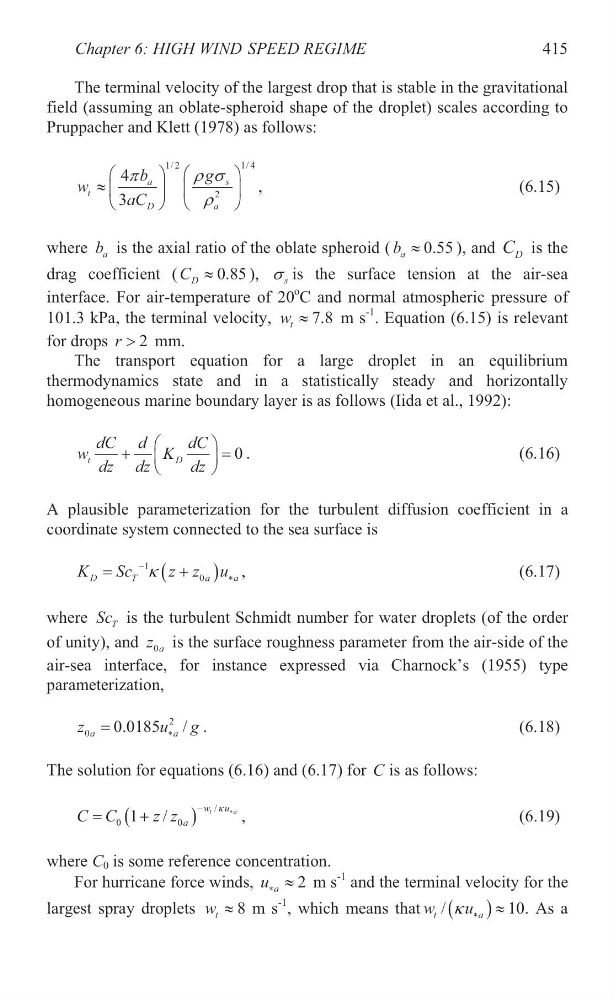
The terminal velocity of the largest drop that is stable in the gravitational
field (assuming an oblate-spheroid shape of the droplet) scales according to
Pruppacher and Klett (1978) as follows:
1/ 4
1/ 2
2
4
3
a
s
t
D
a
b
g
w
aC
S
U V
U
§
·
§
·
|
¨
¸
¨
¸
©
¹ ©
¹
,
(6.15)
where a
b is the axial ratio of the oblate spheroid (
0.55
a
b |
), and D
C is the
drag coefficient (
0.85
D
C |
), s
V is the surface tension at the air-sea
interface. For air-temperature of 20
o C and normal atmospheric pressure of
101.3 kPa, the terminal velocity,
7.8
t
w |
m s
-1 . Equation (6.15) is relevant
for drops
2
r ! mm.
The transport equation for a large droplet in an equilibrium
thermodynamics state and in a statistically steady and horizontally
homogeneous marine boundary layer is as follows (Iida et al., 1992):
0
t
D
dC d
dC
w
K
dz dz
dz
§
·
¨
¸
©
¹
.
(6.16)
A plausible parameterization for the turbulent diffusion coefficient in a
coordinate system connected to the sea surface is
1
0
D
T
a
a
K
Sc
z z u
N
,
(6.17)
where T
Sc is the turbulent Schmidt number for water droplets (of the order
of unity), and 0a
z is the surface roughness parameter from the air-side of the
air-sea interface, for instance expressed via Charnock’s (1955) type
parameterization,
2
0
0.0185 /
a
a
z
u g
.
(6.18)
The solution for equations (6.16) and (6.17) for C is as follows:
/
0
0
1 /
t
a
w u
a
C C
z z
N
,
(6.19)
where C 0 is some reference concentration.
For hurricane force winds,
2
a
u | m s
-1 and the terminal velocity for the
largest spray droplets t
w | 8 m s
-1 , which means that
/
t
a
w
u
N | 10. As a
Chapter 6: HIGH WIND SPEED REGIME
415
field (assuming an oblate-spheroid shape of the droplet) scales according to
Pruppacher and Klett (1978) as follows:
1/ 4
1/ 2
2
4
3
a
s
t
D
a
b
g
w
aC
S
U V
U
§
·
§
·
|
¨
¸
¨
¸
©
¹ ©
¹
,
(6.15)
where a
b is the axial ratio of the oblate spheroid (
0.55
a
b |
), and D
C is the
drag coefficient (
0.85
D
C |
), s
V is the surface tension at the air-sea
interface. For air-temperature of 20
o C and normal atmospheric pressure of
101.3 kPa, the terminal velocity,
7.8
t
w |
m s
-1 . Equation (6.15) is relevant
for drops
2
r ! mm.
The transport equation for a large droplet in an equilibrium
thermodynamics state and in a statistically steady and horizontally
homogeneous marine boundary layer is as follows (Iida et al., 1992):
0
t
D
dC d
dC
w
K
dz dz
dz
§
·
¨
¸
©
¹
.
(6.16)
A plausible parameterization for the turbulent diffusion coefficient in a
coordinate system connected to the sea surface is
1
0
D
T
a
a
K
Sc
z z u
N
,
(6.17)
where T
Sc is the turbulent Schmidt number for water droplets (of the order
of unity), and 0a
z is the surface roughness parameter from the air-side of the
air-sea interface, for instance expressed via Charnock’s (1955) type
parameterization,
2
0
0.0185 /
a
a
z
u g
.
(6.18)
The solution for equations (6.16) and (6.17) for C is as follows:
/
0
0
1 /
t
a
w u
a
C C
z z
N
,
(6.19)
where C 0 is some reference concentration.
For hurricane force winds,
2
a
u | m s
-1 and the terminal velocity for the
largest spray droplets t
w | 8 m s
-1 , which means that
/
t
a
w
u
N | 10. As a
Chapter 6: HIGH WIND SPEED REGIME
415