

THE NEAR-SURFACE LAYER OF THE OCEAN
/ 2
1/ 2
0
/ 2
/
N N
z
H
z
O
O
P
P
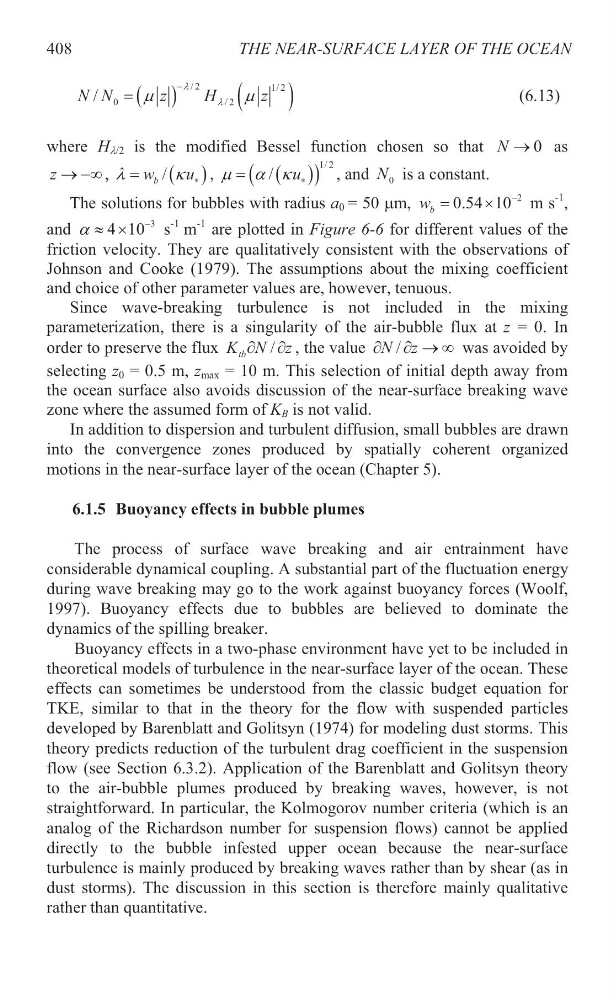
(6.13)
where H O/2 is the modified Bessel function chosen so that
0
N o as
z o f ,
/
b
w
u
O
N ,
1/ 2
/ u
P D N
, and 0
N is a constant.
The solutions for bubbles with radius a 0 = 50 Pm,
2
0.54 10
b
w
u
m s
-1 ,
and
3
4 10
D
| u
s
-1 m
-1 are plotted in Figure 6-6 for different values of the
friction velocity. They are qualitatively consistent with the observations of
Johnson and Cooke (1979). The assumptions about the mixing coefficient
and choice of other parameter values are, however, tenuous.
Since wave-breaking turbulence is not included in the mixing
parameterization, there is a singularity of the air-bubble flux at z = 0. In
order to preserve the flux
/
tb
K N z
w w , the value
/
N z
w w of was avoided by
selecting z 0 = 0.5 m, z max = 10 m. This selection of initial depth away from
the ocean surface also avoids discussion of the near-surface breaking wave
zone where the assumed form of K B is not valid.
In addition to dispersion and turbulent diffusion, small bubbles are drawn
into the convergence zones produced by spatially coherent organized
motions in the near-surface layer of the ocean (Chapter 5).
6.1.5 Buoyancy effects in bubble plumes
The process of surface wave breaking and air entrainment have
considerable dynamical coupling. A substantial part of the fluctuation energy
during wave breaking may go to the work against buoyancy forces (Woolf,
1997). Buoyancy effects due to bubbles are believed to dominate the
dynamics of the spilling breaker.
Buoyancy effects in a two-phase environment have yet to be included in
theoretical models of turbulence in the near-surface layer of the ocean. These
effects can sometimes be understood from the classic budget equation for
TKE, similar to that in the theory for the flow with suspended particles
developed by Barenblatt and Golitsyn (1974) for modeling dust storms. This
theory predicts reduction of the turbulent drag coefficient in the suspension
flow (see Section 6.3.2). Application of the Barenblatt and Golitsyn theory
to the air-bubble plumes produced by breaking waves, however, is not
straightforward. In particular, the Kolmogorov number criteria (which is an
analog of the Richardson number for suspension flows) cannot be applied
directly to the bubble infested upper ocean because the near-surface
turbulence is mainly produced by breaking waves rather than by shear (as in
dust storms). The discussion in this section is therefore mainly qualitative
rather than quantitative.
408
/ 2
1/ 2
0
/ 2
/
N N
z
H
z
O
O
P
P
(6.13)
where H O/2 is the modified Bessel function chosen so that
0
N o as
z o f ,
/
b
w
u
O
N ,
1/ 2
/ u
P D N
, and 0
N is a constant.
The solutions for bubbles with radius a 0 = 50 Pm,
2
0.54 10
b
w
u
m s
-1 ,
and
3
4 10
D
| u
s
-1 m
-1 are plotted in Figure 6-6 for different values of the
friction velocity. They are qualitatively consistent with the observations of
Johnson and Cooke (1979). The assumptions about the mixing coefficient
and choice of other parameter values are, however, tenuous.
Since wave-breaking turbulence is not included in the mixing
parameterization, there is a singularity of the air-bubble flux at z = 0. In
order to preserve the flux
/
tb
K N z
w w , the value
/
N z
w w of was avoided by
selecting z 0 = 0.5 m, z max = 10 m. This selection of initial depth away from
the ocean surface also avoids discussion of the near-surface breaking wave
zone where the assumed form of K B is not valid.
In addition to dispersion and turbulent diffusion, small bubbles are drawn
into the convergence zones produced by spatially coherent organized
motions in the near-surface layer of the ocean (Chapter 5).
6.1.5 Buoyancy effects in bubble plumes
The process of surface wave breaking and air entrainment have
considerable dynamical coupling. A substantial part of the fluctuation energy
during wave breaking may go to the work against buoyancy forces (Woolf,
1997). Buoyancy effects due to bubbles are believed to dominate the
dynamics of the spilling breaker.
Buoyancy effects in a two-phase environment have yet to be included in
theoretical models of turbulence in the near-surface layer of the ocean. These
effects can sometimes be understood from the classic budget equation for
TKE, similar to that in the theory for the flow with suspended particles
developed by Barenblatt and Golitsyn (1974) for modeling dust storms. This
theory predicts reduction of the turbulent drag coefficient in the suspension
flow (see Section 6.3.2). Application of the Barenblatt and Golitsyn theory
to the air-bubble plumes produced by breaking waves, however, is not
straightforward. In particular, the Kolmogorov number criteria (which is an
analog of the Richardson number for suspension flows) cannot be applied
directly to the bubble infested upper ocean because the near-surface
turbulence is mainly produced by breaking waves rather than by shear (as in
dust storms). The discussion in this section is therefore mainly qualitative
rather than quantitative.
408