

THE NEAR-SURFACE LAYER OF THE OCEAN
From dimensional considerations Garrett et al. (2000) derived a bubble
size spectrum for the turbulent fragmentation mechanism
1/ 3 10 / 3
N r
Q
r
H
v
,
(6.5)
where N(r) is the number of bubbles per m
3 per mm radius increment
(bubble density), Q is the volume of air entrained per volume of water per
second (with dimension s
-1 ), and r is the bubble radius. The turbulent
fragmentation mechanism is important during wave-breaking events.
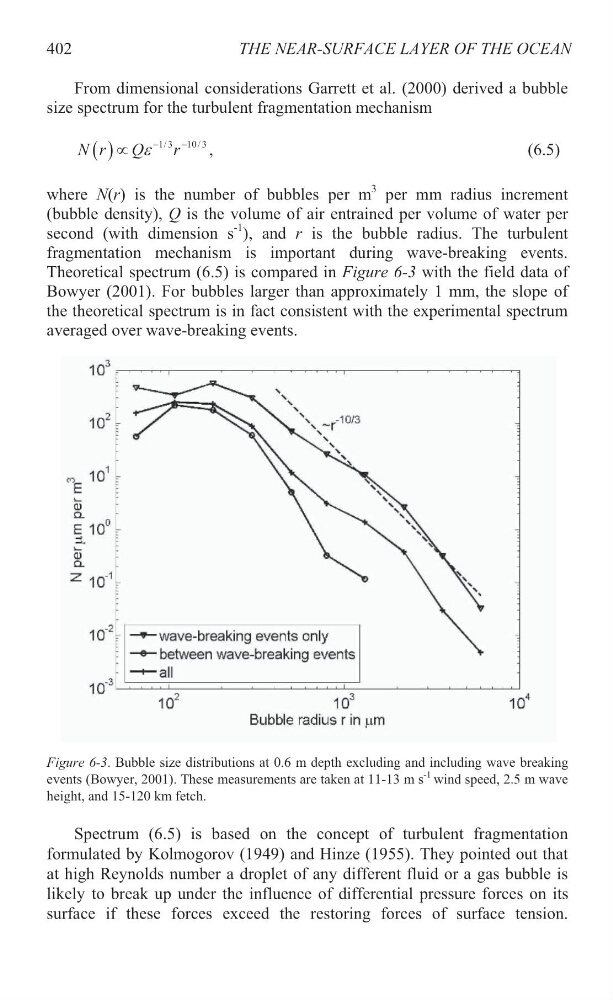
Theoretical spectrum (6.5) is compared in Figure 6-3 with the field data of
Bowyer (2001). For bubbles larger than approximately 1 mm, the slope of
the theoretical spectrum is in fact consistent with the experimental spectrum
averaged over wave-breaking events.
Figure 6-3. Bubble size distributions at 0.6 m depth excluding and including wave breaking
events (Bowyer, 2001). These measurements are taken at 11-13 m s
-1 wind speed, 2.5 m wave
height, and 15-120 km fetch.
Spectrum (6.5) is based on the concept of turbulent fragmentation
formulated by Kolmogorov (1949) and Hinze (1955). They pointed out that
at high Reynolds number a droplet of any different fluid or a gas bubble is
likely to break up under the influence of differential pressure forces on its
surface if these forces exceed the restoring forces of surface tension.
402
From dimensional considerations Garrett et al. (2000) derived a bubble
size spectrum for the turbulent fragmentation mechanism
1/ 3 10 / 3
N r
Q
r
H
v
,
(6.5)
where N(r) is the number of bubbles per m
3 per mm radius increment
(bubble density), Q is the volume of air entrained per volume of water per
second (with dimension s
-1 ), and r is the bubble radius. The turbulent
fragmentation mechanism is important during wave-breaking events.
Theoretical spectrum (6.5) is compared in Figure 6-3 with the field data of
Bowyer (2001). For bubbles larger than approximately 1 mm, the slope of
the theoretical spectrum is in fact consistent with the experimental spectrum
averaged over wave-breaking events.
Figure 6-3. Bubble size distributions at 0.6 m depth excluding and including wave breaking
events (Bowyer, 2001). These measurements are taken at 11-13 m s
-1 wind speed, 2.5 m wave
height, and 15-120 km fetch.
Spectrum (6.5) is based on the concept of turbulent fragmentation
formulated by Kolmogorov (1949) and Hinze (1955). They pointed out that
at high Reynolds number a droplet of any different fluid or a gas bubble is
likely to break up under the influence of differential pressure forces on its
surface if these forces exceed the restoring forces of surface tension.
402