

Chapter 5. SPATIALLY-COHERENT STRUCTURES
century with the experiments of Benard and the theoretical analysis of
Rayleigh. One might expect that heavier fluid would necessarily exchange
places with lighter fluid below due to buoyancy forces. This happens by
means of convective cells or localized plumes of sinking dense fluid and
rising light fluid. However, such cells or plumes are retarded by viscous
forces and are also dissipated by thermal diffusion and entrainment as they
fall or sink into an environment with a different density. When the buoyancy
force is not strong enough to overcome the inhibitory effects, the heavyover-light configuration is stable and no convection forms. The relative
strengths of these conflicting forces is measured by the Rayleigh number, a
nondimensional number given by
3 /( )
T
T
Ra g
Th k
D
Q
'
,
(5.68)
where g is the acceleration of gravity, D is the thermal expansion coefficient
of seawater (
4
2.6 10
T
D
o C
-1 at T = 20
o C and S = 35 psu), 'T is the
temperature difference between the top and bottom surfaces, h is the
convective layer thickness, and Q and k T are the molecular coefficients of
viscosity and thermal diffusivity, respectively (
6
10
1
.
1
Q
m
2 s
-1 and
7
10
3
.
1
T
k
m
2 s
-1 at T = 20
o C and S = 35 psu). The term, D 7 'T = 'U/U,
represents the relative density difference between top and bottom.
387
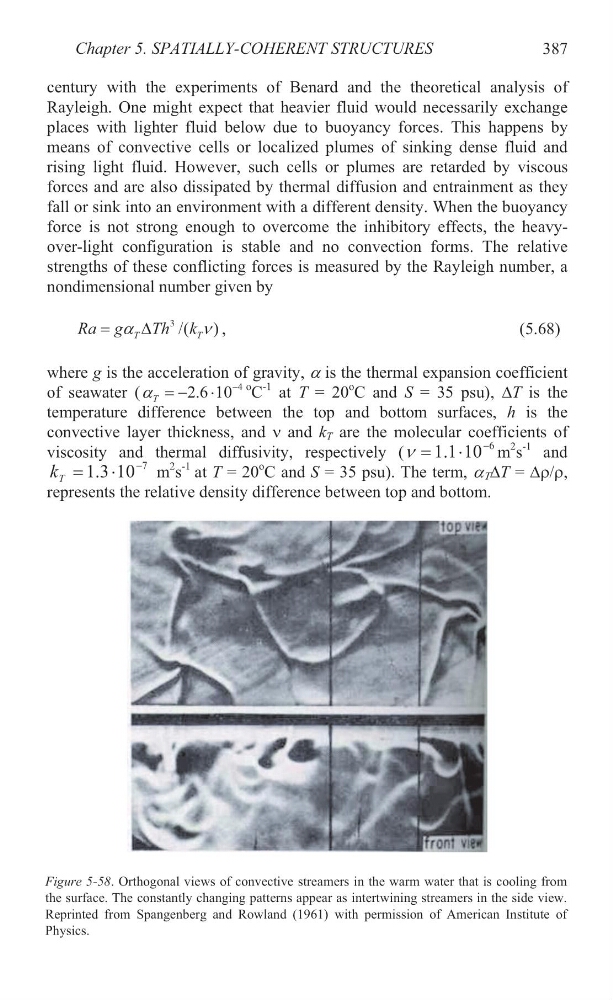
Figure 5-58. Orthogonal views of convective streamers in the warm water that is cooling from
the surface. The constantly changing patterns appear as intertwining streamers in the side view.
Reprinted from Spangenberg and Rowland (1961) with permission of American Institute of
Physics.
century with the experiments of Benard and the theoretical analysis of
Rayleigh. One might expect that heavier fluid would necessarily exchange
places with lighter fluid below due to buoyancy forces. This happens by
means of convective cells or localized plumes of sinking dense fluid and
rising light fluid. However, such cells or plumes are retarded by viscous
forces and are also dissipated by thermal diffusion and entrainment as they
fall or sink into an environment with a different density. When the buoyancy
force is not strong enough to overcome the inhibitory effects, the heavyover-light configuration is stable and no convection forms. The relative
strengths of these conflicting forces is measured by the Rayleigh number, a
nondimensional number given by
3 /( )
T
T
Ra g
Th k
D
Q
'
,
(5.68)
where g is the acceleration of gravity, D is the thermal expansion coefficient
of seawater (
4
2.6 10
T
D
o C
-1 at T = 20
o C and S = 35 psu), 'T is the
temperature difference between the top and bottom surfaces, h is the
convective layer thickness, and Q and k T are the molecular coefficients of
viscosity and thermal diffusivity, respectively (
6
10
1
.
1
Q
m
2 s
-1 and
7
10
3
.
1
T
k
m
2 s
-1 at T = 20
o C and S = 35 psu). The term, D 7 'T = 'U/U,
represents the relative density difference between top and bottom.
387
Figure 5-58. Orthogonal views of convective streamers in the warm water that is cooling from
the surface. The constantly changing patterns appear as intertwining streamers in the side view.
Reprinted from Spangenberg and Rowland (1961) with permission of American Institute of
Physics.