

Chapter 5. SPATIALLY-COHERENT STRUCTURES
1980; Moeng, 1984). Strictly speaking, in order for the LES scheme to be
effective, a trough in the wavenumber spectrum is required. In the case of
Langmuir circulations, the scale separation might not be sufficient. This
aspect concerned Skyllingstad and Denbo (1995) since they could not verify
that there was a proper separation between Langmuir circulations and
subgrid turbulence in the LES.
c ) Models with second order closure schemes
Kantha and Clayson (2004) tried to reproduce the McWilliams et al.
(1997) LES results on Langmuir circulations with a one-dimensional mixed
layer model, based on second moment closure of turbulence. They
incorporated the effect of Langmuir circulations in the model by modifying
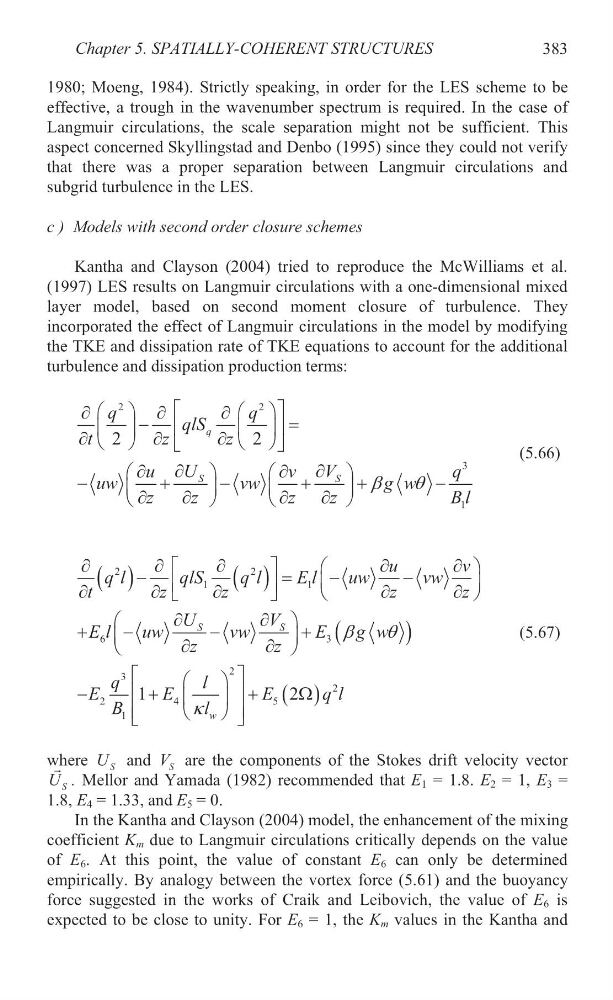
the TKE and dissipation rate of TKE equations to account for the additional
turbulence and dissipation production terms:
2
2
3
1
2
2
q
S
S
q
q
qlS
t
z
z
U
V
u
v
q
uw
vw
g w
z
z
z
z
Bl
E
T
ª
º
§ ·
§ ·
w
w
w
«
»
¨ ¸
¨ ¸
w
w
w
© ¹
© ¹
¬
¼
w
w
w
w
§
·
§
·
¨
¸
¨
¸
w
w
w
w
©
¹
©
¹
(5.66)
2
2
1
1
6
3
2
3
2
2
4
5
1
1
2
S
S
w
u
v
q l
qlS
q l
E l
uw
vw
t
z
z
z
z
U
V
E l
uw
vw
E
g w
z
z
q
l
E
E
E
ql
B
l
E
T
N
w
w
w
w
w
ª
º
§
·
¨
¸
«
»
w
w
w
w
w
¬
¼
©
¹
w
w
§
·
¨
¸
w
w
©
¹
ª
º
§
·
«
»
:
¨
¸
«
»
©
¹
¬
¼
(5.67)
where S
U and S
V are the components of the Stokes drift velocity vector
S
U
G
. Mellor and Yamada (1982) recommended that E 1 = 1.8. E 2 = 1, E 3 =
1.8, E 4 = 1.33, and E 5 = 0.
In the Kantha and Clayson (2004) model, the enhancement of the mixing
coefficient K m due to Langmuir circulations critically depends on the value
of E 6 . At this point, the value of constant E 6 can only be determined
empirically. By analogy between the vortex force (5.61) and the buoyancy
force suggested in the works of Craik and Leibovich, the value of E 6 is
expected to be close to unity. For E 6 = 1, the K m values in the Kantha and
383
1980; Moeng, 1984). Strictly speaking, in order for the LES scheme to be
effective, a trough in the wavenumber spectrum is required. In the case of
Langmuir circulations, the scale separation might not be sufficient. This
aspect concerned Skyllingstad and Denbo (1995) since they could not verify
that there was a proper separation between Langmuir circulations and
subgrid turbulence in the LES.
c ) Models with second order closure schemes
Kantha and Clayson (2004) tried to reproduce the McWilliams et al.
(1997) LES results on Langmuir circulations with a one-dimensional mixed
layer model, based on second moment closure of turbulence. They
incorporated the effect of Langmuir circulations in the model by modifying
the TKE and dissipation rate of TKE equations to account for the additional
turbulence and dissipation production terms:
2
2
3
1
2
2
q
S
S
q
q
qlS
t
z
z
U
V
u
v
q
uw
vw
g w
z
z
z
z
Bl
E
T
ª
º
§ ·
§ ·
w
w
w
«
»
¨ ¸
¨ ¸
w
w
w
© ¹
© ¹
¬
¼
w
w
w
w
§
·
§
·
¨
¸
¨
¸
w
w
w
w
©
¹
©
¹
(5.66)
2
2
1
1
6
3
2
3
2
2
4
5
1
1
2
S
S
w
u
v
q l
qlS
q l
E l
uw
vw
t
z
z
z
z
U
V
E l
uw
vw
E
g w
z
z
q
l
E
E
E
ql
B
l
E
T
N
w
w
w
w
w
ª
º
§
·
¨
¸
«
»
w
w
w
w
w
¬
¼
©
¹
w
w
§
·
¨
¸
w
w
©
¹
ª
º
§
·
«
»
:
¨
¸
«
»
©
¹
¬
¼
(5.67)
where S
U and S
V are the components of the Stokes drift velocity vector
S
U
G
. Mellor and Yamada (1982) recommended that E 1 = 1.8. E 2 = 1, E 3 =
1.8, E 4 = 1.33, and E 5 = 0.
In the Kantha and Clayson (2004) model, the enhancement of the mixing
coefficient K m due to Langmuir circulations critically depends on the value
of E 6 . At this point, the value of constant E 6 can only be determined
empirically. By analogy between the vortex force (5.61) and the buoyancy
force suggested in the works of Craik and Leibovich, the value of E 6 is
expected to be close to unity. For E 6 = 1, the K m values in the Kantha and
383