

Chapter 5. SPATIALLY-COHERENT STRUCTURES
an opportunity to parameterize the mixing produced by this type of
organized motion within a simple, first order scheme based on the gradient
Richardson number, which is similar to that developed by Soloviev et al.
(2001a).
5.7.3 Numerical models of Langmuir circulations
a) Direct numerical simulation (DNS)
Leibovich and Lele (1982) computed cases with constant N, together with
other examples with variable N simulating preexisting mixed layers bounded
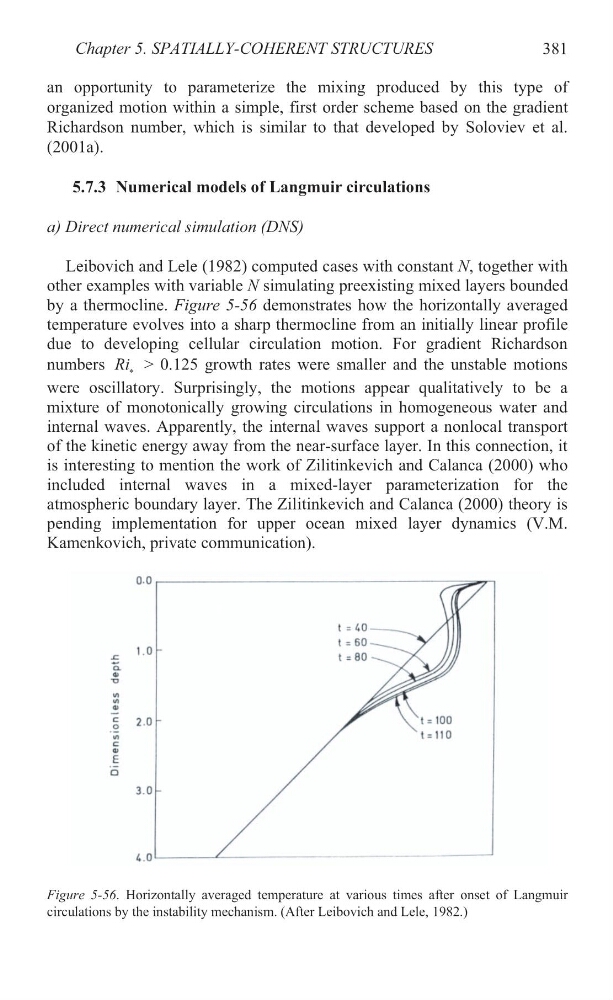
by a thermocline. Figure 5-56 demonstrates how the horizontally averaged
temperature evolves into a sharp thermocline from an initially linear profile
due to developing cellular circulation motion. For gradient Richardson
numbers Ri > 0.125 growth rates were smaller and the unstable motions
were oscillatory. Surprisingly, the motions appear qualitatively to be a
mixture of monotonically growing circulations in homogeneous water and
internal waves. Apparently, the internal waves support a nonlocal transport
of the kinetic energy away from the near-surface layer. In this connection, it
is interesting to mention the work of Zilitinkevich and Calanca (2000) who
included internal waves in a mixed-layer parameterization for the
atmospheric boundary layer. The Zilitinkevich and Calanca (2000) theory is
pending implementation for upper ocean mixed layer dynamics (V.M.
Kamenkovich, private communication).
Figure 5-56. Horizontally averaged temperature at various times after onset of Langmuir
circulations by the instability mechanism. (After Leibovich and Lele, 1982.)
381
an opportunity to parameterize the mixing produced by this type of
organized motion within a simple, first order scheme based on the gradient
Richardson number, which is similar to that developed by Soloviev et al.
(2001a).
5.7.3 Numerical models of Langmuir circulations
a) Direct numerical simulation (DNS)
Leibovich and Lele (1982) computed cases with constant N, together with
other examples with variable N simulating preexisting mixed layers bounded
by a thermocline. Figure 5-56 demonstrates how the horizontally averaged
temperature evolves into a sharp thermocline from an initially linear profile
due to developing cellular circulation motion. For gradient Richardson
numbers Ri > 0.125 growth rates were smaller and the unstable motions
were oscillatory. Surprisingly, the motions appear qualitatively to be a
mixture of monotonically growing circulations in homogeneous water and
internal waves. Apparently, the internal waves support a nonlocal transport
of the kinetic energy away from the near-surface layer. In this connection, it
is interesting to mention the work of Zilitinkevich and Calanca (2000) who
included internal waves in a mixed-layer parameterization for the
atmospheric boundary layer. The Zilitinkevich and Calanca (2000) theory is
pending implementation for upper ocean mixed layer dynamics (V.M.
Kamenkovich, private communication).
Figure 5-56. Horizontally averaged temperature at various times after onset of Langmuir
circulations by the instability mechanism. (After Leibovich and Lele, 1982.)
381