

THE NEAR-SURFACE LAYER OF THE OCEAN
circulations (Marmorino et al., 2005). Surface convergences between
successive pairs of Langmuir cells interact with the cool skin producing the
cool streaks in the imagery. This observation was made from an aircraft
flying over the inner West Florida continental shelf where the water depth
was only 3 m. The wind of about 5 m s
-1 was blowing nearly parallel to the
streaks. The spacing of the streaks in Figure 5-52 is 10 to 20 m, which gives
each cell an unusually large width-to-height aspect ratio of about 2.5. In the
open ocean, the aspect ratio of the largest Langmuir cells is believed to be
close to unity.
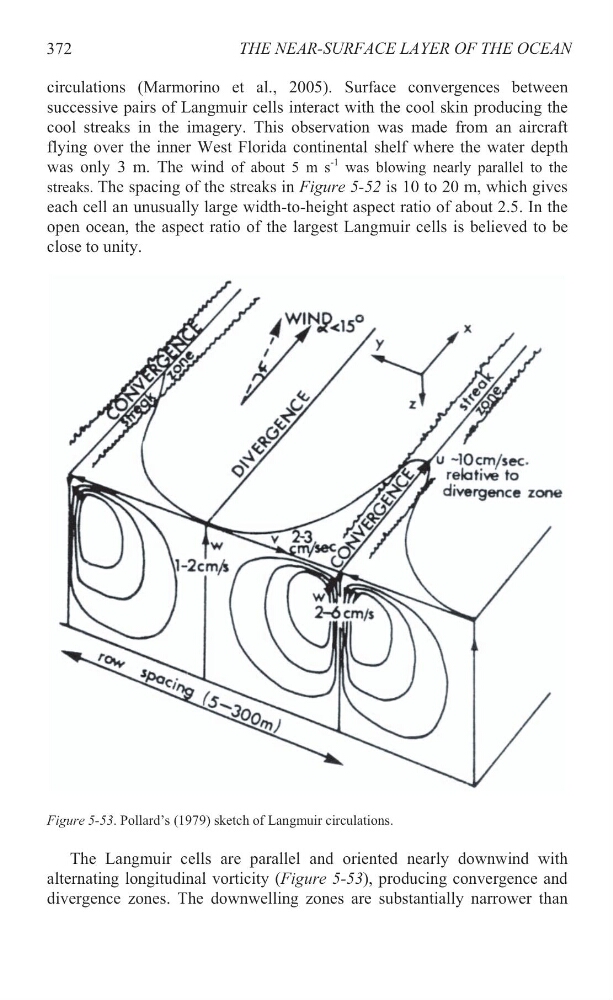
Figure 5-53. Pollard’s (1979) sketch of Langmuir circulations.
The Langmuir cells are parallel and oriented nearly downwind with
alternating longitudinal vorticity (Figure 5-53), producing convergence and
divergence zones. The downwelling zones are substantially narrower than
372
circulations (Marmorino et al., 2005). Surface convergences between
successive pairs of Langmuir cells interact with the cool skin producing the
cool streaks in the imagery. This observation was made from an aircraft
flying over the inner West Florida continental shelf where the water depth
was only 3 m. The wind of about 5 m s
-1 was blowing nearly parallel to the
streaks. The spacing of the streaks in Figure 5-52 is 10 to 20 m, which gives
each cell an unusually large width-to-height aspect ratio of about 2.5. In the
open ocean, the aspect ratio of the largest Langmuir cells is believed to be
close to unity.
Figure 5-53. Pollard’s (1979) sketch of Langmuir circulations.
The Langmuir cells are parallel and oriented nearly downwind with
alternating longitudinal vorticity (Figure 5-53), producing convergence and
divergence zones. The downwelling zones are substantially narrower than
372