

Chapter 5. SPATIALLY-COHERENT STRUCTURES
the viscous terms are negligible on length scales
1/ 2
Re
L
h
. Here
Re
0 /
u h Q ; velocity 0
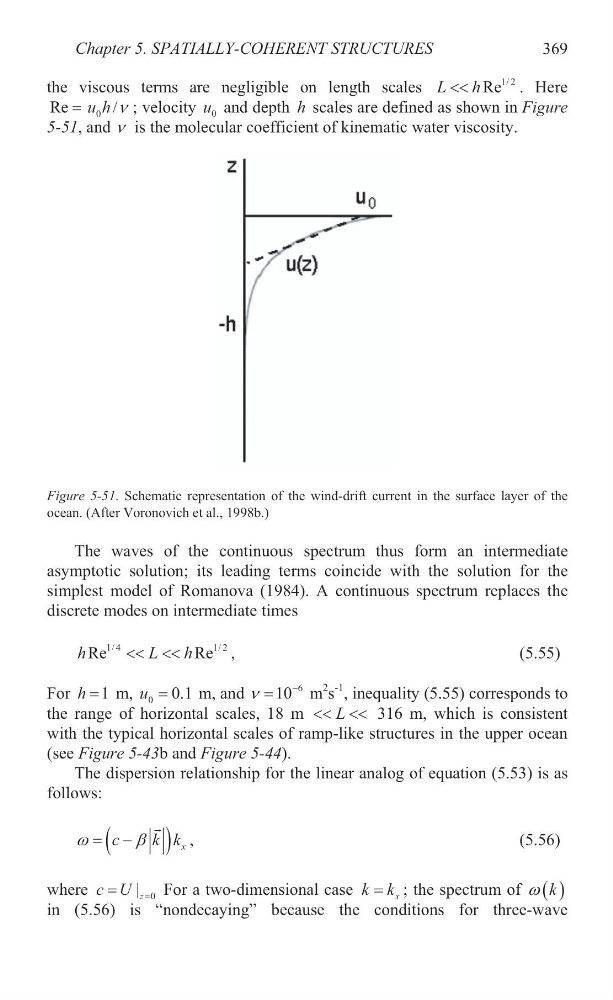
u and depth h scales are defined as shown in Figure
5-51, and Q is the molecular coefficient of kinematic water viscosity.
Figure 5-51. Schematic representation of the wind-drift current in the surface layer of the
ocean. (After Voronovich et al., 1998b.)
The waves of the continuous spectrum thus form an intermediate
asymptotic solution; its leading terms coincide with the solution for the
simplest model of Romanova (1984). A continuous spectrum replaces the
discrete modes on intermediate times
1/ 4
1/ 2
Re
Re
h
L
h
,
(5.55)
For
1
h
m, 0 0.1
u
m, and
6
10
Q
m
2 s
-1 , inequality (5.55) corresponds to
the range of horizontal scales, 18 m
L
316 m, which is consistent
with the typical horizontal scales of ramp-like structures in the upper ocean
(see Figure 5-43b and Figure 5-44).
The dispersion relationship for the linear analog of equation (5.53) is as
follows:
x
c
k k
Z
E
G
,
(5.56)
where
0
| z
c U
For a two-dimensional case
x
k k ; the spectrum of
k
Z
in (5.56) is “nondecaying” because the conditions for three-wave
369
the viscous terms are negligible on length scales
1/ 2
Re
L
h
. Here
Re
0 /
u h Q ; velocity 0
u and depth h scales are defined as shown in Figure
5-51, and Q is the molecular coefficient of kinematic water viscosity.
Figure 5-51. Schematic representation of the wind-drift current in the surface layer of the
ocean. (After Voronovich et al., 1998b.)
The waves of the continuous spectrum thus form an intermediate
asymptotic solution; its leading terms coincide with the solution for the
simplest model of Romanova (1984). A continuous spectrum replaces the
discrete modes on intermediate times
1/ 4
1/ 2
Re
Re
h
L
h
,
(5.55)
For
1
h
m, 0 0.1
u
m, and
6
10
Q
m
2 s
-1 , inequality (5.55) corresponds to
the range of horizontal scales, 18 m
L
316 m, which is consistent
with the typical horizontal scales of ramp-like structures in the upper ocean
(see Figure 5-43b and Figure 5-44).
The dispersion relationship for the linear analog of equation (5.53) is as
follows:
x
c
k k
Z
E
G
,
(5.56)
where
0
| z
c U
For a two-dimensional case
x
k k ; the spectrum of
k
Z
in (5.56) is “nondecaying” because the conditions for three-wave
369