

THE NEAR-SURFACE LAYER OF THE OCEAN
where ' is a free parameter corresponding to a disparity in the coupled wave
phase speeds.
Two types of solutions for plane solitary waves follow from (5.28). The
first type of solutions (“supercritical”) propagates with velocities greater
than that of the current, which is expressed by inequality:
0
0
/
N
u H c N
.
(5.29)
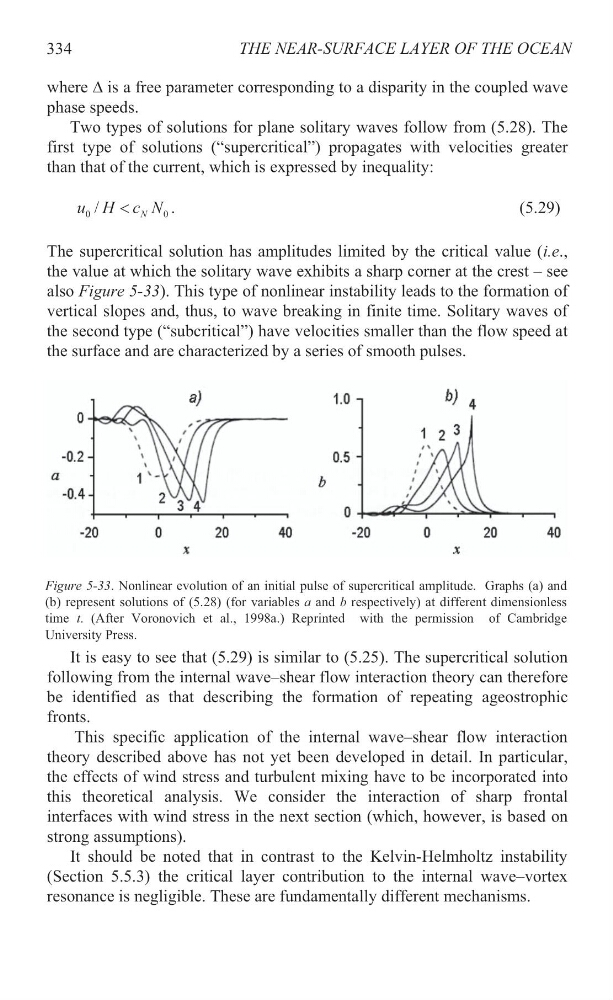
The supercritical solution has amplitudes limited by the critical value (i.e.,
the value at which the solitary wave exhibits a sharp corner at the crest – see
also Figure 5-33). This type of nonlinear instability leads to the formation of
vertical slopes and, thus, to wave breaking in finite time. Solitary waves of
the second type (“subcritical”) have velocities smaller than the flow speed at
the surface and are characterized by a series of smooth pulses.
It is easy to see that (5.29) is similar to (5.25). The supercritical solution
following from the internal wave–shear flow interaction theory can therefore
be identified as that describing the formation of repeating ageostrophic
fronts.
This specific application of the internal wave–shear flow interaction
theory described above has not yet been developed in detail. In particular,
the effects of wind stress and turbulent mixing have to be incorporated into
this theoretical analysis. We consider the interaction of sharp frontal
interfaces with wind stress in the next section (which, however, is based on
strong assumptions).
It should be noted that in contrast to the Kelvin-Helmholtz instability
(Section 5.5.3) the critical layer contribution to the internal wave–vortex
resonance is negligible. These are fundamentally different mechanisms.
334
Figure 5-33. Nonlinear evolution of an initial pulse of supercritical amplitude. Graphs (a) and
(b) represent solutions of (5.28) (for variables a and b respectively) at different dimensionless
time t. (After Voronovich et al., 1998a.) Reprinted with the permission of Cambridge
University Press.
where ' is a free parameter corresponding to a disparity in the coupled wave
phase speeds.
Two types of solutions for plane solitary waves follow from (5.28). The
first type of solutions (“supercritical”) propagates with velocities greater
than that of the current, which is expressed by inequality:
0
0
/
N
u H c N
.
(5.29)
The supercritical solution has amplitudes limited by the critical value (i.e.,
the value at which the solitary wave exhibits a sharp corner at the crest – see
also Figure 5-33). This type of nonlinear instability leads to the formation of
vertical slopes and, thus, to wave breaking in finite time. Solitary waves of
the second type (“subcritical”) have velocities smaller than the flow speed at
the surface and are characterized by a series of smooth pulses.
It is easy to see that (5.29) is similar to (5.25). The supercritical solution
following from the internal wave–shear flow interaction theory can therefore
be identified as that describing the formation of repeating ageostrophic
fronts.
This specific application of the internal wave–shear flow interaction
theory described above has not yet been developed in detail. In particular,
the effects of wind stress and turbulent mixing have to be incorporated into
this theoretical analysis. We consider the interaction of sharp frontal
interfaces with wind stress in the next section (which, however, is based on
strong assumptions).
It should be noted that in contrast to the Kelvin-Helmholtz instability
(Section 5.5.3) the critical layer contribution to the internal wave–vortex
resonance is negligible. These are fundamentally different mechanisms.
334
Figure 5-33. Nonlinear evolution of an initial pulse of supercritical amplitude. Graphs (a) and
(b) represent solutions of (5.28) (for variables a and b respectively) at different dimensionless
time t. (After Voronovich et al., 1998a.) Reprinted with the permission of Cambridge
University Press.