

THE NEAR-SURFACE LAYER OF THE OCEAN
5.3.7 Relationship between vertical and horizontal mixing and
atmospheric forcing conditions
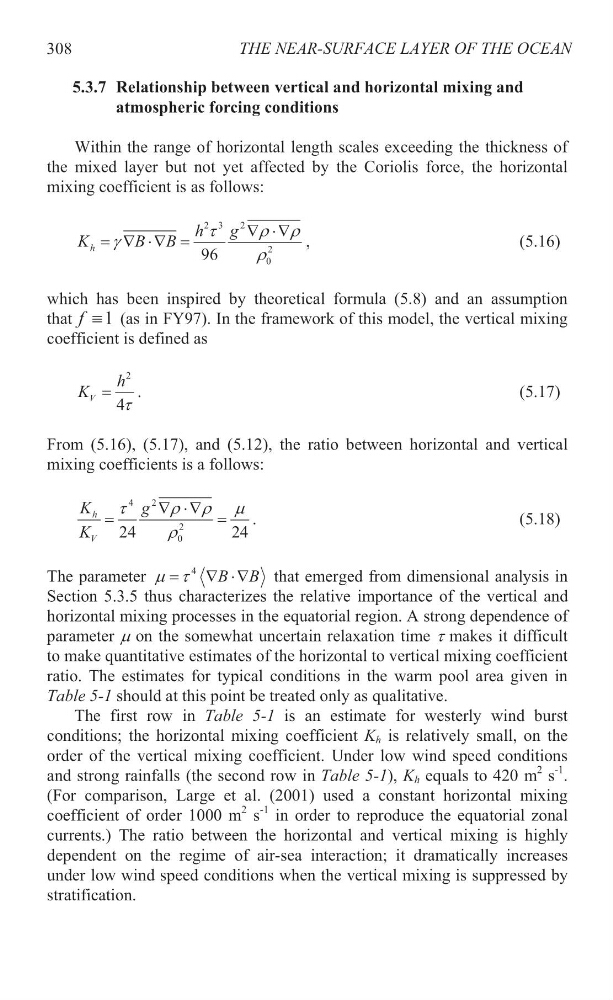
Within the range of horizontal length scales exceeding the thickness of
the mixed layer but not yet affected by the Coriolis force, the horizontal
mixing coefficient is as follows:
2 3
2
2
0
96
h
h
g
K
B B
W
U U
J
U
,
(5.16)
which has been inspired by theoretical formula (5.8) and an assumption
that
1
f { (as in FY97). In the framework of this model, the vertical mixing
coefficient is defined as
2
4
V
h
K
W
.
(5.17)
From (5.16), (5.17), and (5.12), the ratio between horizontal and vertical
mixing coefficients is a follows:
4
2
2
0
24
24
h
V
K
g
K
W
U U P
U
.
(5.18)
The parameter
4
B B
P W that emerged from dimensional analysis in
Section 5.3.5 thus characterizes the relative importance of the vertical and
horizontal mixing processes in the equatorial region. A strong dependence of
parameter P on the somewhat uncertain relaxation time W makes it difficult
to make quantitative estimates of the horizontal to vertical mixing coefficient
ratio. The estimates for typical conditions in the warm pool area given in
Table 5-1 should at this point be treated only as qualitative.
The first row in Table 5-1 is an estimate for westerly wind burst
conditions; the horizontal mixing coefficient K h is relatively small, on the
order of the vertical mixing coefficient. Under low wind speed conditions
and strong rainfalls (the second row in Table 5-1), K h equals to 420 m
2 s
-1 .
(For comparison, Large et al. (2001) used a constant horizontal mixing
coefficient of order 1000 m
2 s
-1 in order to reproduce the equatorial zonal
currents.) The ratio between the horizontal and vertical mixing is highly
dependent on the regime of air-sea interaction; it dramatically increases
under low wind speed conditions when the vertical mixing is suppressed by
stratification.
308
5.3.7 Relationship between vertical and horizontal mixing and
atmospheric forcing conditions
Within the range of horizontal length scales exceeding the thickness of
the mixed layer but not yet affected by the Coriolis force, the horizontal
mixing coefficient is as follows:
2 3
2
2
0
96
h
h
g
K
B B
W
U U
J
U
,
(5.16)
which has been inspired by theoretical formula (5.8) and an assumption
that
1
f { (as in FY97). In the framework of this model, the vertical mixing
coefficient is defined as
2
4
V
h
K
W
.
(5.17)
From (5.16), (5.17), and (5.12), the ratio between horizontal and vertical
mixing coefficients is a follows:
4
2
2
0
24
24
h
V
K
g
K
W
U U P
U
.
(5.18)
The parameter
4
B B
P W that emerged from dimensional analysis in
Section 5.3.5 thus characterizes the relative importance of the vertical and
horizontal mixing processes in the equatorial region. A strong dependence of
parameter P on the somewhat uncertain relaxation time W makes it difficult
to make quantitative estimates of the horizontal to vertical mixing coefficient
ratio. The estimates for typical conditions in the warm pool area given in
Table 5-1 should at this point be treated only as qualitative.
The first row in Table 5-1 is an estimate for westerly wind burst
conditions; the horizontal mixing coefficient K h is relatively small, on the
order of the vertical mixing coefficient. Under low wind speed conditions
and strong rainfalls (the second row in Table 5-1), K h equals to 420 m
2 s
-1 .
(For comparison, Large et al. (2001) used a constant horizontal mixing
coefficient of order 1000 m
2 s
-1 in order to reproduce the equatorial zonal
currents.) The ratio between the horizontal and vertical mixing is highly
dependent on the regime of air-sea interaction; it dramatically increases
under low wind speed conditions when the vertical mixing is suppressed by
stratification.
308