

Chapter 4: FINE STRUCTURE AND MICROSTRUCTURE
ocean processes. The ice and upper ocean thus represent a strongly coupled
system whose description should rely on a detailed understanding of these
heat, salt, and momentum transfer processes.
Antarctic pack ice is relatively thin. The ice drift patterns prevent most
Antarctic sea ice from reaching ages greater than 1-2 years. Wadhams et al.
(1987) found the mean thickness of ice floes formed during one year to be
about 50-60 cm only.
In the Antarctic, melt occurs mainly from the bottom and the sides of the
ice, which are in contact with the ocean. Divergence of the pack creates
more open water, allowing more solar radiation to be absorbed by the ocean
with a subsequent warming of the surface water. As austral summer
approaches the surface layer of the ocean warms up and the rate of melting
of the ice increases. Ice edge retreat begins in November, accelerates in
December and continues throughout February along the entire East Antarctic
coastline. By November, areas of open water within the pack are no longer
exclusively sites of enhanced ice production; rather they become a focus for
the uptake of solar radiation and contribute to the rapid decay of the ice. By
this process, the pack ice decays "from within" as well as by the retreat of
the ice edge from north to south. Particularly rapid retreat occurs in regions
where the ice edge extended furthest north at maximum extent.
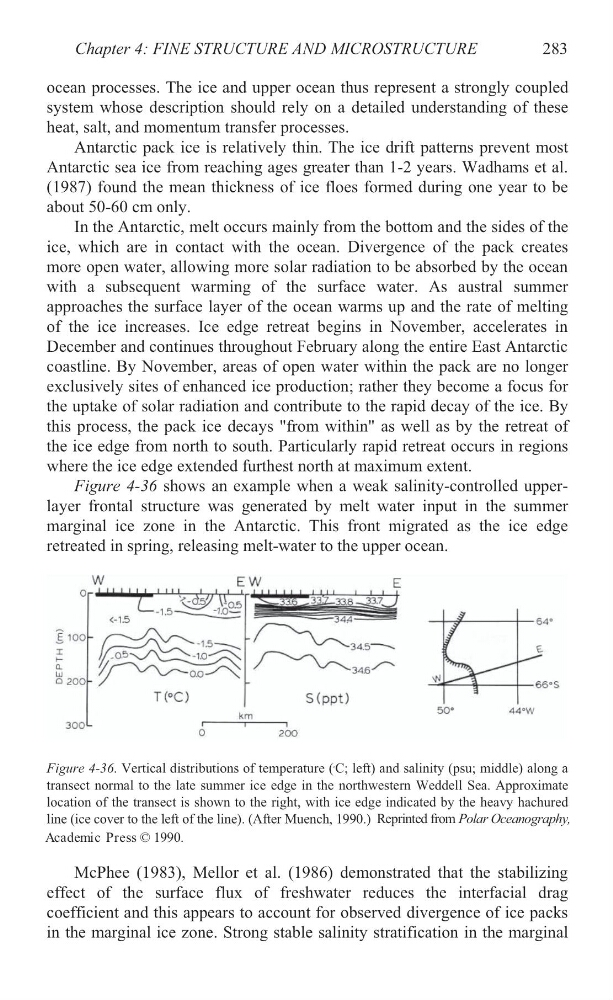
X Figure 4-36X shows an example when a weak salinity-controlled upperlayer frontal structure was generated by melt water input in the summer
marginal ice zone in the Antarctic. This front migrated as the ice edge
retreated in spring, releasing melt-water to the upper ocean.
Figure 4-36. Vertical distributions of temperature (P o
P C; left) and salinity (psu; middle) along a
transect normal to the late summer ice edge in the northwestern Weddell Sea. Approximate
location of the transect is shown to the right, with ice edge indicated by the heavy hachured
line (ice cover to the left of the line). (After Muench, 1990.)
McPhee (1983), Mellor et al. (1986) demonstrated that the stabilizing
effect of the surface flux of freshwater reduces the interfacial drag
coefficient and this appears to account for observed divergence of ice packs
in the marginal ice zone. Strong stable salinity stratification in the marginal
283
Reprinted from Polar Oceanography,
Academic Press © 1990.
ocean processes. The ice and upper ocean thus represent a strongly coupled
system whose description should rely on a detailed understanding of these
heat, salt, and momentum transfer processes.
Antarctic pack ice is relatively thin. The ice drift patterns prevent most
Antarctic sea ice from reaching ages greater than 1-2 years. Wadhams et al.
(1987) found the mean thickness of ice floes formed during one year to be
about 50-60 cm only.
In the Antarctic, melt occurs mainly from the bottom and the sides of the
ice, which are in contact with the ocean. Divergence of the pack creates
more open water, allowing more solar radiation to be absorbed by the ocean
with a subsequent warming of the surface water. As austral summer
approaches the surface layer of the ocean warms up and the rate of melting
of the ice increases. Ice edge retreat begins in November, accelerates in
December and continues throughout February along the entire East Antarctic
coastline. By November, areas of open water within the pack are no longer
exclusively sites of enhanced ice production; rather they become a focus for
the uptake of solar radiation and contribute to the rapid decay of the ice. By
this process, the pack ice decays "from within" as well as by the retreat of
the ice edge from north to south. Particularly rapid retreat occurs in regions
where the ice edge extended furthest north at maximum extent.
X Figure 4-36X shows an example when a weak salinity-controlled upperlayer frontal structure was generated by melt water input in the summer
marginal ice zone in the Antarctic. This front migrated as the ice edge
retreated in spring, releasing melt-water to the upper ocean.
Figure 4-36. Vertical distributions of temperature (P o
P C; left) and salinity (psu; middle) along a
transect normal to the late summer ice edge in the northwestern Weddell Sea. Approximate
location of the transect is shown to the right, with ice edge indicated by the heavy hachured
line (ice cover to the left of the line). (After Muench, 1990.)
McPhee (1983), Mellor et al. (1986) demonstrated that the stabilizing
effect of the surface flux of freshwater reduces the interfacial drag
coefficient and this appears to account for observed divergence of ice packs
in the marginal ice zone. Strong stable salinity stratification in the marginal
283
Reprinted from Polar Oceanography,
Academic Press © 1990.