

Chapter 4: FINE STRUCTURE AND MICROSTRUCTURE
data are in good agreement. The dependence of the diurnal heating on the
wind speed is clearly seen in this figure. During the morning wind forcing,
there is practically no rise in SST. Although diurnal warming is suppressed
during morning hours, it increases strongly at 10 a.m. when the wind speed
drops below 5 m sP
-1
P.
According to X Figure 4-35X a, the daily variation in atmospheric
temperature is even larger than it is in the ocean. Hoeber (1969) previously
observed a similar effect in the equatorial region. This effect is supposedly
because the moist equatorial atmosphere absorbs solar radiation directly
during the daytime and is cooled again during the nighttime (see discussion
in Kraus and Businger, 1994, p. 170).
Note the diurnal cycle of relative humidity (X Figure 4-35X b). The relative
humidity decreases with the daytime SST increase, thus enhancing the latent
heat flux. This is a manifestation of the negative feedback mechanism
stabilizing the SST (Greenhut, 1978; Gautier, 1978; Lukas, 1990a; Katsaros
and DeCosmo, 1990; Kraus and Businger, 1994).
Direct numerical simulation represents another possible approach to
modeling the diurnal cycle of SST under low wind speed conditions. The
model of Verevochkin and Startsev (2000) mentioned in Section X 4.5.1X is one
of the first attempts in this direction. The present version of this model,
unfortunately, does not include wind mixing.
4.6 Fine Structure of the Near-Surface Layer in the
Polar Seas
Few details are known about the near-surface layer of the polar seas.
Barrier layers similar to those observed in the Indo-Pacific warm pool are
possibly an important factor in the dynamics of the polar seas in marginal ice
zones.
In the cold surface water of the polar seas, the coefficient of thermal
expansion DB 7 B is substantially smaller than in mid- and low latitude surface
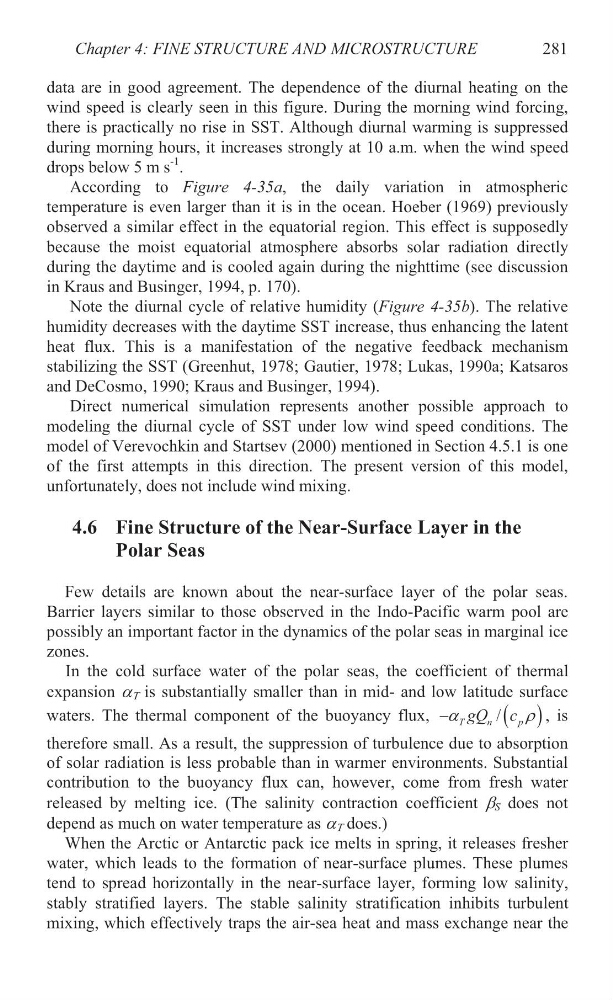
waters. The thermal component of the buoyancy flux,
/
T
n
p
gQ c
D
U
, is
therefore small. As a result, the suppression of turbulence due to absorption
of solar radiation is less probable than in warmer environments. Substantial
contribution to the buoyancy flux can, however, come from fresh water
released by melting ice. (The salinity contraction coefficient EB S B does not
depend as much on water temperature as DB 7 B does.)
When the Arctic or Antarctic pack ice melts in spring, it releases fresher
water, which leads to the formation of near-surface plumes. These plumes
tend to spread horizontally in the near-surface layer, forming low salinity,
stably stratified layers. The stable salinity stratification inhibits turbulent
mixing, which effectively traps the air-sea heat and mass exchange near the
281
data are in good agreement. The dependence of the diurnal heating on the
wind speed is clearly seen in this figure. During the morning wind forcing,
there is practically no rise in SST. Although diurnal warming is suppressed
during morning hours, it increases strongly at 10 a.m. when the wind speed
drops below 5 m sP
-1
P.
According to X Figure 4-35X a, the daily variation in atmospheric
temperature is even larger than it is in the ocean. Hoeber (1969) previously
observed a similar effect in the equatorial region. This effect is supposedly
because the moist equatorial atmosphere absorbs solar radiation directly
during the daytime and is cooled again during the nighttime (see discussion
in Kraus and Businger, 1994, p. 170).
Note the diurnal cycle of relative humidity (X Figure 4-35X b). The relative
humidity decreases with the daytime SST increase, thus enhancing the latent
heat flux. This is a manifestation of the negative feedback mechanism
stabilizing the SST (Greenhut, 1978; Gautier, 1978; Lukas, 1990a; Katsaros
and DeCosmo, 1990; Kraus and Businger, 1994).
Direct numerical simulation represents another possible approach to
modeling the diurnal cycle of SST under low wind speed conditions. The
model of Verevochkin and Startsev (2000) mentioned in Section X 4.5.1X is one
of the first attempts in this direction. The present version of this model,
unfortunately, does not include wind mixing.
4.6 Fine Structure of the Near-Surface Layer in the
Polar Seas
Few details are known about the near-surface layer of the polar seas.
Barrier layers similar to those observed in the Indo-Pacific warm pool are
possibly an important factor in the dynamics of the polar seas in marginal ice
zones.
In the cold surface water of the polar seas, the coefficient of thermal
expansion DB 7 B is substantially smaller than in mid- and low latitude surface
waters. The thermal component of the buoyancy flux,
/
T
n
p
gQ c
D
U
, is
therefore small. As a result, the suppression of turbulence due to absorption
of solar radiation is less probable than in warmer environments. Substantial
contribution to the buoyancy flux can, however, come from fresh water
released by melting ice. (The salinity contraction coefficient EB S B does not
depend as much on water temperature as DB 7 B does.)
When the Arctic or Antarctic pack ice melts in spring, it releases fresher
water, which leads to the formation of near-surface plumes. These plumes
tend to spread horizontally in the near-surface layer, forming low salinity,
stably stratified layers. The stable salinity stratification inhibits turbulent
mixing, which effectively traps the air-sea heat and mass exchange near the
281