

Chapter 4: FINE STRUCTURE AND MICROSTRUCTURE
speed when the effect of volume absorption of solar radiation is of
importance.
Below we consider modeling of the diurnal cycle for the example of the
transilient model (though it also has a disadvantage in that it does not allow
unstable stratification to develop). The transilient model deals with the
parameterization of turbulent transports by a spectrum of eddies that
transport fluid properties over a range of distances (Stull and Kraus, 1987).
The transilient model specifies a velocity scale l
u u and a vertical length
scale l
z
N , where u is the frictional velocity in water, N is the von
Karman constant, and z is the vertical coordinate. For the unstably stratified
near-surface layer (nighttime) Soloviev and Lukas (1997a) proposed to use a
different scaling: l
u w and
c
l L , where according to Priestly (1959)
1/ 3
0
c
w
L B
, c
L is the depth of the unstably stratified near-surface layer,
and BB 0 B is the surface buoyancy flux. The absorption of solar radiation with
depth was parameterized with a 9 exponential dependence (1.62).
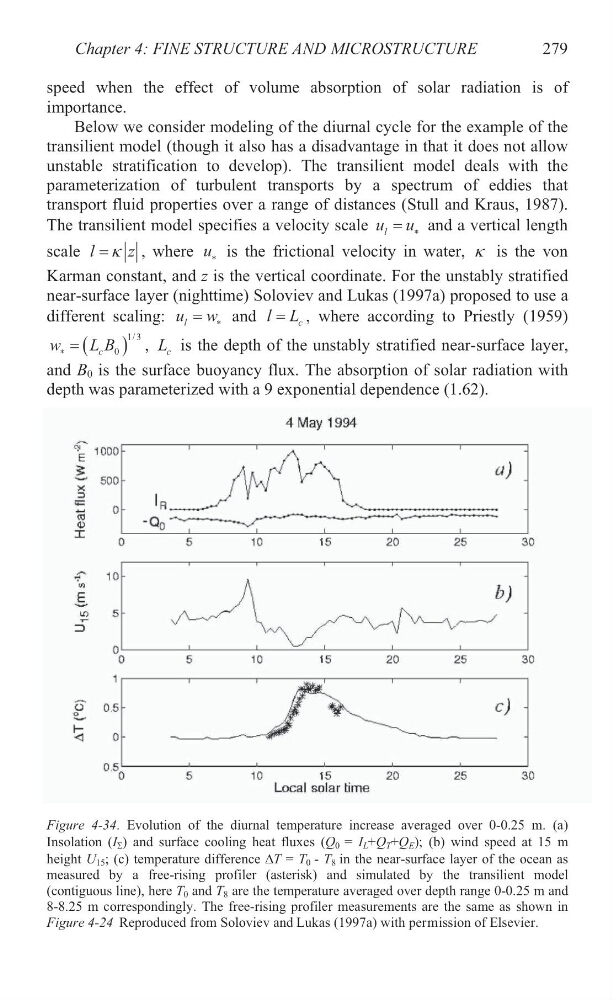
Figure 4-34. Evolution of the diurnal temperature increase averaged over 0-0.25 m. (a)
Insolation (IB 6 B ) and surface cooling heat fluxes (QB 0 B = IB L B +QB T B +QB E B ); (b) wind speed at 15 m
height UB 15 B ; (c) temperature difference 'T = TB 0 B - TB 8 B in the near-surface layer of the ocean as
measured by a free-rising profiler (asterisk) and simulated by the transilient model
(contiguous line), here TB 0 B and TB 8 B are the temperature averaged over depth range 0-0.25 m and
8-8.25 m correspondingly. The free-rising profiler measurements are the same as shown in
X Figure 4-24.
279
Reproduced from Soloviev and Lukas (1997a) with permission of Elsevier.
speed when the effect of volume absorption of solar radiation is of
importance.
Below we consider modeling of the diurnal cycle for the example of the
transilient model (though it also has a disadvantage in that it does not allow
unstable stratification to develop). The transilient model deals with the
parameterization of turbulent transports by a spectrum of eddies that
transport fluid properties over a range of distances (Stull and Kraus, 1987).
The transilient model specifies a velocity scale l
u u and a vertical length
scale l
z
N , where u is the frictional velocity in water, N is the von
Karman constant, and z is the vertical coordinate. For the unstably stratified
near-surface layer (nighttime) Soloviev and Lukas (1997a) proposed to use a
different scaling: l
u w and
c
l L , where according to Priestly (1959)
1/ 3
0
c
w
L B
, c
L is the depth of the unstably stratified near-surface layer,
and BB 0 B is the surface buoyancy flux. The absorption of solar radiation with
depth was parameterized with a 9 exponential dependence (1.62).
Figure 4-34. Evolution of the diurnal temperature increase averaged over 0-0.25 m. (a)
Insolation (IB 6 B ) and surface cooling heat fluxes (QB 0 B = IB L B +QB T B +QB E B ); (b) wind speed at 15 m
height UB 15 B ; (c) temperature difference 'T = TB 0 B - TB 8 B in the near-surface layer of the ocean as
measured by a free-rising profiler (asterisk) and simulated by the transilient model
(contiguous line), here TB 0 B and TB 8 B are the temperature averaged over depth range 0-0.25 m and
8-8.25 m correspondingly. The free-rising profiler measurements are the same as shown in
X Figure 4-24.
279
Reproduced from Soloviev and Lukas (1997a) with permission of Elsevier.