

Chapter 4: FINE STRUCTURE AND MICROSTRUCTURE
max
2
1
0.75 14.67
C
T
U
'
.
(4.56)
This parameterization was intended for the equatorial ocean, where the daily
average cloud fraction is a good proxy for the cumulative daily insolation.
The presence of
2
U in the right side of the regression implies that below
some critical value of the wind speed the diurnal warming of the ocean
surface layer rapidly increases. Equation X (4.56)X is derived using data only for
wind speed exceeding 2.7 m sP
-1
P,
because the scatter of points strongly
increases under very low wind speed conditions. This equation should not
therefore be applied for very low and calm winds. It was not intended for use
outside the western Pacific warm pool but it should be applicable to other
regions with possible change of coefficients.
Clayson and Curry (1996) extended the Lukas (1991) approach to low
wind speeds by modifying the set of determining parameters and separating
wind speed conditions below and above a 2 m sP
-1
P
threshold. Their regression
parameterization of the diurnal SST range has the following form:
max
0
0
0
0
0
0
ln
ln
S
S
T
a b I
c P d
U c I
U
f U
'
, (4.57)
where IB S B is the peak insolation, P is the daily average precipitation, and U
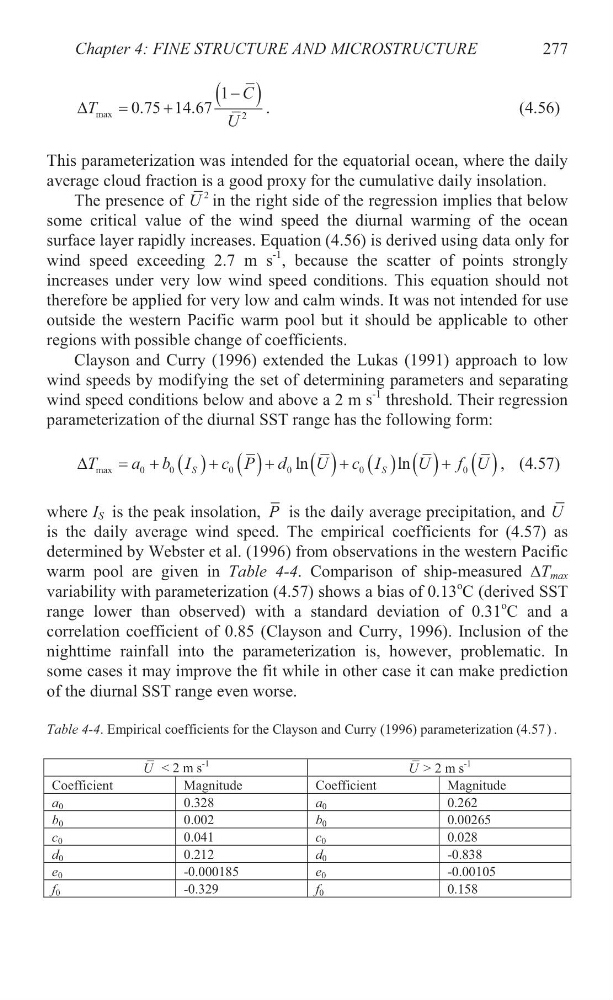
is the daily average wind speed. The empirical coefficients for X (4.57)X as
determined by Webster et al. (1996) from observations in the western Pacific
warm pool are given in X Table 4-4X . Comparison of ship-measured 'TB max B
variability with parameterization X (4.57)X shows a bias of 0.13P
o
PC
(derived SST
range lower than observed) with a standard deviation of 0.31P
o
PC
and a
correlation coefficient of 0.85 (Clayson and Curry, 1996). Inclusion of the
nighttime rainfall into the parameterization is, however, problematic. In
some cases it may improve the fit while in other case it can make prediction
of the diurnal SST range even worse.
X
X
U < 2 m sP
-1
P
U > 2 m sP
-1
P
Coefficient
Magnitude
Coefficient
Magnitude
aB 0 B
0.328
aB 0 B
0.262
bB 0 B
0.002
bB 0 B
0.00265
cB 0 B
0.041
cB 0 B
0.028
dB 0 B
0.212
dB 0 B
-0.838
eB 0 B
-0.000185
eB 0 B
-0.00105
fB 0 B
-0.329
fB 0 B
0.158
Table 4-4. Empirical coefficients for the Clayson and Curry (1996) parameterization (4.57 .
)
277
max
2
1
0.75 14.67
C
T
U
'
.
(4.56)
This parameterization was intended for the equatorial ocean, where the daily
average cloud fraction is a good proxy for the cumulative daily insolation.
The presence of
2
U in the right side of the regression implies that below
some critical value of the wind speed the diurnal warming of the ocean
surface layer rapidly increases. Equation X (4.56)X is derived using data only for
wind speed exceeding 2.7 m sP
-1
P,
because the scatter of points strongly
increases under very low wind speed conditions. This equation should not
therefore be applied for very low and calm winds. It was not intended for use
outside the western Pacific warm pool but it should be applicable to other
regions with possible change of coefficients.
Clayson and Curry (1996) extended the Lukas (1991) approach to low
wind speeds by modifying the set of determining parameters and separating
wind speed conditions below and above a 2 m sP
-1
P
threshold. Their regression
parameterization of the diurnal SST range has the following form:
max
0
0
0
0
0
0
ln
ln
S
S
T
a b I
c P d
U c I
U
f U
'
, (4.57)
where IB S B is the peak insolation, P is the daily average precipitation, and U
is the daily average wind speed. The empirical coefficients for X (4.57)X as
determined by Webster et al. (1996) from observations in the western Pacific
warm pool are given in X Table 4-4X . Comparison of ship-measured 'TB max B
variability with parameterization X (4.57)X shows a bias of 0.13P
o
PC
(derived SST
range lower than observed) with a standard deviation of 0.31P
o
PC
and a
correlation coefficient of 0.85 (Clayson and Curry, 1996). Inclusion of the
nighttime rainfall into the parameterization is, however, problematic. In
some cases it may improve the fit while in other case it can make prediction
of the diurnal SST range even worse.
X
X
U < 2 m sP
-1
P
U > 2 m sP
-1
P
Coefficient
Magnitude
Coefficient
Magnitude
aB 0 B
0.328
aB 0 B
0.262
bB 0 B
0.002
bB 0 B
0.00265
cB 0 B
0.041
cB 0 B
0.028
dB 0 B
0.212
dB 0 B
-0.838
eB 0 B
-0.000185
eB 0 B
-0.00105
fB 0 B
-0.329
fB 0 B
0.158
Table 4-4. Empirical coefficients for the Clayson and Curry (1996) parameterization (4.57 .
)
277