

THE NEAR-SURFACE LAYER OF THE OCEAN
The Richardson number within the steady turbulent boundary layer is
restricted from above to its critical value cr
Ri . If the Richardson number
exceeds the critical value, this is an indication that this is an area outside of
the surface turbulent boundary layer.
From (3.85), ] can be expressed as a function of Ri :
at -0.20
0
/ 1
/
at 0
cr
cr
Ri
Ri
Ri
Ri Ri
Ri Ri
]
d
®
d
¯
(3.87)
(The analytical relationship between Ri and z is bulky for
0.20
9
;
therefore it is not shown in (3.85) and (3.87).)
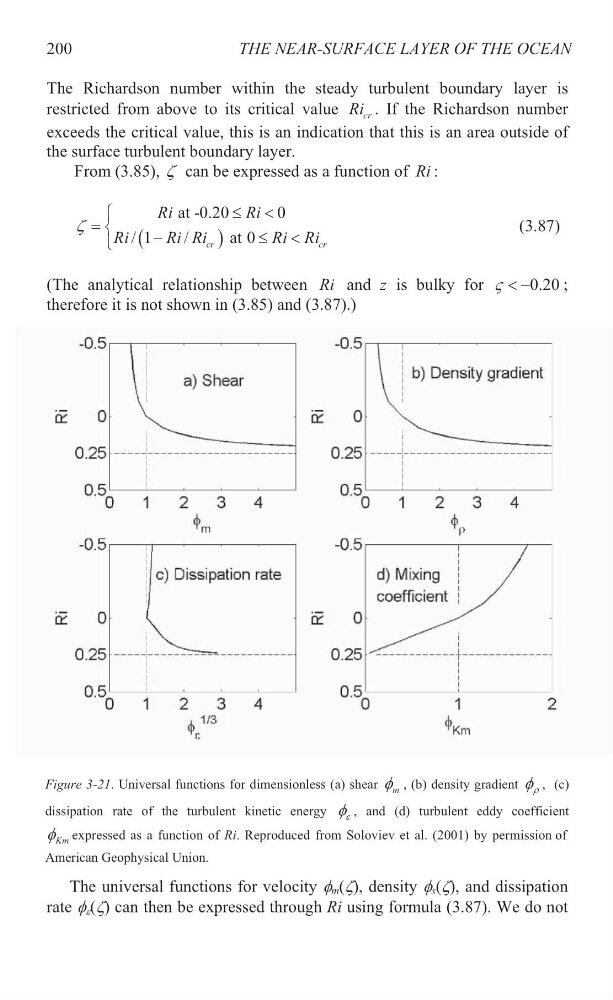
The universal functions for velocity I m (]), density I s (]), and dissipation
rate I H (]) can then be expressed through Ri using formula (3.87). We do not
200
Figure 3-21. Universal functions for dimensionless (a) shear m
I , (b) density gradient U
I , (c)
dissipation rate of the turbulent kinetic energy H
I , and (d) turbulent eddy coefficient
Km
I
American Geophysical Union.
expressed as a function of Ri. Reproduced from Soloviev et al. (2001) by permission of
The Richardson number within the steady turbulent boundary layer is
restricted from above to its critical value cr
Ri . If the Richardson number
exceeds the critical value, this is an indication that this is an area outside of
the surface turbulent boundary layer.
From (3.85), ] can be expressed as a function of Ri :
at -0.20
0
/ 1
/
at 0
cr
cr
Ri
Ri
Ri
Ri Ri
Ri Ri
]
d
®
d
¯
(3.87)
(The analytical relationship between Ri and z is bulky for
0.20
9
;
therefore it is not shown in (3.85) and (3.87).)
The universal functions for velocity I m (]), density I s (]), and dissipation
rate I H (]) can then be expressed through Ri using formula (3.87). We do not
200
Figure 3-21. Universal functions for dimensionless (a) shear m
I , (b) density gradient U
I , (c)
dissipation rate of the turbulent kinetic energy H
I , and (d) turbulent eddy coefficient
Km
I
American Geophysical Union.
expressed as a function of Ri. Reproduced from Soloviev et al. (2001) by permission of