

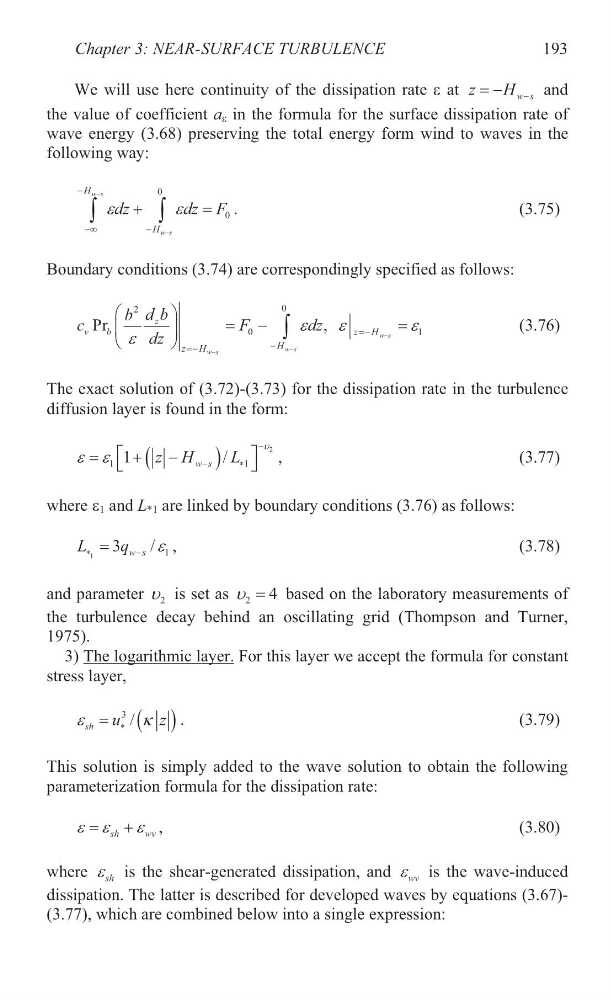
We will use here continuity of the dissipation rate H at
w s
z
H
and
the value of coefficient a H in the formula for the surface dissipation rate of
wave energy (3.68) preserving the total energy form wind to waves in the
following way:
0
0
w s
w s
H
H
dz
dz F
H
H
f
³
³
.
(3.75)
Boundary conditions (3.74) are correspondingly specified as follows:
0
2
0
1
Pr
,
w s
w s
w s
z
v
b
z H
H
z H
d b
b
c
F
d z
dz
H
H
H
H
§
·
¨
¸
©
¹
³
(3.76)
The exact solution of (3.72)-(3.73) for the dissipation rate in the turbulence
diffusion layer is found in the form:
2
1
1
1
/
w s
z H
L
X
H H
ª
º
¬
¼ ,
(3.77)
where H 1 and L *1 are linked by boundary conditions (3.76) as follows:
1
1
3
/
w s
L
q
H
,
(3.78)
and parameter 2
X is set as 2 4
X
based on the laboratory measurements of
the turbulence decay behind an oscillating grid (Thompson and Turner,
1975).
3) The logarithmic layer. For this layer we accept the formula for constant
stress layer,
3 /
sh
u
z
H
N
.
(3.79)
This solution is simply added to the wave solution to obtain the following
parameterization formula for the dissipation rate:
sh
w v
H H
H
,
(3.80)
where sh
H is the shear-generated dissipation, and wv
H is the wave-induced
dissipation. The latter is described for developed waves by equations (3.67)(3.77), which are combined below into a single expression:
Chapter 3: NEAR-SURFACE TURBULENCE
193
w s
z
H
and
the value of coefficient a H in the formula for the surface dissipation rate of
wave energy (3.68) preserving the total energy form wind to waves in the
following way:
0
0
w s
w s
H
H
dz
dz F
H
H
f
³
³
.
(3.75)
Boundary conditions (3.74) are correspondingly specified as follows:
0
2
0
1
Pr
,
w s
w s
w s
z
v
b
z H
H
z H
d b
b
c
F
d z
dz
H
H
H
H
§
·
¨
¸
©
¹
³
(3.76)
The exact solution of (3.72)-(3.73) for the dissipation rate in the turbulence
diffusion layer is found in the form:
2
1
1
1
/
w s
z H
L
X
H H
ª
º
¬
¼ ,
(3.77)
where H 1 and L *1 are linked by boundary conditions (3.76) as follows:
1
1
3
/
w s
L
q
H
,
(3.78)
and parameter 2
X is set as 2 4
X
based on the laboratory measurements of
the turbulence decay behind an oscillating grid (Thompson and Turner,
1975).
3) The logarithmic layer. For this layer we accept the formula for constant
stress layer,
3 /
sh
u
z
H
N
.
(3.79)
This solution is simply added to the wave solution to obtain the following
parameterization formula for the dissipation rate:
sh
w v
H H
H
,
(3.80)
where sh
H is the shear-generated dissipation, and wv
H is the wave-induced
dissipation. The latter is described for developed waves by equations (3.67)(3.77), which are combined below into a single expression:
Chapter 3: NEAR-SURFACE TURBULENCE
193