

THE NEAR-SURFACE LAYER OF THE OCEAN
of surface wave theory directly relating to the dynamics of the near-surface
layer of the ocean are introduced as solutions for the equations of fluid
mechanics.
Matching the dynamics and thermodynamics of the ocean and atmosphere
occurs in the planetary boundary layers (PBL), which are the subject of
Section 1.7.
1.2 Basic Equations of Fluid Mechanics and Useful
Approximations
1.2.1 Mathematical notation and governing equations
This book covers a variety of topics relating to different disciplines.
Some reuse of symbols for different properties is therefore unavoidable. This
is noted in the list of frequently used mathematical symbols given in
Appendix. An attempt is made to avoid situations where a symbol with two
different meanings would appear in the same equation or even in the same
section. Symbols that appear only locally in the text typically are not
included in the list of frequently used mathematical symbols.
The main equations that govern the oceanic and atmospheric boundary
layers including the near-surface layer of the ocean have been formulated
and discussed in many scientific publications. The full system of equations
includes conservation laws for mass, momentum, heat, energy, salt or
humidity plus the equation of state. The transport equation for an arbitrary
passive tracer can be easily included.
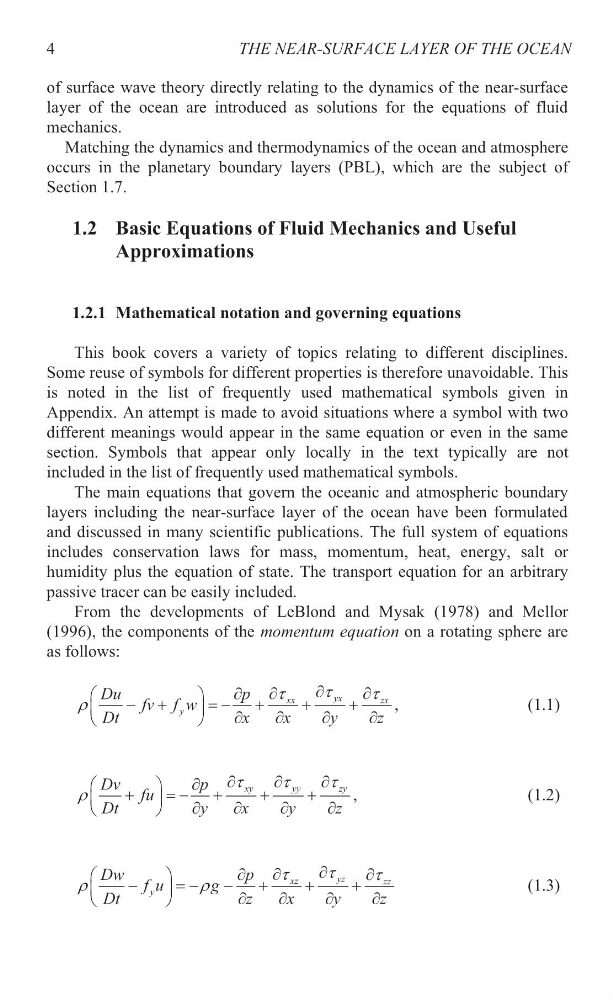
From the developments of LeBlond and Mysak (1978) and Mellor
(1996), the components of the momentum equation on a rotating sphere are
as follows:
yx
xx
z x
y
Du
p
fv f w
Dt
x
x
y
z
W
W
W
U
w
w
w
w
§
·
¨
¸
w
w
w
w
©
¹
,
(1.1)
xy
y y
z y
Dv
p
fu
Dt
y
x
y
z
W
W
W
U
w
w
w
w
§
·
¨
¸
w
w
w
w
©
¹
,
(1.2)
yz
xz
zz
y
Dw
p
f u
g
Dt
z
x
y
z
W
W
W
U
U
w
w
w
w
§
·
¨
¸
w
w
w
w
©
¹
(1.3)
4
of surface wave theory directly relating to the dynamics of the near-surface
layer of the ocean are introduced as solutions for the equations of fluid
mechanics.
Matching the dynamics and thermodynamics of the ocean and atmosphere
occurs in the planetary boundary layers (PBL), which are the subject of
Section 1.7.
1.2 Basic Equations of Fluid Mechanics and Useful
Approximations
1.2.1 Mathematical notation and governing equations
This book covers a variety of topics relating to different disciplines.
Some reuse of symbols for different properties is therefore unavoidable. This
is noted in the list of frequently used mathematical symbols given in
Appendix. An attempt is made to avoid situations where a symbol with two
different meanings would appear in the same equation or even in the same
section. Symbols that appear only locally in the text typically are not
included in the list of frequently used mathematical symbols.
The main equations that govern the oceanic and atmospheric boundary
layers including the near-surface layer of the ocean have been formulated
and discussed in many scientific publications. The full system of equations
includes conservation laws for mass, momentum, heat, energy, salt or
humidity plus the equation of state. The transport equation for an arbitrary
passive tracer can be easily included.
From the developments of LeBlond and Mysak (1978) and Mellor
(1996), the components of the momentum equation on a rotating sphere are
as follows:
yx
xx
z x
y
Du
p
fv f w
Dt
x
x
y
z
W
W
W
U
w
w
w
w
§
·
¨
¸
w
w
w
w
©
¹
,
(1.1)
xy
y y
z y
Dv
p
fu
Dt
y
x
y
z
W
W
W
U
w
w
w
w
§
·
¨
¸
w
w
w
w
©
¹
,
(1.2)
yz
xz
zz
y
Dw
p
f u
g
Dt
z
x
y
z
W
W
W
U
U
w
w
w
w
§
·
¨
¸
w
w
w
w
©
¹
(1.3)
4