

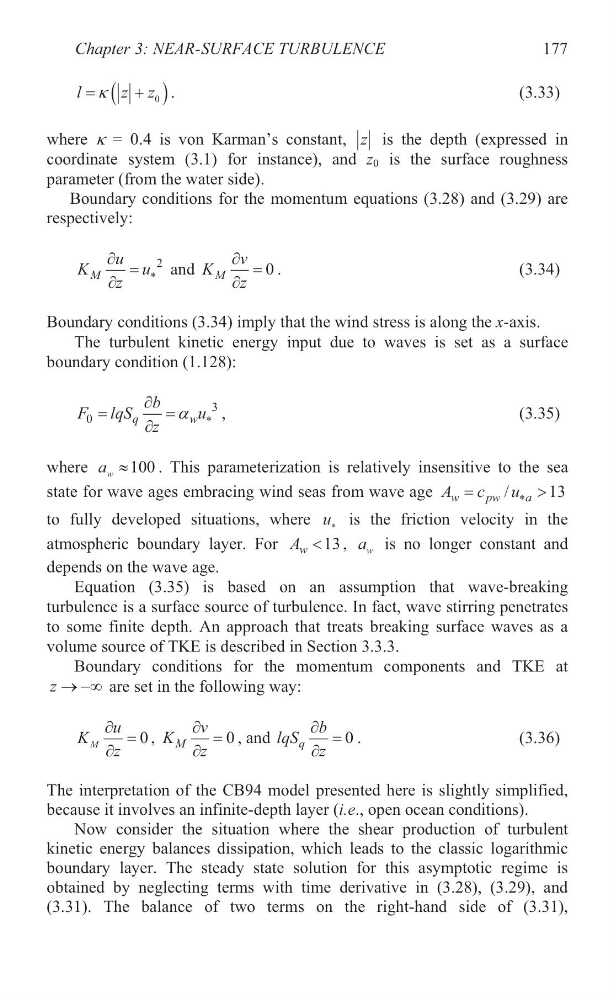
0
l
z z
N
.
(3.33)
where N = 0.4 is von Karman’s constant, z is the depth (expressed in
coordinate system (3.1) for instance), and z 0 is the surface roughness
parameter (from the water side).
Boundary conditions for the momentum equations (3.28) and (3.29) are
respectively:
2
M
u
K
u
z
w
w
and
0
M
v
K
z
w
w
.
(3.34)
Boundary conditions (3.34) imply that the wind stress is along the x-axis.
The turbulent kinetic energy input due to waves is set as a surface
3
0
q
w
b
F lqS
u
z
D
w
w
,
(3.35)
where
100
w
a |
. This parameterization is relatively insensitive to the sea
state for wave ages embracing wind seas from wave age
/
13
w
pw
a
A c
u !
to fully developed situations, where u is the friction velocity in the
atmospheric boundary layer. For
13
w
A , w
a is no longer constant and
depends on the wave age.
Equation (3.35) is based on an assumption that wave-breaking
turbulence is a surface source of turbulence. In fact, wave stirring penetrates
to some finite depth. An approach that treats breaking surface waves as a
volume source of TKE is described in Section 3.3.3.
Boundary conditions for the momentum components and TKE at
z o f are set in the following way:
0
M
u
K
z
w
w
,
0
M
v
K
z
w
w
, and
0
q
b
lqS
z
w
w
.
(3.36)
The interpretation of the CB94 model presented here is slightly simplified,
because it involves an infinite-depth layer (i.e., open ocean conditions).
Now consider the situation where the shear production of turbulent
kinetic energy balances dissipation, which leads to the classic logarithmic
boundary layer. The steady state solution for this asymptotic regime is
obtained by neglecting terms with time derivative in (3.28), (3.29), and
(3.31). The balance of two terms on the right-hand side of (3.31),
Chapter 3: NEAR-SURFACE TURBULENCE
177
boundary condition (1.128):
l
z z
N
.
(3.33)
where N = 0.4 is von Karman’s constant, z is the depth (expressed in
coordinate system (3.1) for instance), and z 0 is the surface roughness
parameter (from the water side).
Boundary conditions for the momentum equations (3.28) and (3.29) are
respectively:
2
M
u
K
u
z
w
w
and
0
M
v
K
z
w
w
.
(3.34)
Boundary conditions (3.34) imply that the wind stress is along the x-axis.
The turbulent kinetic energy input due to waves is set as a surface
3
0
q
w
b
F lqS
u
z
D
w
w
,
(3.35)
where
100
w
a |
. This parameterization is relatively insensitive to the sea
state for wave ages embracing wind seas from wave age
/
13
w
pw
a
A c
u !
to fully developed situations, where u is the friction velocity in the
atmospheric boundary layer. For
13
w
A , w
a is no longer constant and
depends on the wave age.
Equation (3.35) is based on an assumption that wave-breaking
turbulence is a surface source of turbulence. In fact, wave stirring penetrates
to some finite depth. An approach that treats breaking surface waves as a
volume source of TKE is described in Section 3.3.3.
Boundary conditions for the momentum components and TKE at
z o f are set in the following way:
0
M
u
K
z
w
w
,
0
M
v
K
z
w
w
, and
0
q
b
lqS
z
w
w
.
(3.36)
The interpretation of the CB94 model presented here is slightly simplified,
because it involves an infinite-depth layer (i.e., open ocean conditions).
Now consider the situation where the shear production of turbulent
kinetic energy balances dissipation, which leads to the classic logarithmic
boundary layer. The steady state solution for this asymptotic regime is
obtained by neglecting terms with time derivative in (3.28), (3.29), and
(3.31). The balance of two terms on the right-hand side of (3.31),
Chapter 3: NEAR-SURFACE TURBULENCE
177
boundary condition (1.128):