

2
0
0.3( /
) for
0.6
/
0.83
for
0.6
S
S
wv S
S
z H
z
H
H F
z
H
H
!
°
®
° ¯
.
(3.27)
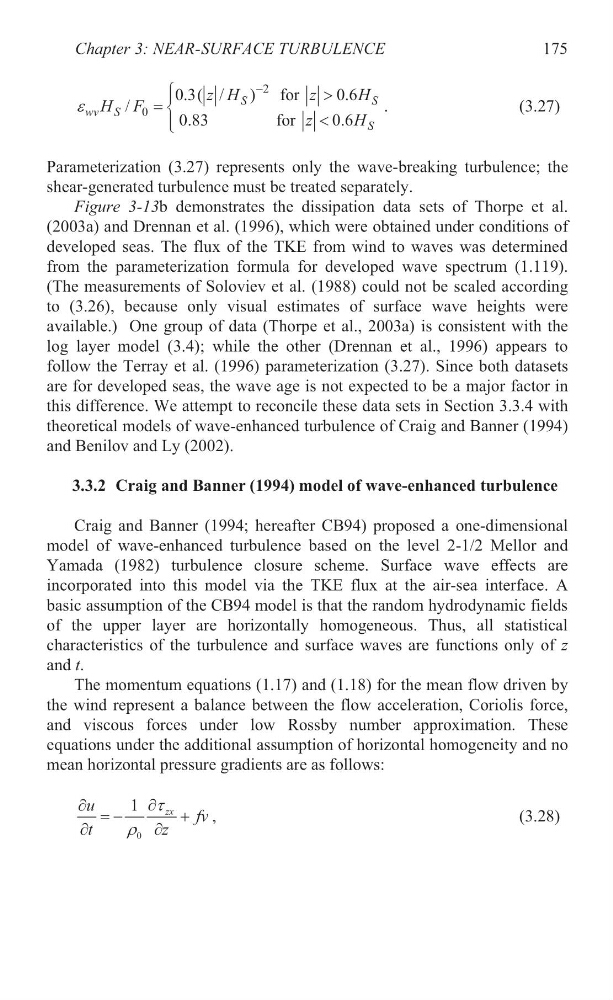
Parameterization (3.27) represents only the wave-breaking turbulence; the
shear-generated turbulence must be treated separately.
Figure 3-13b demonstrates the dissipation data sets of Thorpe et al.
(2003a) and Drennan et al. (1996), which were obtained under conditions of
developed seas. The flux of the TKE from wind to waves was determined
from the parameterization formula for developed wave spectrum (1.119).
(The measurements of Soloviev et al. (1988) could not be scaled according
to (3.26), because only visual estimates of surface wave heights were
available.) One group of data (Thorpe et al., 2003a) is consistent with the
log layer model (3.4); while the other (Drennan et al., 1996) appears to
follow the Terray et al. (1996) parameterization (3.27). Since both datasets
are for developed seas, the wave age is not expected to be a major factor in
this difference. We attempt to reconcile these data sets in Section 3.3.4 with
theoretical models of wave-enhanced turbulence of Craig and Banner (1994)
and Benilov and Ly (2002).
3.3.2 Craig and Banner (1994) model of wave-enhanced turbulence
Craig and Banner (1994; hereafter CB94) proposed a one-dimensional
model of wave-enhanced turbulence based on the level 2-1/2 Mellor and
Yamada (1982) turbulence closure scheme. Surface wave effects are
incorporated into this model via the TKE flux at the air-sea interface. A
basic assumption of the CB94 model is that the random hydrodynamic fields
of the upper layer are horizontally homogeneous. Thus, all statistical
characteristics of the turbulence and surface waves are functions only of z
and t.
The momentum equations (1.17) and (1.18) for the mean flow driven by
the wind represent a balance between the flow acceleration, Coriolis force,
and viscous forces under low Rossby number approximation. These
equations under the additional assumption of horizontal homogeneity and no
mean horizontal pressure gradients are as follows:
0
1
zx
u
fv
t
z
W
U
w
w
w
w
,
(3.28)
Chapter 3: NEAR-SURFACE TURBULENCE
175
0
0.3( /
) for
0.6
/
0.83
for
0.6
S
S
wv S
S
z H
z
H
H F
z
H
H
!
°
®
° ¯
.
(3.27)
Parameterization (3.27) represents only the wave-breaking turbulence; the
shear-generated turbulence must be treated separately.
Figure 3-13b demonstrates the dissipation data sets of Thorpe et al.
(2003a) and Drennan et al. (1996), which were obtained under conditions of
developed seas. The flux of the TKE from wind to waves was determined
from the parameterization formula for developed wave spectrum (1.119).
(The measurements of Soloviev et al. (1988) could not be scaled according
to (3.26), because only visual estimates of surface wave heights were
available.) One group of data (Thorpe et al., 2003a) is consistent with the
log layer model (3.4); while the other (Drennan et al., 1996) appears to
follow the Terray et al. (1996) parameterization (3.27). Since both datasets
are for developed seas, the wave age is not expected to be a major factor in
this difference. We attempt to reconcile these data sets in Section 3.3.4 with
theoretical models of wave-enhanced turbulence of Craig and Banner (1994)
and Benilov and Ly (2002).
3.3.2 Craig and Banner (1994) model of wave-enhanced turbulence
Craig and Banner (1994; hereafter CB94) proposed a one-dimensional
model of wave-enhanced turbulence based on the level 2-1/2 Mellor and
Yamada (1982) turbulence closure scheme. Surface wave effects are
incorporated into this model via the TKE flux at the air-sea interface. A
basic assumption of the CB94 model is that the random hydrodynamic fields
of the upper layer are horizontally homogeneous. Thus, all statistical
characteristics of the turbulence and surface waves are functions only of z
and t.
The momentum equations (1.17) and (1.18) for the mean flow driven by
the wind represent a balance between the flow acceleration, Coriolis force,
and viscous forces under low Rossby number approximation. These
equations under the additional assumption of horizontal homogeneity and no
mean horizontal pressure gradients are as follows:
0
1
zx
u
fv
t
z
W
U
w
w
w
w
,
(3.28)
Chapter 3: NEAR-SURFACE TURBULENCE
175