

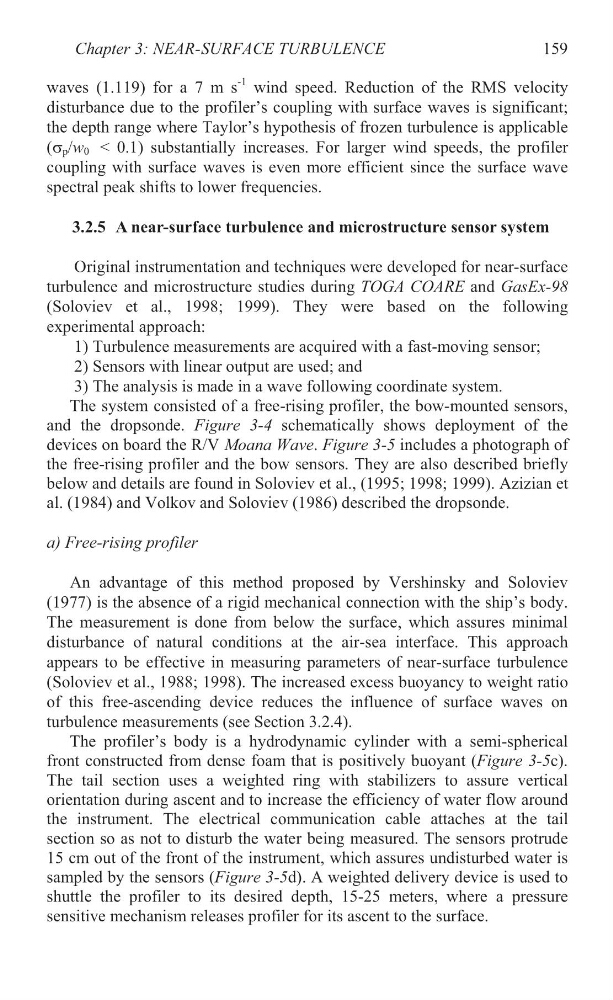
waves (1.119) for a 7 m s
-1 wind speed. Reduction of the RMS velocity
disturbance due to the profiler’s coupling with surface waves is significant;
the depth range where Taylor’s hypothesis of frozen turbulence is applicable
(V p /w 0 < 0.1) substantially increases. For larger wind speeds, the profiler
coupling with surface waves is even more efficient since the surface wave
spectral peak shifts to lower frequencies.
3.2.5 A near-surface turbulence and microstructure sensor system
Original instrumentation and techniques were developed for near-surface
turbulence and microstructure studies during TOGA COARE and GasEx-98
(Soloviev et al., 1998; 1999). They were based on the following
experimental approach:
1) Turbulence measurements are acquired with a fast-moving sensor;
2) Sensors with linear output are used; and
3) The analysis is made in a wave following coordinate system.
The system consisted of a free-rising profiler, the bow-mounted sensors,
and the dropsonde. Figure 3-4 schematically shows deployment of the
devices on board the R/V Moana Wave. Figure 3-5 includes a photograph of
the free-rising profiler and the bow sensors. They are also described briefly
below and details are found in Soloviev et al., (1995; 1998; 1999). Azizian et
al. (1984) and Volkov and Soloviev (1986) described the dropsonde.
a) Free-rising profiler
An advantage of this method proposed by Vershinsky and Soloviev
(1977) is the absence of a rigid mechanical connection with the ship’s body.
The measurement is done from below the surface, which assures minimal
disturbance of natural conditions at the air-sea interface. This approach
appears to be effective in measuring parameters of near-surface turbulence
(Soloviev et al., 1988; 1998). The increased excess buoyancy to weight ratio
of this free-ascending device reduces the influence of surface waves on
turbulence measurements (see Section 3.2.4).
The profiler’s body is a hydrodynamic cylinder with a semi-spherical
front constructed from dense foam that is positively buoyant (Figure 3-5c).
The tail section uses a weighted ring with stabilizers to assure vertical
orientation during ascent and to increase the efficiency of water flow around
the instrument. The electrical communication cable attaches at the tail
section so as not to disturb the water being measured. The sensors protrude
15 cm out of the front of the instrument, which assures undisturbed water is
sampled by the sensors (Figure 3-5d). A weighted delivery device is used to
shuttle the profiler to its desired depth, 15-25 meters, where a pressure
sensitive mechanism releases profiler for its ascent to the surface.
Chapter 3: NEAR-SURFACE TURBULENCE
159
-1 wind speed. Reduction of the RMS velocity
disturbance due to the profiler’s coupling with surface waves is significant;
the depth range where Taylor’s hypothesis of frozen turbulence is applicable
(V p /w 0 < 0.1) substantially increases. For larger wind speeds, the profiler
coupling with surface waves is even more efficient since the surface wave
spectral peak shifts to lower frequencies.
3.2.5 A near-surface turbulence and microstructure sensor system
Original instrumentation and techniques were developed for near-surface
turbulence and microstructure studies during TOGA COARE and GasEx-98
(Soloviev et al., 1998; 1999). They were based on the following
experimental approach:
1) Turbulence measurements are acquired with a fast-moving sensor;
2) Sensors with linear output are used; and
3) The analysis is made in a wave following coordinate system.
The system consisted of a free-rising profiler, the bow-mounted sensors,
and the dropsonde. Figure 3-4 schematically shows deployment of the
devices on board the R/V Moana Wave. Figure 3-5 includes a photograph of
the free-rising profiler and the bow sensors. They are also described briefly
below and details are found in Soloviev et al., (1995; 1998; 1999). Azizian et
al. (1984) and Volkov and Soloviev (1986) described the dropsonde.
a) Free-rising profiler
An advantage of this method proposed by Vershinsky and Soloviev
(1977) is the absence of a rigid mechanical connection with the ship’s body.
The measurement is done from below the surface, which assures minimal
disturbance of natural conditions at the air-sea interface. This approach
appears to be effective in measuring parameters of near-surface turbulence
(Soloviev et al., 1988; 1998). The increased excess buoyancy to weight ratio
of this free-ascending device reduces the influence of surface waves on
turbulence measurements (see Section 3.2.4).
The profiler’s body is a hydrodynamic cylinder with a semi-spherical
front constructed from dense foam that is positively buoyant (Figure 3-5c).
The tail section uses a weighted ring with stabilizers to assure vertical
orientation during ascent and to increase the efficiency of water flow around
the instrument. The electrical communication cable attaches at the tail
section so as not to disturb the water being measured. The sensors protrude
15 cm out of the front of the instrument, which assures undisturbed water is
sampled by the sensors (Figure 3-5d). A weighted delivery device is used to
shuttle the profiler to its desired depth, 15-25 meters, where a pressure
sensitive mechanism releases profiler for its ascent to the surface.
Chapter 3: NEAR-SURFACE TURBULENCE
159