

THE NEAR-SURFACE LAYER OF THE OCEAN
3
3
2
1
0
0
1
0
1 2
0
2
1
3
1
1 2
0
2
0
2
exp 2
3
exp
2
3
3
exp
2
2
exp
2
3
,
c
k
r
F
n r b
r
bb
r r
b b
vr r
b
r r
X
X
X
SU
f
ª
/
/
¬
º
/
/
¼
³
(2.129)
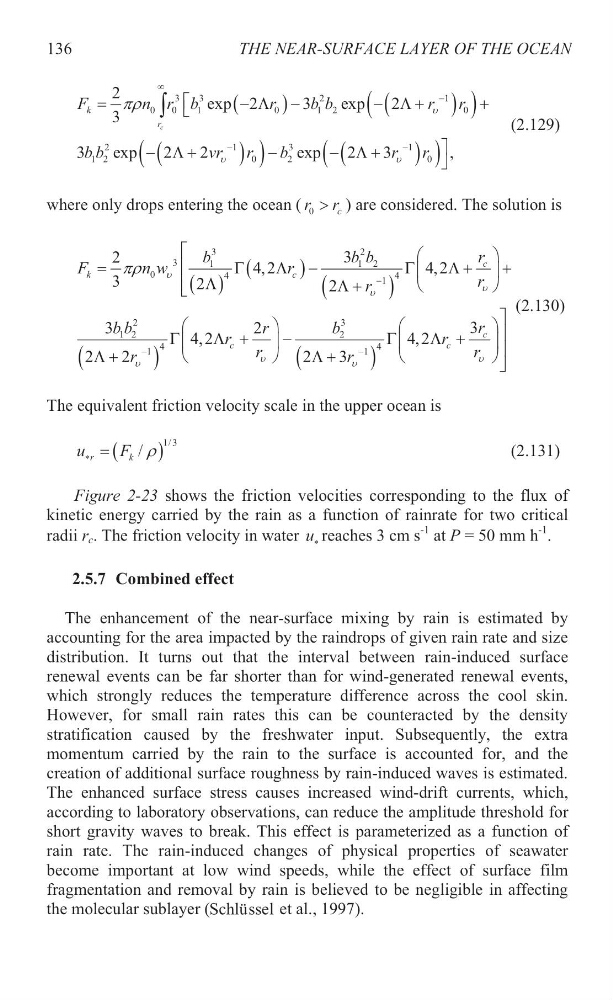
where only drops entering the ocean ( 0 c
r r
! ) are considered. The solution is
3
2
3
1
1 2
0
4
4
1
2
3
1 2
2
4
4
1
1
3
2
4, 2
4, 2
3
2
2
3
3
2
4, 2
4, 2
2
2
2
3
c
k
c
c
c
c
r
b
b b
F
nw
r
r
r
r
b b
b
r
r
r
r
r
r
r
X
X
X
X
X
X
X
SU
ª
§
·
«
*
/
*
/
¨
¸
/
«
©
¹
/
¬
º
§
·
§
· »
*
/
*
/
¨
¸
¨
¸ »
©
¹
©
¹
/
/
¼
(2.130)
The equivalent friction velocity scale in the upper ocean is
1/ 3
/
r
k
u
F U
(2.131)
Figure 2-23 shows the friction velocities corresponding to the flux of
kinetic energy carried by the rain as a function of rainrate for two critical
radii r c . The friction velocity in water u reaches 3 cm s
-1 at P = 50 mm h
-1 .
2.5.7 Combined effect
The enhancement of the near-surface mixing by rain is estimated by
accounting for the area impacted by the raindrops of given rain rate and size
distribution. It turns out that the interval between rain-induced surface
renewal events can be far shorter than for wind-generated renewal events,
which strongly reduces the temperature difference across the cool skin.
However, for small rain rates this can be counteracted by the density
stratification caused by the freshwater input. Subsequently, the extra
momentum carried by the rain to the surface is accounted for, and the
creation of additional surface roughness by rain-induced waves is estimated.
The enhanced surface stress causes increased wind-drift currents, which,
according to laboratory observations, can reduce the amplitude threshold for
short gravity waves to break. This effect is parameterized as a function of
rain rate. The rain-induced changes of physical properties of seawater
become important at low wind speeds, while the effect of surface film
fragmentation and removal by rain is believed to be negligible in affecting
the molecular sublayer (
et al., 1997).
136
Schl ssel
ü
3
3
2
1
0
0
1
0
1 2
0
2
1
3
1
1 2
0
2
0
2
exp 2
3
exp
2
3
3
exp
2
2
exp
2
3
,
c
k
r
F
n r b
r
bb
r r
b b
vr r
b
r r
X
X
X
SU
f
ª
/
/
¬
º
/
/
¼
³
(2.129)
where only drops entering the ocean ( 0 c
r r
! ) are considered. The solution is
3
2
3
1
1 2
0
4
4
1
2
3
1 2
2
4
4
1
1
3
2
4, 2
4, 2
3
2
2
3
3
2
4, 2
4, 2
2
2
2
3
c
k
c
c
c
c
r
b
b b
F
nw
r
r
r
r
b b
b
r
r
r
r
r
r
r
X
X
X
X
X
X
X
SU
ª
§
·
«
*
/
*
/
¨
¸
/
«
©
¹
/
¬
º
§
·
§
· »
*
/
*
/
¨
¸
¨
¸ »
©
¹
©
¹
/
/
¼
(2.130)
The equivalent friction velocity scale in the upper ocean is
1/ 3
/
r
k
u
F U
(2.131)
Figure 2-23 shows the friction velocities corresponding to the flux of
kinetic energy carried by the rain as a function of rainrate for two critical
radii r c . The friction velocity in water u reaches 3 cm s
-1 at P = 50 mm h
-1 .
2.5.7 Combined effect
The enhancement of the near-surface mixing by rain is estimated by
accounting for the area impacted by the raindrops of given rain rate and size
distribution. It turns out that the interval between rain-induced surface
renewal events can be far shorter than for wind-generated renewal events,
which strongly reduces the temperature difference across the cool skin.
However, for small rain rates this can be counteracted by the density
stratification caused by the freshwater input. Subsequently, the extra
momentum carried by the rain to the surface is accounted for, and the
creation of additional surface roughness by rain-induced waves is estimated.
The enhanced surface stress causes increased wind-drift currents, which,
according to laboratory observations, can reduce the amplitude threshold for
short gravity waves to break. This effect is parameterized as a function of
rain rate. The rain-induced changes of physical properties of seawater
become important at low wind speeds, while the effect of surface film
fragmentation and removal by rain is believed to be negligible in affecting
the molecular sublayer (
et al., 1997).
136
Schl ssel
ü