

Chapter 2: SEA SURFACE MICROLAYER
The analysis of Figure 2-21 also suggests that the contribution of the
volume freshwater flux into the diffusion molecular sublayer (freshwater
skin) is relatively small compared to that of the surface freshwater flux. The
contribution of the volume source into the freshwater skin is negligible in
most cases.
2.5.5 Rain effects on sea surface roughness
Disruptions of the sea surface produced by rain increase the sea surface
roughness. The Rayleigh-jet columns, together with the raindrops on their
tops and the wavelets radiated from the drop impact zones, are roughness
elements that can increase the surface roughness beyond the wind-induced
roughness. The roughness elements produced by the rain do not propagate as
the wind-induced waves do and therefore resemble fixed obstacles such as
roughness elements on land surfaces.
The molecular sublayers of the surface ocean are mainly controlled by
the tangential shear stress. The flow above the surface is aerodynamically
smooth as long as the height of the roughness elements is smaller than
5 /u
Q , where Q is the kinematic viscosity and u is the friction velocity of
the air (Schlichting, 1979). In the aerodynamically smooth flow the
momentum is passed to the ocean by skin friction only. If the roughness
elements are greater than 70 / u
Q , the flow is aerodynamically rough, and
the momentum transfer is affected by the form drag. Figure 2-22a shows the
smooth and rough regimes as a function of friction velocity. There is a
transition zone between these regimes, where both skin and form drag are
important. The Rayleigh-jet that extends a centimeter or more into the air
(Siscoe and Levin, 1971) therefore affects form drag, except for situations
with very low friction velocities when the thickness of the viscous sublayer
increases without bound.
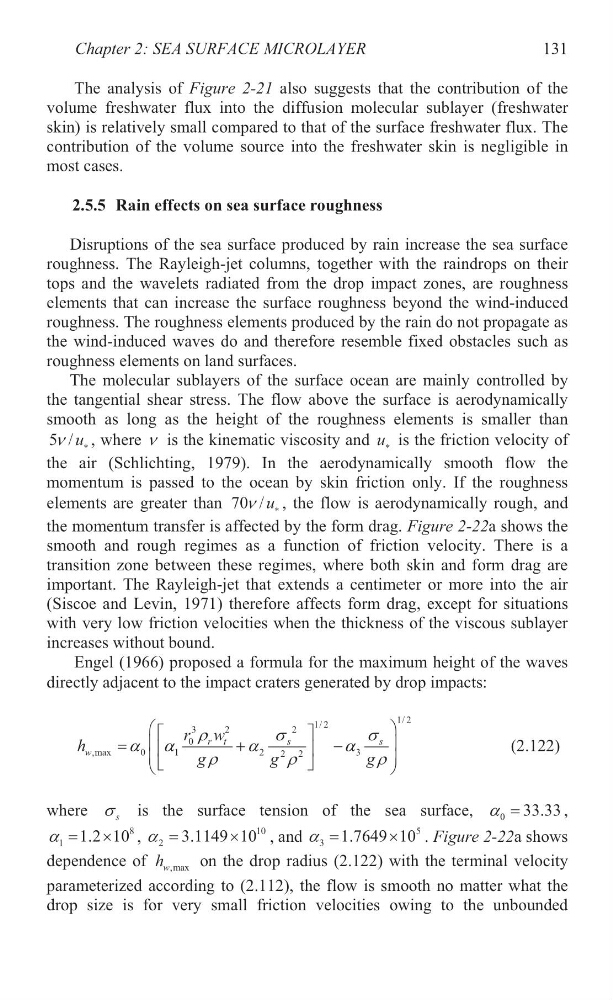
Engel (1966) proposed a formula for the maximum height of the waves
directly adjacent to the impact craters generated by drop impacts:
1/ 2
1/ 2
3
2
2
0
,max
0
1
2
3
2 2
r t
s
s
w
r w
h
g
g
g
U
V
V
D D
D
D
U
U
U
§
·
ª
º
¨
¸
«
»
¨
¸
¬
¼
©
¹
(2.122)
where
s
V is the surface tension of the sea surface,
0
33.33
D
,
8
1
1.2 10
D
u
,
10
2
3.1149 10
D
u
, and
5
3
1.7649 10
D
u
. Figure 2-22a shows
dependence of ,max
w
h
on the drop radius (2.122) with the terminal velocity
parameterized according to (2.112), the flow is smooth no matter what the
drop size is for very small friction velocities owing to the unbounded
131
The analysis of Figure 2-21 also suggests that the contribution of the
volume freshwater flux into the diffusion molecular sublayer (freshwater
skin) is relatively small compared to that of the surface freshwater flux. The
contribution of the volume source into the freshwater skin is negligible in
most cases.
2.5.5 Rain effects on sea surface roughness
Disruptions of the sea surface produced by rain increase the sea surface
roughness. The Rayleigh-jet columns, together with the raindrops on their
tops and the wavelets radiated from the drop impact zones, are roughness
elements that can increase the surface roughness beyond the wind-induced
roughness. The roughness elements produced by the rain do not propagate as
the wind-induced waves do and therefore resemble fixed obstacles such as
roughness elements on land surfaces.
The molecular sublayers of the surface ocean are mainly controlled by
the tangential shear stress. The flow above the surface is aerodynamically
smooth as long as the height of the roughness elements is smaller than
5 /u
Q , where Q is the kinematic viscosity and u is the friction velocity of
the air (Schlichting, 1979). In the aerodynamically smooth flow the
momentum is passed to the ocean by skin friction only. If the roughness
elements are greater than 70 / u
Q , the flow is aerodynamically rough, and
the momentum transfer is affected by the form drag. Figure 2-22a shows the
smooth and rough regimes as a function of friction velocity. There is a
transition zone between these regimes, where both skin and form drag are
important. The Rayleigh-jet that extends a centimeter or more into the air
(Siscoe and Levin, 1971) therefore affects form drag, except for situations
with very low friction velocities when the thickness of the viscous sublayer
increases without bound.
Engel (1966) proposed a formula for the maximum height of the waves
directly adjacent to the impact craters generated by drop impacts:
1/ 2
1/ 2
3
2
2
0
,max
0
1
2
3
2 2
r t
s
s
w
r w
h
g
g
g
U
V
V
D D
D
D
U
U
U
§
·
ª
º
¨
¸
«
»
¨
¸
¬
¼
©
¹
(2.122)
where
s
V is the surface tension of the sea surface,
0
33.33
D
,
8
1
1.2 10
D
u
,
10
2
3.1149 10
D
u
, and
5
3
1.7649 10
D
u
. Figure 2-22a shows
dependence of ,max
w
h
on the drop radius (2.122) with the terminal velocity
parameterized according to (2.112), the flow is smooth no matter what the
drop size is for very small friction velocities owing to the unbounded
131