

THE NEAR-SURFACE LAYER OF THE OCEAN
very small values while in light rain the drop of surface salinity remains
relatively small so that the solution for the nonlinear case may not be
required in most cases.
2.5.3 Surface renewals due to rain mixing
Small raindrops do not produce an impact crater on the sea surface, while
large drops do, disturbing the aqueous molecular sublayer. The area covered
by each impact crater is subject to a surface renewal event since the impact
crater is deeper than the conductive layer and represents a “catastrophic”
event for the molecular sublayer (Engel, 1966). (Note that spray droplets
from breaking waves also have to be considered in this regard.)
Rodriguez and Mesler (1988) studied drops falling from low heights into
pools of liquid; they found that the impact crater radius r k exceeds about two
to three times the corresponding drop radius r 0 . Drops falling from higher
altitudes generate even bigger craters, with radii up to
0
4
k
r
r
|
(Prosperetti
and Oguz, 1993). Dimensional analysis conducted by these authors suggests
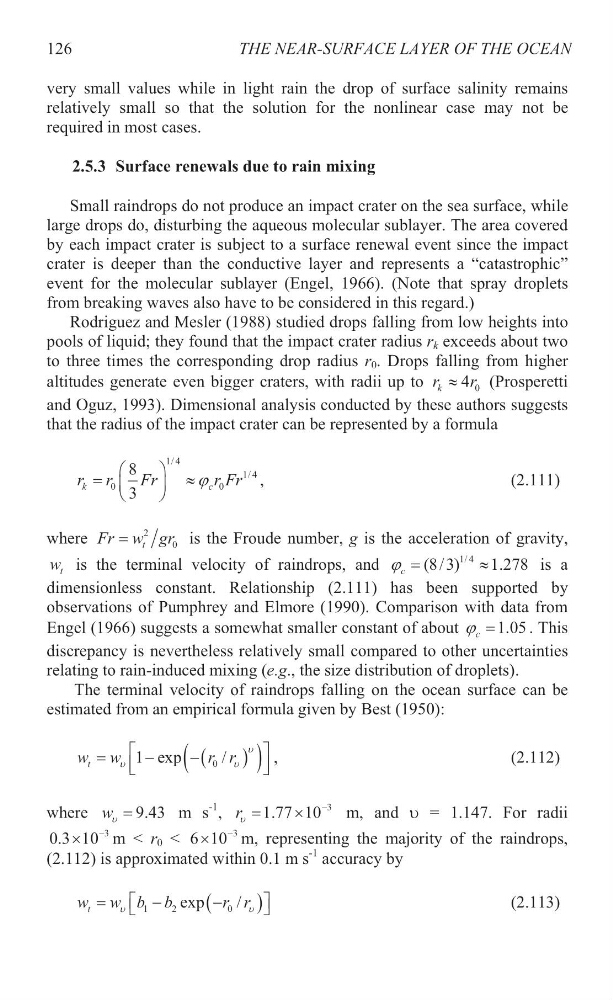
that the radius of the impact crater can be represented by a formula
1/ 4
1/ 4
0
0
8
3
k
c
r r
Fr
r Fr
M
§
· |
¨
¸
©
¹
,
(2.111)
where
2
0
t
Fr w gr is the Froude number, g is the acceleration of gravity,
t
w is the terminal velocity of raindrops, and
1/ 4
(8 / 3)
1.278
c
M
|
is a
dimensionless constant. Relationship (2.111) has been supported by
observations of Pumphrey and Elmore (1990). Comparison with data from
Engel (1966) suggests a somewhat smaller constant of about
1.05
c
M
. This
discrepancy is nevertheless relatively small compared to other uncertainties
relating to rain-induced mixing (e.g., the size distribution of droplets).
The terminal velocity of raindrops falling on the ocean surface can be
estimated from an empirical formula given by Best (1950):
0
1 exp
/
t
w w
r r
X
X
X
ª
º
«
»
¬
¼
,
(2.112)
where
9.43
w X
m s
-1 ,
3
1.77 10
r X
u
m, and X = 1.147. For radii
3
0.3 10
u
m < r 0 <
3
6 10
u
m, representing the majority of the raindrops,
(2.112) is approximated within 0.1 m s
-1 accuracy by
1
2
0
exp
/
t
w w b b
r r
X
X
ª
º
¬
¼
(2.113)
126
very small values while in light rain the drop of surface salinity remains
relatively small so that the solution for the nonlinear case may not be
required in most cases.
2.5.3 Surface renewals due to rain mixing
Small raindrops do not produce an impact crater on the sea surface, while
large drops do, disturbing the aqueous molecular sublayer. The area covered
by each impact crater is subject to a surface renewal event since the impact
crater is deeper than the conductive layer and represents a “catastrophic”
event for the molecular sublayer (Engel, 1966). (Note that spray droplets
from breaking waves also have to be considered in this regard.)
Rodriguez and Mesler (1988) studied drops falling from low heights into
pools of liquid; they found that the impact crater radius r k exceeds about two
to three times the corresponding drop radius r 0 . Drops falling from higher
altitudes generate even bigger craters, with radii up to
0
4
k
r
r
|
(Prosperetti
and Oguz, 1993). Dimensional analysis conducted by these authors suggests
that the radius of the impact crater can be represented by a formula
1/ 4
1/ 4
0
0
8
3
k
c
r r
Fr
r Fr
M
§
· |
¨
¸
©
¹
,
(2.111)
where
2
0
t
Fr w gr is the Froude number, g is the acceleration of gravity,
t
w is the terminal velocity of raindrops, and
1/ 4
(8 / 3)
1.278
c
M
|
is a
dimensionless constant. Relationship (2.111) has been supported by
observations of Pumphrey and Elmore (1990). Comparison with data from
Engel (1966) suggests a somewhat smaller constant of about
1.05
c
M
. This
discrepancy is nevertheless relatively small compared to other uncertainties
relating to rain-induced mixing (e.g., the size distribution of droplets).
The terminal velocity of raindrops falling on the ocean surface can be
estimated from an empirical formula given by Best (1950):
0
1 exp
/
t
w w
r r
X
X
X
ª
º
«
»
¬
¼
,
(2.112)
where
9.43
w X
m s
-1 ,
3
1.77 10
r X
u
m, and X = 1.147. For radii
3
0.3 10
u
m < r 0 <
3
6 10
u
m, representing the majority of the raindrops,
(2.112) is approximated within 0.1 m s
-1 accuracy by
1
2
0
exp
/
t
w w b b
r r
X
X
ª
º
¬
¼
(2.113)
126