

Chapter 2: SEA SURFACE MICROLAYER
very close to the interface. The combined effect,
T z
'
, shows a maximum
in a small range of depths between 50 and 150 Pm. Above this maximum,
surface cooling prevails at high wind speeds, while for the values of energy
fluxes chosen here, the net effect at low wind speed is a surface warming.
Calculations with different water types from Table 1.2 do not show the
temperature differences larger than 0.02
o C. The absorption and scattering of
light in near infrared band mainly determine the transmission of solar
radiation within the upper few millimeters of the ocean. Dependence on the
water type is small for this wavelength range.
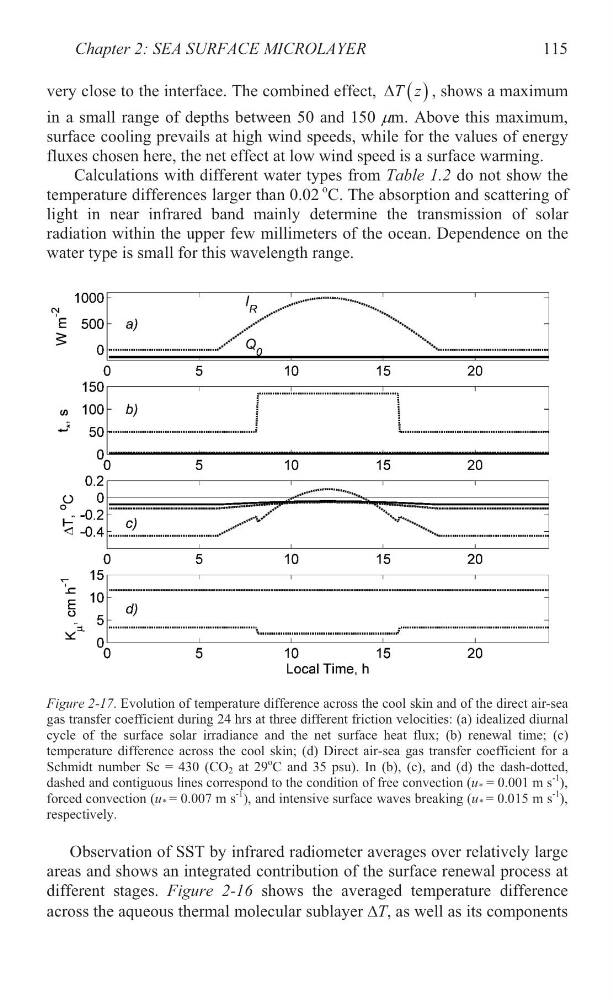
Figure 2-17. Evolution of temperature difference across the cool skin and of the direct air-sea
gas transfer coefficient during 24 hrs at three different friction velocities: (a) idealized diurnal
cycle of the surface solar irradiance and the net surface heat flux; (b) renewal time; (c)
temperature difference across the cool skin; (d) Direct air-sea gas transfer coefficient for a
Schmidt number Sc = 430 (CO 2 at 29
o C and 35 psu). In (b), (c), and (d) the dash-dotted,
dashed and contiguous lines correspond to the condition of free convection (u * = 0.001 m s
-1 ),
forced convection (u * = 0.007 m s
-1 ), and intensive surface waves breaking (u * = 0.015 m s
-1 ),
respectively.
Observation of SST by infrared radiometer averages over relatively large
areas and shows an integrated contribution of the surface renewal process at
different stages. Figure 2-16 shows the averaged temperature difference
across the aqueous thermal molecular sublayer 'T, as well as its components
115
very close to the interface. The combined effect,
T z
'
, shows a maximum
in a small range of depths between 50 and 150 Pm. Above this maximum,
surface cooling prevails at high wind speeds, while for the values of energy
fluxes chosen here, the net effect at low wind speed is a surface warming.
Calculations with different water types from Table 1.2 do not show the
temperature differences larger than 0.02
o C. The absorption and scattering of
light in near infrared band mainly determine the transmission of solar
radiation within the upper few millimeters of the ocean. Dependence on the
water type is small for this wavelength range.
Figure 2-17. Evolution of temperature difference across the cool skin and of the direct air-sea
gas transfer coefficient during 24 hrs at three different friction velocities: (a) idealized diurnal
cycle of the surface solar irradiance and the net surface heat flux; (b) renewal time; (c)
temperature difference across the cool skin; (d) Direct air-sea gas transfer coefficient for a
Schmidt number Sc = 430 (CO 2 at 29
o C and 35 psu). In (b), (c), and (d) the dash-dotted,
dashed and contiguous lines correspond to the condition of free convection (u * = 0.001 m s
-1 ),
forced convection (u * = 0.007 m s
-1 ), and intensive surface waves breaking (u * = 0.015 m s
-1 ),
respectively.
Observation of SST by infrared radiometer averages over relatively large
areas and shows an integrated contribution of the surface renewal process at
different stages. Figure 2-16 shows the averaged temperature difference
across the aqueous thermal molecular sublayer 'T, as well as its components
115