

Chapter 2: SEA SURFACE MICROLAYER
where
0
0 /
/
p
T
E
L
p
q Q c
Q Q I
c
U
U
, and w
T is the bulk water
temperature. E
Q and L
I do not depend strongly on the presence of the
temperature difference across the cool skin (Paulson and Simpson, 1981).
The sensible heat flux Q T can appreciably depend on the temperature
difference across the cool skin; the magnitude of Q T is, however, usually
much less that that of Q E or I L . The total heat flux Q 0 is thereby assumed to
be constant during the time period between successive surface renewals.
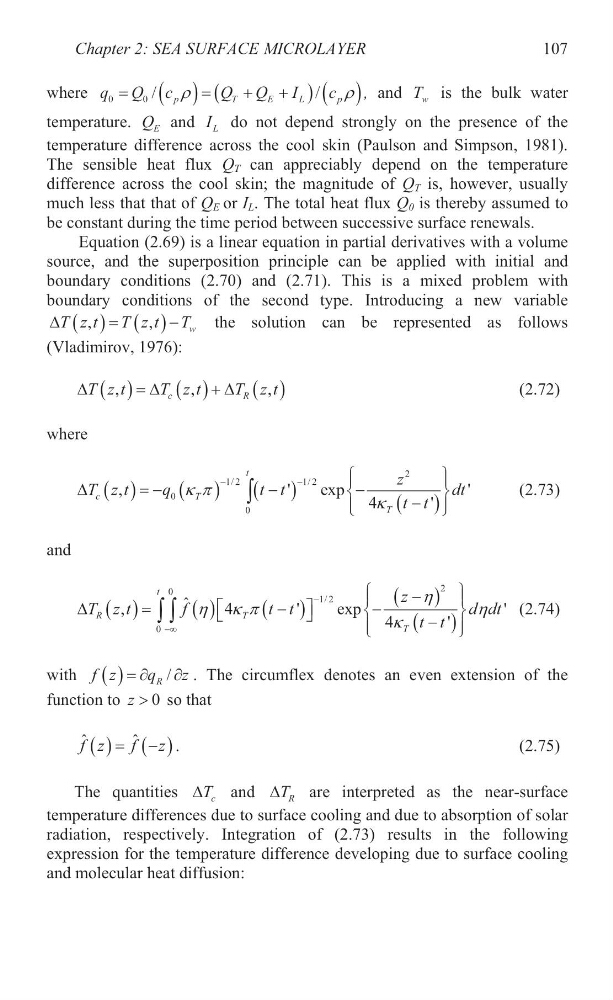
Equation (2.69) is a linear equation in partial derivatives with a volume
source, and the superposition principle can be applied with initial and
boundary conditions (2.70) and (2.71). This is a mixed problem with
boundary conditions of the second type. Introducing a new variable
,
,
w
T z t T z t T
'
the solution can be represented as follows
(Vladimirov, 1976):
,
,
,
c
R
T z t
T z t
T z t
'
'
'
(2.72)
where
2
1/ 2
1/ 2
0
0
,
'
e x p
'
4
'
t
c
T
T
z
T z t
q
t t
dt
t t
N S
N
½
°
°
'
®
¾
°
°
¯
¿
³
(2.73)
and
2
0
1/ 2
0
ˆ
,
4
'
e x p
'
4
'
t
R
T
T
z
T z t
f
t t
d dt
t t
K
K N S
K
N
f
½
°
°
ª
º
'
®
¾
¬
¼
°
°
¯
¿
³ ³
(2.74)
with
/
R
f z
q
z
w
w . The circumflex denotes an even extension of the
function to
0
z ! so that
ˆ
ˆ
f z
f z
.
(2.75)
The quantities
c
T
'
and
R
T
'
are interpreted as the near-surface
temperature differences due to surface cooling and due to absorption of solar
radiation, respectively. Integration of (2.73) results in the following
expression for the temperature difference developing due to surface cooling
and molecular heat diffusion:
107
where
0
0 /
/
p
T
E
L
p
q Q c
Q Q I
c
U
U
, and w
T is the bulk water
temperature. E
Q and L
I do not depend strongly on the presence of the
temperature difference across the cool skin (Paulson and Simpson, 1981).
The sensible heat flux Q T can appreciably depend on the temperature
difference across the cool skin; the magnitude of Q T is, however, usually
much less that that of Q E or I L . The total heat flux Q 0 is thereby assumed to
be constant during the time period between successive surface renewals.
Equation (2.69) is a linear equation in partial derivatives with a volume
source, and the superposition principle can be applied with initial and
boundary conditions (2.70) and (2.71). This is a mixed problem with
boundary conditions of the second type. Introducing a new variable
,
,
w
T z t T z t T
'
the solution can be represented as follows
(Vladimirov, 1976):
,
,
,
c
R
T z t
T z t
T z t
'
'
'
(2.72)
where
2
1/ 2
1/ 2
0
0
,
'
e x p
'
4
'
t
c
T
T
z
T z t
q
t t
dt
t t
N S
N
½
°
°
'
®
¾
°
°
¯
¿
³
(2.73)
and
2
0
1/ 2
0
ˆ
,
4
'
e x p
'
4
'
t
R
T
T
z
T z t
f
t t
d dt
t t
K
K N S
K
N
f
½
°
°
ª
º
'
®
¾
¬
¼
°
°
¯
¿
³ ³
(2.74)
with
/
R
f z
q
z
w
w . The circumflex denotes an even extension of the
function to
0
z ! so that
ˆ
ˆ
f z
f z
.
(2.75)
The quantities
c
T
'
and
R
T
'
are interpreted as the near-surface
temperature differences due to surface cooling and due to absorption of solar
radiation, respectively. Integration of (2.73) results in the following
expression for the temperature difference developing due to surface cooling
and molecular heat diffusion:
107