

Chapter 2: SEA SURFACE MICROLAYER
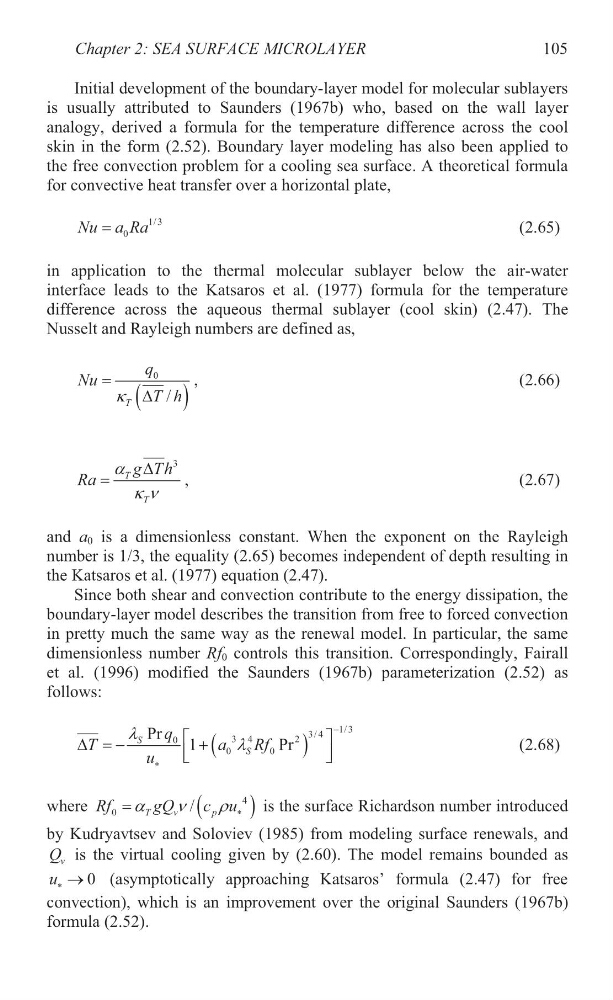
Initial development of the boundary-layer model for molecular sublayers
is usually attributed to Saunders (1967b) who, based on the wall layer
analogy, derived a formula for the temperature difference across the cool
skin in the form (2.52). Boundary layer modeling has also been applied to
the free convection problem for a cooling sea surface. A theoretical formula
for convective heat transfer over a horizontal plate,
1/ 3
0
Nu a Ra
(2.65)
in application to the thermal molecular sublayer below the air-water
interface leads to the Katsaros et al. (1977) formula for the temperature
difference across the aqueous thermal sublayer (cool skin) (2.47). The
0
/
T
q
Nu
T h
N '
,
(2.66)
3
T
T
g Th
Ra
D
N Q
'
,
(2.67)
and a 0 is a dimensionless constant. When the exponent on the Rayleigh
number is 1/3, the equality (2.65) becomes independent of depth resulting in
the Katsaros et al. (1977) equation (2.47).
Since both shear and convection contribute to the energy dissipation, the
boundary-layer model describes the transition from free to forced convection
in pretty much the same way as the renewal model. In particular, the same
dimensionless number Rf 0 controls this transition. Correspondingly, Fairall
et al. (1996) modified the Saunders (1967b) parameterization (2.52) as
follows:
1/ 3
3/ 4
3 4
2
0
0
0
Pr
1
P r
S
S
q
T
a
R f
u
O
O
ª
º
'
«
»
¬
¼
(2.68)
where
4
0
/
T
v
p
Rf
gQ
c u
D
Q
U is the surface Richardson number introduced
by Kudryavtsev and Soloviev (1985) from modeling surface renewals, and
v
Q is the virtual cooling given by (2.60). The model remains bounded as
0
u o
(asymptotically approaching Katsaros’ formula (2.47) for free
convection), which is an improvement over the original Saunders (1967b)
formula (2.52).
105
Nusselt and Rayleigh numbers are defined as,
Initial development of the boundary-layer model for molecular sublayers
is usually attributed to Saunders (1967b) who, based on the wall layer
analogy, derived a formula for the temperature difference across the cool
skin in the form (2.52). Boundary layer modeling has also been applied to
the free convection problem for a cooling sea surface. A theoretical formula
for convective heat transfer over a horizontal plate,
1/ 3
0
Nu a Ra
(2.65)
in application to the thermal molecular sublayer below the air-water
interface leads to the Katsaros et al. (1977) formula for the temperature
difference across the aqueous thermal sublayer (cool skin) (2.47). The
0
/
T
q
Nu
T h
N '
,
(2.66)
3
T
T
g Th
Ra
D
N Q
'
,
(2.67)
and a 0 is a dimensionless constant. When the exponent on the Rayleigh
number is 1/3, the equality (2.65) becomes independent of depth resulting in
the Katsaros et al. (1977) equation (2.47).
Since both shear and convection contribute to the energy dissipation, the
boundary-layer model describes the transition from free to forced convection
in pretty much the same way as the renewal model. In particular, the same
dimensionless number Rf 0 controls this transition. Correspondingly, Fairall
et al. (1996) modified the Saunders (1967b) parameterization (2.52) as
follows:
1/ 3
3/ 4
3 4
2
0
0
0
Pr
1
P r
S
S
q
T
a
R f
u
O
O
ª
º
'
«
»
¬
¼
(2.68)
where
4
0
/
T
v
p
Rf
gQ
c u
D
Q
U is the surface Richardson number introduced
by Kudryavtsev and Soloviev (1985) from modeling surface renewals, and
v
Q is the virtual cooling given by (2.60). The model remains bounded as
0
u o
(asymptotically approaching Katsaros’ formula (2.47) for free
convection), which is an improvement over the original Saunders (1967b)
formula (2.52).
105
Nusselt and Rayleigh numbers are defined as,