

Chapter 2: SEA SURFACE MICROLAYER
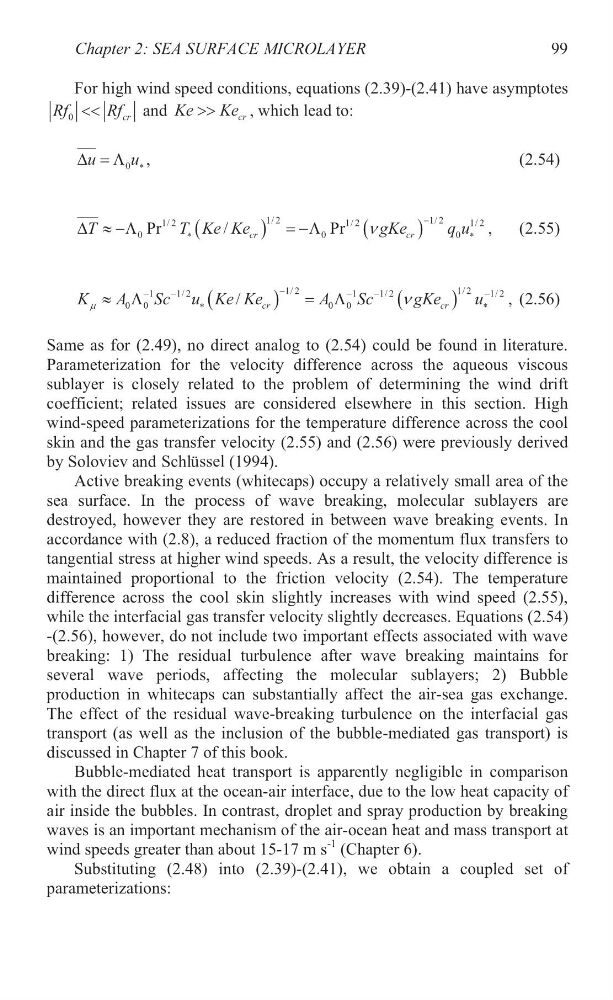
For high wind speed conditions, equations (2.39)-(2.41) have asymptotes
0
cr
Rf
Rf
and
cr
Ke
Ke
!!
, which lead to:
0
u
u
'
/ ,
(2.54)
1/ 2
1/ 2
1/ 2
1/ 2
1/ 2
0
0
0
Pr
/
Pr
cr
cr
T
T Ke Ke
gKe
q u
Q
' | /
/
,
(2.55)
1/ 2
1/ 2
1
1 /2
1
1 /2
1 /2
0 0
0 0
/ cr
cr
K
A
Sc u Ke Ke
A
Sc
gKe
u
P
Q
| /
/
, (2.56)
Same as for (2.49), no direct analog to (2.54) could be found in literature.
Parameterization for the velocity difference across the aqueous viscous
sublayer is closely related to the problem of determining the wind drift
coefficient; related issues are considered elsewhere in this section. High
wind-speed parameterizations for the temperature difference across the cool
skin and the gas transfer velocity (2.55) and (2.56) were previously derived
by Soloviev and
(1994).
Active breaking events (whitecaps) occupy a relatively small area of the
sea surface. In the process of wave breaking, molecular sublayers are
destroyed, however they are restored in between wave breaking events. In
accordance with (2.8), a reduced fraction of the momentum flux transfers to
tangential stress at higher wind speeds. As a result, the velocity difference is
maintained proportional to the friction velocity (2.54). The temperature
difference across the cool skin slightly increases with wind speed (2.55),
while the interfacial gas transfer velocity slightly decreases. Equations (2.54)
-(2.56), however, do not include two important effects associated with wave
breaking: 1) The residual turbulence after wave breaking maintains for
several wave periods, affecting the molecular sublayers; 2) Bubble
production in whitecaps can substantially affect the air-sea gas exchange.
The effect of the residual wave-breaking turbulence on the interfacial gas
transport (as well as the inclusion of the bubble-mediated gas transport) is
discussed in Chapter 7 of this book.
Bubble-mediated heat transport is apparently negligible in comparison
with the direct flux at the ocean-air interface, due to the low heat capacity of
air inside the bubbles. In contrast, droplet and spray production by breaking
waves is an important mechanism of the air-ocean heat and mass transport at
wind speeds greater than about 15-17 m s
-1 (Chapter 6).
Substituting (2.48) into (2.39)-(2.41), we obtain a coupled set of
parameterizations:
99
Schl ssel
ü
For high wind speed conditions, equations (2.39)-(2.41) have asymptotes
0
cr
Rf
Rf
and
cr
Ke
Ke
!!
, which lead to:
0
u
u
'
/ ,
(2.54)
1/ 2
1/ 2
1/ 2
1/ 2
1/ 2
0
0
0
Pr
/
Pr
cr
cr
T
T Ke Ke
gKe
q u
Q
' | /
/
,
(2.55)
1/ 2
1/ 2
1
1 /2
1
1 /2
1 /2
0 0
0 0
/ cr
cr
K
A
Sc u Ke Ke
A
Sc
gKe
u
P
Q
| /
/
, (2.56)
Same as for (2.49), no direct analog to (2.54) could be found in literature.
Parameterization for the velocity difference across the aqueous viscous
sublayer is closely related to the problem of determining the wind drift
coefficient; related issues are considered elsewhere in this section. High
wind-speed parameterizations for the temperature difference across the cool
skin and the gas transfer velocity (2.55) and (2.56) were previously derived
by Soloviev and
(1994).
Active breaking events (whitecaps) occupy a relatively small area of the
sea surface. In the process of wave breaking, molecular sublayers are
destroyed, however they are restored in between wave breaking events. In
accordance with (2.8), a reduced fraction of the momentum flux transfers to
tangential stress at higher wind speeds. As a result, the velocity difference is
maintained proportional to the friction velocity (2.54). The temperature
difference across the cool skin slightly increases with wind speed (2.55),
while the interfacial gas transfer velocity slightly decreases. Equations (2.54)
-(2.56), however, do not include two important effects associated with wave
breaking: 1) The residual turbulence after wave breaking maintains for
several wave periods, affecting the molecular sublayers; 2) Bubble
production in whitecaps can substantially affect the air-sea gas exchange.
The effect of the residual wave-breaking turbulence on the interfacial gas
transport (as well as the inclusion of the bubble-mediated gas transport) is
discussed in Chapter 7 of this book.
Bubble-mediated heat transport is apparently negligible in comparison
with the direct flux at the ocean-air interface, due to the low heat capacity of
air inside the bubbles. In contrast, droplet and spray production by breaking
waves is an important mechanism of the air-ocean heat and mass transport at
wind speeds greater than about 15-17 m s
-1 (Chapter 6).
Substituting (2.48) into (2.39)-(2.41), we obtain a coupled set of
parameterizations:
99
Schl ssel
ü