

Chapter 2: SEA SURFACE MICROLAYER
The dynamic mechanism relates to the viscoelastic properties of surface
films (Frew, 1997). Non-zero viscoelasticity modifies the surface boundary
conditions, which affects hydrodynamic processes at the air-sea interface.
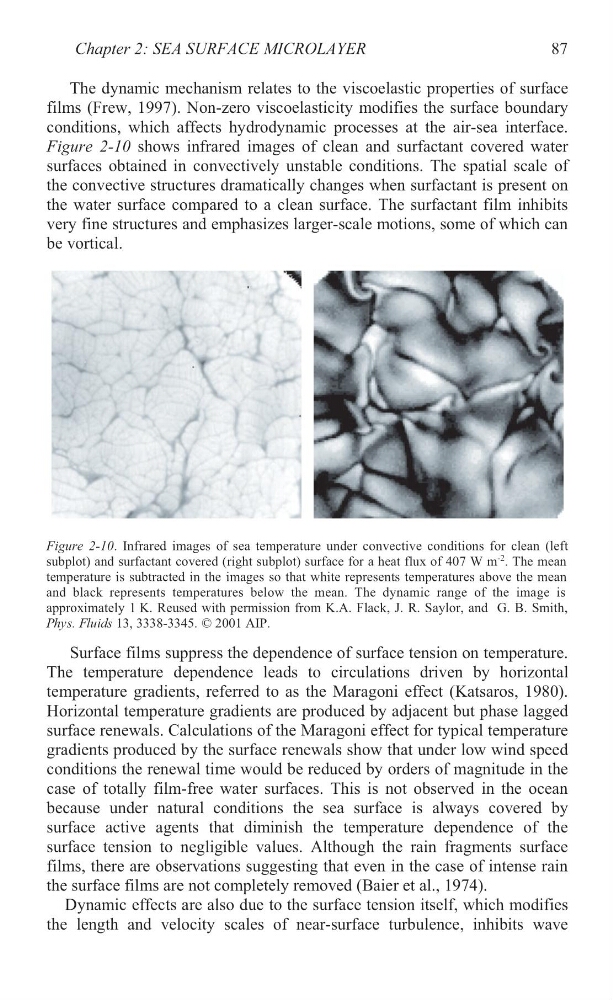
Figure 2-10 shows infrared images of clean and surfactant covered water
surfaces obtained in convectively unstable conditions. The spatial scale of
the convective structures dramatically changes when surfactant is present on
the water surface compared to a clean surface. The surfactant film inhibits
very fine structures and emphasizes larger-scale motions, some of which can
be vortical.
Surface films suppress the dependence of surface tension on temperature.
The temperature dependence leads to circulations driven by horizontal
temperature gradients, referred to as the Maragoni effect (Katsaros, 1980).
Horizontal temperature gradients are produced by adjacent but phase lagged
surface renewals. Calculations of the Maragoni effect for typical temperature
gradients produced by the surface renewals show that under low wind speed
conditions the renewal time would be reduced by orders of magnitude in the
case of totally film-free water surfaces. This is not observed in the ocean
because under natural conditions the sea surface is always covered by
surface active agents that diminish the temperature dependence of the
surface tension to negligible values. Although the rain fragments surface
films, there are observations suggesting that even in the case of intense rain
the surface films are not completely removed (Baier et al., 1974).
Dynamic effects are also due to the surface tension itself, which modifies
the length and velocity scales of near-surface turbulence, inhibits wave
87
Figure 2-10. Infrared images of sea temperature under convective conditions for clean (left
subplot) and surfactant covered (right subplot) surface for a heat flux of 407 W m
-2 . The mean
temperature is subtracted in the images so that white represents temperatures above the mean
and black represents temperatures below the mean. The dynamic range of the image is
approximately 1 K. Reused with permission from K.A. Flack, J. R. Saylor, and G. B. Smith,
Phys. Fluids 13, 3338-3345. © 2001 AIP.
The dynamic mechanism relates to the viscoelastic properties of surface
films (Frew, 1997). Non-zero viscoelasticity modifies the surface boundary
conditions, which affects hydrodynamic processes at the air-sea interface.
Figure 2-10 shows infrared images of clean and surfactant covered water
surfaces obtained in convectively unstable conditions. The spatial scale of
the convective structures dramatically changes when surfactant is present on
the water surface compared to a clean surface. The surfactant film inhibits
very fine structures and emphasizes larger-scale motions, some of which can
be vortical.
Surface films suppress the dependence of surface tension on temperature.
The temperature dependence leads to circulations driven by horizontal
temperature gradients, referred to as the Maragoni effect (Katsaros, 1980).
Horizontal temperature gradients are produced by adjacent but phase lagged
surface renewals. Calculations of the Maragoni effect for typical temperature
gradients produced by the surface renewals show that under low wind speed
conditions the renewal time would be reduced by orders of magnitude in the
case of totally film-free water surfaces. This is not observed in the ocean
because under natural conditions the sea surface is always covered by
surface active agents that diminish the temperature dependence of the
surface tension to negligible values. Although the rain fragments surface
films, there are observations suggesting that even in the case of intense rain
the surface films are not completely removed (Baier et al., 1974).
Dynamic effects are also due to the surface tension itself, which modifies
the length and velocity scales of near-surface turbulence, inhibits wave
87
Figure 2-10. Infrared images of sea temperature under convective conditions for clean (left
subplot) and surfactant covered (right subplot) surface for a heat flux of 407 W m
-2 . The mean
temperature is subtracted in the images so that white represents temperatures above the mean
and black represents temperatures below the mean. The dynamic range of the image is
approximately 1 K. Reused with permission from K.A. Flack, J. R. Saylor, and G. B. Smith,
Phys. Fluids 13, 3338-3345. © 2001 AIP.