

86
DYNAMICAL OCEANOGRAPHY
4.5. Exercises on chapter 4
(4.1) Helmholtz theorem
Let C 1 and C 2 be two curves on a closed vortex tube, S i be the surfaces enclosed by the C i , S be the total surface of the tube and V be the total volume
enclosed by S (see Fig. 4.1). From the identity ∇·ω =0, show that
Γ 1 =
C1
v · ds =
C2
v · ds =Γ 2
(4.2) Tornado
A tornado consists of a thin vortex tube. Assume that the vorticity is constant
over the cross section of the tube.
a. Show that locally the vorticity decreases when the thickness of the vortex
tube increases.
b. About 10 m from the center of a tornado one measures wind speeds of 200
km/hr. Determine the pressure variations when the tornado passes by.
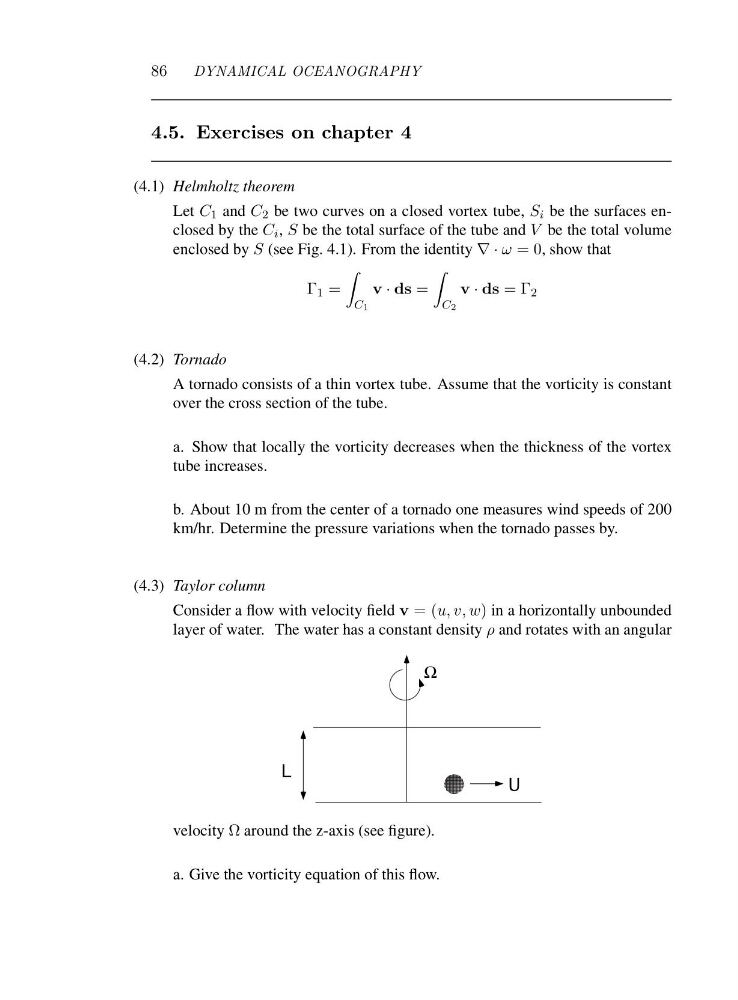
(4.3) Taylor column
Consider a flow with velocity field v =(u, v, w) in a horizontally unbounded
layer of water. The water has a constant density ρ and rotates with an angular
U
L
Ω
velocity Ω around the z-axis (see figure).
a. Give the vorticity equation of this flow.
DYNAMICAL OCEANOGRAPHY
4.5. Exercises on chapter 4
(4.1) Helmholtz theorem
Let C 1 and C 2 be two curves on a closed vortex tube, S i be the surfaces enclosed by the C i , S be the total surface of the tube and V be the total volume
enclosed by S (see Fig. 4.1). From the identity ∇·ω =0, show that
Γ 1 =
C1
v · ds =
C2
v · ds =Γ 2
(4.2) Tornado
A tornado consists of a thin vortex tube. Assume that the vorticity is constant
over the cross section of the tube.
a. Show that locally the vorticity decreases when the thickness of the vortex
tube increases.
b. About 10 m from the center of a tornado one measures wind speeds of 200
km/hr. Determine the pressure variations when the tornado passes by.
(4.3) Taylor column
Consider a flow with velocity field v =(u, v, w) in a horizontally unbounded
layer of water. The water has a constant density ρ and rotates with an angular
U
L
Ω
velocity Ω around the z-axis (see figure).
a. Give the vorticity equation of this flow.