

Mathematical description
61
3.2.1. Equations of motion
The equations of motion for a flow of fluid with density ρ and velocity v (for
an observer moving with the rotating sphere) are
ρ
Dv
dt
+2Ω ∧ v
= −∇p + ρ∇Φ+ρF I ,
(3.29a)
Dρ
dt
+ ρ∇·v =0 ,
(3.29b)
where I will use D/dt to indicate the material derivative given by D/dt = ∂/∂t+
v ·∇, with t the time coordinate. In the equations above, p is the pressure and Φ
the geopotential (∇Φ=−ge 3 ), with g the gravitational acceleration and e 3 the
unit vector in the radial direction. The vector F I represents the effect of mixing
due to random (turbulent) small-scale motions as formulated in (3.17).
The left hand side of (3.29a) represents the change in momentum of a fluid
parcel. It is caused by velocity changes of the fluid parcel with time (Dv/dt)
consisting of local velocity changes (∂v/∂t) and the changes due to advection of
the fluid parcel (v ·∇v), and effects induced by the frame of reference, taking into
account the Coriolis acceleration. Terms on the right hand side of (3.29a) represent the causes of these changes and are given by pressure forces, shear stresses
and volume forces. Equation (3.29b) is the conservation of mass of a particular
fluid parcel when moving with the flow.
Δθ
Δφ
Ω
V
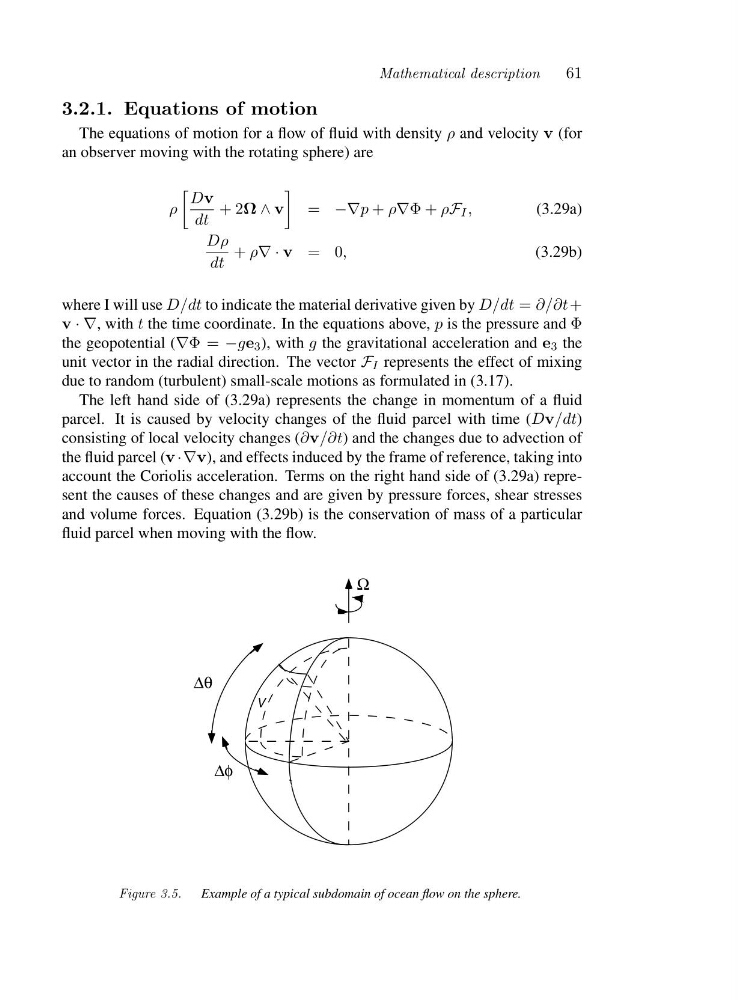
Figure 3.5. Example of a typical subdomain of ocean flow on the sphere.
61
3.2.1. Equations of motion
The equations of motion for a flow of fluid with density ρ and velocity v (for
an observer moving with the rotating sphere) are
ρ
Dv
dt
+2Ω ∧ v
= −∇p + ρ∇Φ+ρF I ,
(3.29a)
Dρ
dt
+ ρ∇·v =0 ,
(3.29b)
where I will use D/dt to indicate the material derivative given by D/dt = ∂/∂t+
v ·∇, with t the time coordinate. In the equations above, p is the pressure and Φ
the geopotential (∇Φ=−ge 3 ), with g the gravitational acceleration and e 3 the
unit vector in the radial direction. The vector F I represents the effect of mixing
due to random (turbulent) small-scale motions as formulated in (3.17).
The left hand side of (3.29a) represents the change in momentum of a fluid
parcel. It is caused by velocity changes of the fluid parcel with time (Dv/dt)
consisting of local velocity changes (∂v/∂t) and the changes due to advection of
the fluid parcel (v ·∇v), and effects induced by the frame of reference, taking into
account the Coriolis acceleration. Terms on the right hand side of (3.29a) represent the causes of these changes and are given by pressure forces, shear stresses
and volume forces. Equation (3.29b) is the conservation of mass of a particular
fluid parcel when moving with the flow.
Δθ
Δφ
Ω
V
Figure 3.5. Example of a typical subdomain of ocean flow on the sphere.