

Antarctic Circumpolar Current
347
Ex. 14.5
The first two terms on the left hand side represent a horizontal flux of momentum through the divergence of the Reynolds’ stress terms associated with the
‘standing eddies’ (the terms with uu, etc.) and with the ‘transient eddies’ (the
terms with ˜
u˜ u, etc.). Vertical transport of horizontal momentum is represented by
the third term on the left hand side. The remainder of the terms are the Coriolis
acceleration, the pressure gradient, and the lateral and vertical friction in the same
way as in the stationary equations. When the different terms are calculated from
z = -D + h b
windstress
interfacial form stress
bottom
form stress
isopycnals
eddies
eddies
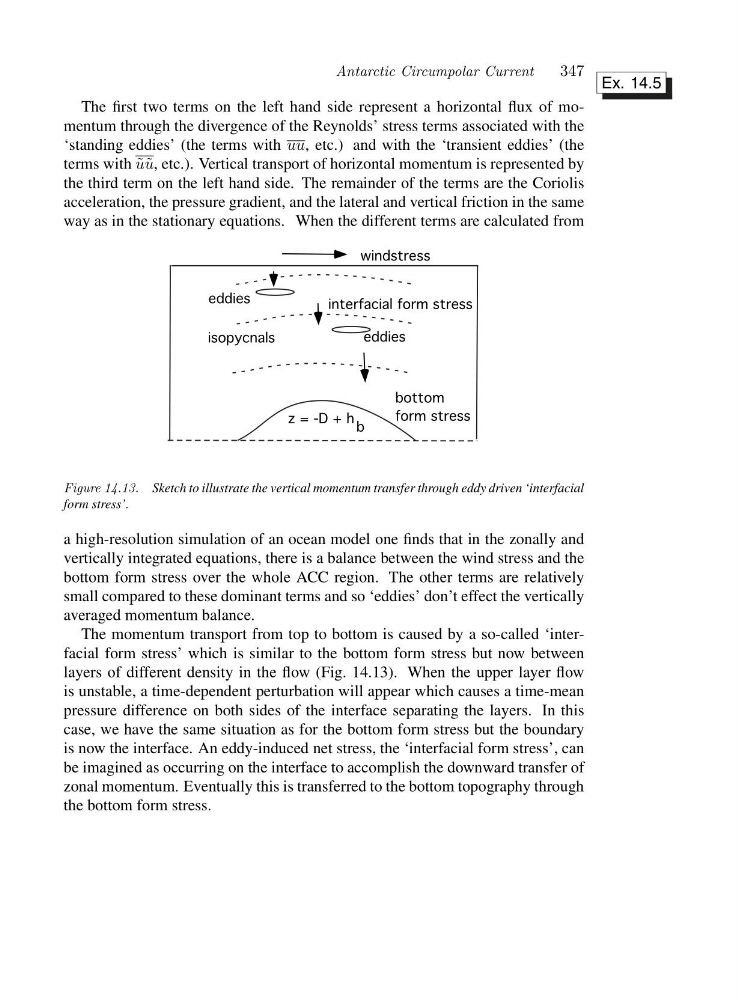
Figure 14.13. Sketch to illustrate the vertical momentum transfer through eddy driven ‘interfacial
form stress’.
a high-resolution simulation of an ocean model one finds that in the zonally and
vertically integrated equations, there is a balance between the wind stress and the
bottom form stress over the whole ACC region. The other terms are relatively
small compared to these dominant terms and so ‘eddies’ don’t effect the vertically
averaged momentum balance.
The momentum transport from top to bottom is caused by a so-called ‘interfacial form stress’ which is similar to the bottom form stress but now between
layers of different density in the flow (Fig. 14.13). When the upper layer flow
is unstable, a time-dependent perturbation will appear which causes a time-mean
pressure difference on both sides of the interface separating the layers. In this
case, we have the same situation as for the bottom form stress but the boundary
is now the interface. An eddy-induced net stress, the ‘interfacial form stress’, can
be imagined as occurring on the interface to accomplish the downward transfer of
zonal momentum. Eventually this is transferred to the bottom topography through
the bottom form stress.
347
Ex. 14.5
The first two terms on the left hand side represent a horizontal flux of momentum through the divergence of the Reynolds’ stress terms associated with the
‘standing eddies’ (the terms with uu, etc.) and with the ‘transient eddies’ (the
terms with ˜
u˜ u, etc.). Vertical transport of horizontal momentum is represented by
the third term on the left hand side. The remainder of the terms are the Coriolis
acceleration, the pressure gradient, and the lateral and vertical friction in the same
way as in the stationary equations. When the different terms are calculated from
z = -D + h b
windstress
interfacial form stress
bottom
form stress
isopycnals
eddies
eddies
Figure 14.13. Sketch to illustrate the vertical momentum transfer through eddy driven ‘interfacial
form stress’.
a high-resolution simulation of an ocean model one finds that in the zonally and
vertically integrated equations, there is a balance between the wind stress and the
bottom form stress over the whole ACC region. The other terms are relatively
small compared to these dominant terms and so ‘eddies’ don’t effect the vertically
averaged momentum balance.
The momentum transport from top to bottom is caused by a so-called ‘interfacial form stress’ which is similar to the bottom form stress but now between
layers of different density in the flow (Fig. 14.13). When the upper layer flow
is unstable, a time-dependent perturbation will appear which causes a time-mean
pressure difference on both sides of the interface separating the layers. In this
case, we have the same situation as for the bottom form stress but the boundary
is now the interface. An eddy-induced net stress, the ‘interfacial form stress’, can
be imagined as occurring on the interface to accomplish the downward transfer of
zonal momentum. Eventually this is transferred to the bottom topography through
the bottom form stress.