

Antarctic Circumpolar Current
329
-0.2
-0.1
0
0.1
0.2
0.3
0.4
-80
-70
-60
-50
-40
-30
-20
-10
0
θ θ θ
θ
τ τ τ
τ
φ φ
φ
φ (Pa)
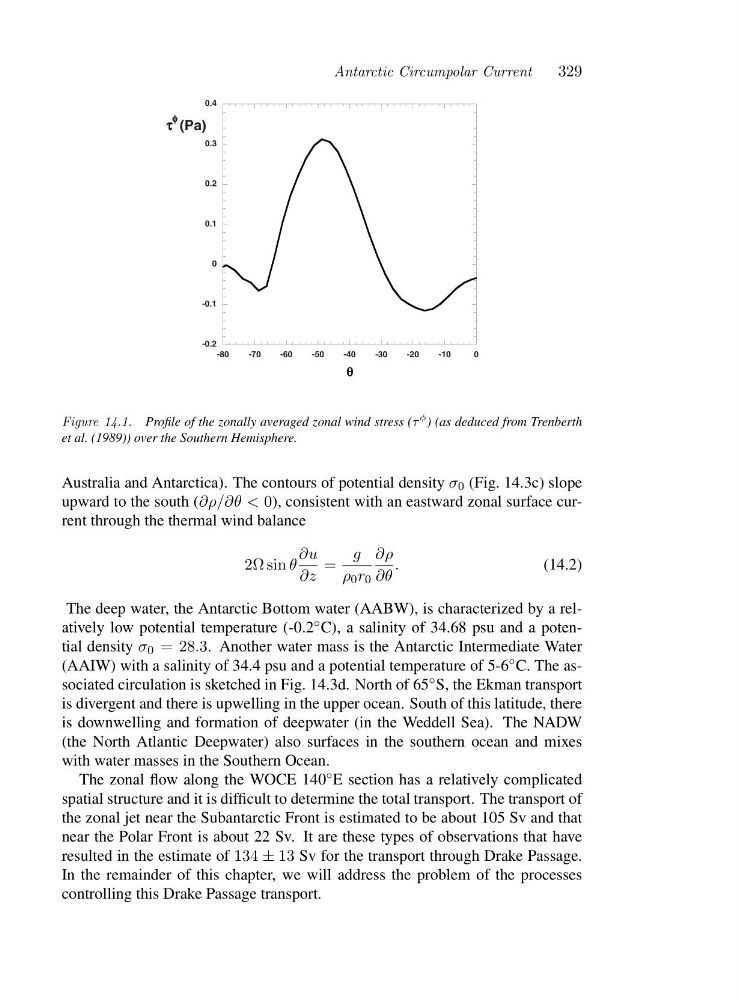
Figure 14.1. Profile of the zonally averaged zonal wind stress (τ
φ ) (as deduced from Trenberth
et al. (1989)) over the Southern Hemisphere.
Australia and Antarctica). The contours of potential density σ 0 (Fig. 14.3c) slope
upward to the south (∂ρ/∂θ < 0), consistent with an eastward zonal surface current through the thermal wind balance
2Ω sin θ
∂u
∂z
=
g
ρ 0 r 0
∂ρ
∂θ
.
(14.2)
The deep water, the Antarctic Bottom water (AABW), is characterized by a relatively low potential temperature (-0.2 ◦ C), a salinity of 34.68 psu and a potential density σ 0 =2 8 .3. Another water mass is the Antarctic Intermediate Water
(AAIW) with a salinity of 34.4 psu and a potential temperature of 5-6 ◦ C. The associated circulation is sketched in Fig. 14.3d. North of 65 ◦ S, the Ekman transport
is divergent and there is upwelling in the upper ocean. South of this latitude, there
is downwelling and formation of deepwater (in the Weddell Sea). The NADW
(the North Atlantic Deepwater) also surfaces in the southern ocean and mixes
with water masses in the Southern Ocean.
The zonal flow along the WOCE 140 ◦ E section has a relatively complicated
spatial structure and it is difficult to determine the total transport. The transport of
the zonal jet near the Subantarctic Front is estimated to be about 105 Sv and that
near the Polar Front is about 22 Sv. It are these types of observations that have
resulted in the estimate of 134 ± 13 Sv for the transport through Drake Passage.
In the remainder of this chapter, we will address the problem of the processes
controlling this Drake Passage transport.
329
-0.2
-0.1
0
0.1
0.2
0.3
0.4
-80
-70
-60
-50
-40
-30
-20
-10
0
θ θ θ
θ
τ τ τ
τ
φ φ
φ
φ (Pa)
Figure 14.1. Profile of the zonally averaged zonal wind stress (τ
φ ) (as deduced from Trenberth
et al. (1989)) over the Southern Hemisphere.
Australia and Antarctica). The contours of potential density σ 0 (Fig. 14.3c) slope
upward to the south (∂ρ/∂θ < 0), consistent with an eastward zonal surface current through the thermal wind balance
2Ω sin θ
∂u
∂z
=
g
ρ 0 r 0
∂ρ
∂θ
.
(14.2)
The deep water, the Antarctic Bottom water (AABW), is characterized by a relatively low potential temperature (-0.2 ◦ C), a salinity of 34.68 psu and a potential density σ 0 =2 8 .3. Another water mass is the Antarctic Intermediate Water
(AAIW) with a salinity of 34.4 psu and a potential temperature of 5-6 ◦ C. The associated circulation is sketched in Fig. 14.3d. North of 65 ◦ S, the Ekman transport
is divergent and there is upwelling in the upper ocean. South of this latitude, there
is downwelling and formation of deepwater (in the Weddell Sea). The NADW
(the North Atlantic Deepwater) also surfaces in the southern ocean and mixes
with water masses in the Southern Ocean.
The zonal flow along the WOCE 140 ◦ E section has a relatively complicated
spatial structure and it is difficult to determine the total transport. The transport of
the zonal jet near the Subantarctic Front is estimated to be about 105 Sv and that
near the Polar Front is about 22 Sv. It are these types of observations that have
resulted in the estimate of 134 ± 13 Sv for the transport through Drake Passage.
In the remainder of this chapter, we will address the problem of the processes
controlling this Drake Passage transport.