

Thermocline problem
323
Summary
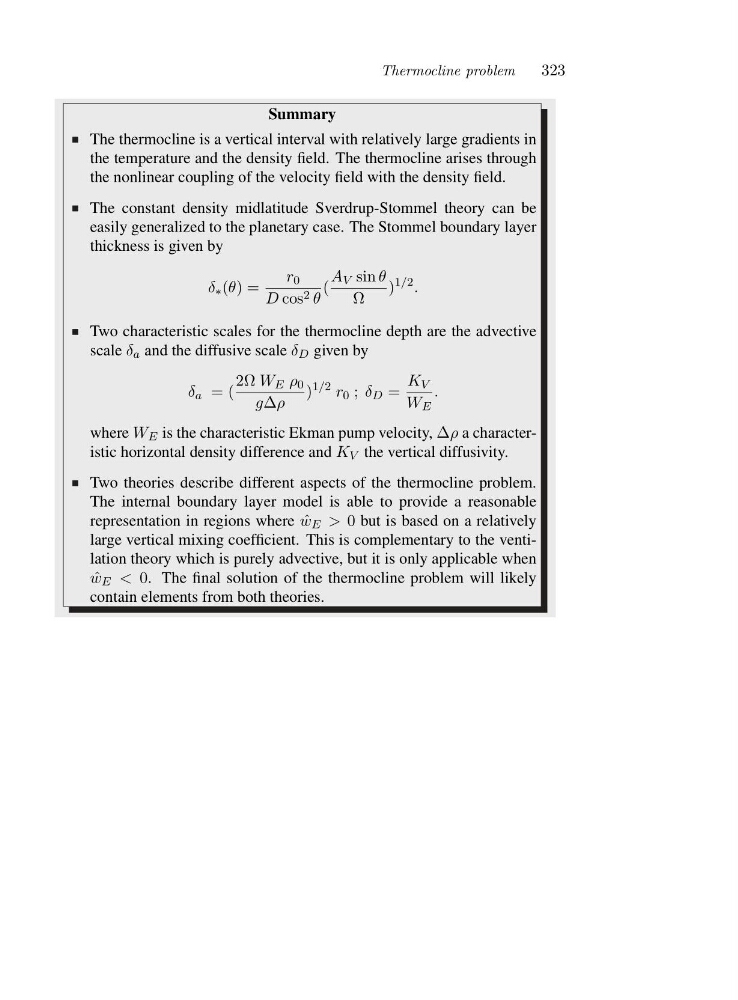
The thermocline is a vertical interval with relatively large gradients in
the temperature and the density field. The thermocline arises through
the nonlinear coupling of the velocity field with the density field.
The constant density midlatitude Sverdrup-Stommel theory can be
easily generalized to the planetary case. The Stommel boundary layer
thickness is given by
δ ∗ (θ)=
r 0
D cos 2 θ
(
A V sin θ
Ω
)
1/2 .
Two characteristic scales for the thermocline depth are the advective
scale δ a and the diffusive scale δ D given by
δ a =(
2Ω W E ρ 0
gΔρ
)
1/2 r 0 ; δ D =
K V
W E
.
where W E is the characteristic Ekman pump velocity, Δρ a characteristic horizontal density difference and K V the vertical diffusivity.
Two theories describe different aspects of the thermocline problem.
The internal boundary layer model is able to provide a reasonable
representation in regions where ˆ
w E > 0 but is based on a relatively
large vertical mixing coefficient. This is complementary to the ventilation theory which is purely advective, but it is only applicable when
ˆ
w E < 0. The final solution of the thermocline problem will likely
contain elements from both theories.
323
Summary
The thermocline is a vertical interval with relatively large gradients in
the temperature and the density field. The thermocline arises through
the nonlinear coupling of the velocity field with the density field.
The constant density midlatitude Sverdrup-Stommel theory can be
easily generalized to the planetary case. The Stommel boundary layer
thickness is given by
δ ∗ (θ)=
r 0
D cos 2 θ
(
A V sin θ
Ω
)
1/2 .
Two characteristic scales for the thermocline depth are the advective
scale δ a and the diffusive scale δ D given by
δ a =(
2Ω W E ρ 0
gΔρ
)
1/2 r 0 ; δ D =
K V
W E
.
where W E is the characteristic Ekman pump velocity, Δρ a characteristic horizontal density difference and K V the vertical diffusivity.
Two theories describe different aspects of the thermocline problem.
The internal boundary layer model is able to provide a reasonable
representation in regions where ˆ
w E > 0 but is based on a relatively
large vertical mixing coefficient. This is complementary to the ventilation theory which is purely advective, but it is only applicable when
ˆ
w E < 0. The final solution of the thermocline problem will likely
contain elements from both theories.