

Thermocline problem
319
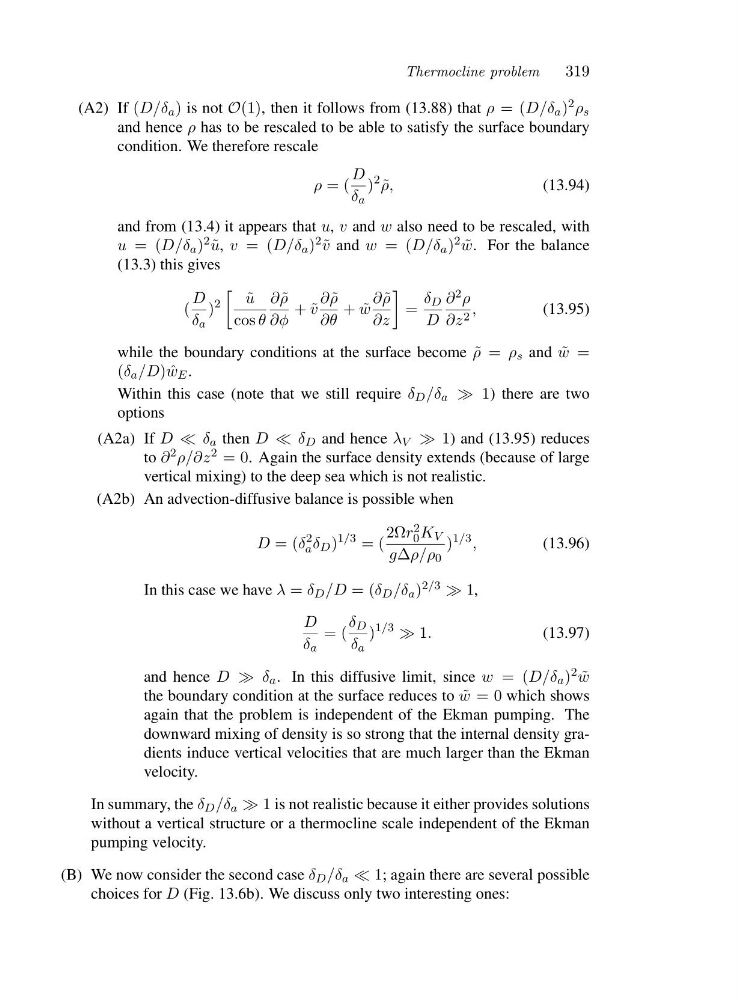
(A2) If (D/δ a ) is not O(1), then it follows from (13.88) that ρ =( D/δ a ) 2 ρ s
and hence ρ has to be rescaled to be able to satisfy the surface boundary
condition. We therefore rescale
ρ =(
D
δ a
)
2 ˜
ρ,
(13.94)
and from (13.4) it appears that u, v and w also need to be rescaled, with
u =( D/δ a ) 2 ˜
u, v =( D/δ a ) 2 ˜
v and w =( D/δ a ) 2 ˜
w. For the balance
(13.3) this gives
(
D
δ a
)
2
˜
u
cos θ
∂ ˜
ρ
∂φ
+˜ v
∂ ˜
ρ
∂θ
+˜ w
∂ ˜
ρ
∂z
=
δ D
D
∂ 2 ρ
∂z 2 ,
(13.95)
while the boundary conditions at the surface become ˜
ρ = ρ s and ˜
w =
(δ a /D)ˆ w E .
Within this case (note that we still require δ D /δ a ≫ 1) there are two
options
(A2a) If D ≪ δ a then D ≪ δ D and hence λ V ≫ 1) and (13.95) reduces
to ∂ 2 ρ/∂z 2 =0 . Again the surface density extends (because of large
vertical mixing) to the deep sea which is not realistic.
(A2b) An advection-diffusive balance is possible when
D =(δ
2
a δ D )
1/3 =(
2Ωr 2
0 K V
gΔρ/ρ 0
)
1/3 ,
(13.96)
In this case we have λ = δ D /D =(δ D /δ a ) 2/3 ≫ 1,
D
δ a
=(
δ D
δ a
)
1/3 ≫ 1.
(13.97)
and hence D ≫ δ a . In this diffusive limit, since w =( D/δ a ) 2 ˜
w
the boundary condition at the surface reduces to ˜
w =0which shows
again that the problem is independent of the Ekman pumping. The
downward mixing of density is so strong that the internal density gradients induce vertical velocities that are much larger than the Ekman
velocity.
In summary, the δ D /δ a ≫ 1 is not realistic because it either provides solutions
without a vertical structure or a thermocline scale independent of the Ekman
pumping velocity.
(B) We now consider the second case δ D /δ a ≪ 1; again there are several possible
choices for D (Fig. 13.6b). We discuss only two interesting ones:
319
(A2) If (D/δ a ) is not O(1), then it follows from (13.88) that ρ =( D/δ a ) 2 ρ s
and hence ρ has to be rescaled to be able to satisfy the surface boundary
condition. We therefore rescale
ρ =(
D
δ a
)
2 ˜
ρ,
(13.94)
and from (13.4) it appears that u, v and w also need to be rescaled, with
u =( D/δ a ) 2 ˜
u, v =( D/δ a ) 2 ˜
v and w =( D/δ a ) 2 ˜
w. For the balance
(13.3) this gives
(
D
δ a
)
2
˜
u
cos θ
∂ ˜
ρ
∂φ
+˜ v
∂ ˜
ρ
∂θ
+˜ w
∂ ˜
ρ
∂z
=
δ D
D
∂ 2 ρ
∂z 2 ,
(13.95)
while the boundary conditions at the surface become ˜
ρ = ρ s and ˜
w =
(δ a /D)ˆ w E .
Within this case (note that we still require δ D /δ a ≫ 1) there are two
options
(A2a) If D ≪ δ a then D ≪ δ D and hence λ V ≫ 1) and (13.95) reduces
to ∂ 2 ρ/∂z 2 =0 . Again the surface density extends (because of large
vertical mixing) to the deep sea which is not realistic.
(A2b) An advection-diffusive balance is possible when
D =(δ
2
a δ D )
1/3 =(
2Ωr 2
0 K V
gΔρ/ρ 0
)
1/3 ,
(13.96)
In this case we have λ = δ D /D =(δ D /δ a ) 2/3 ≫ 1,
D
δ a
=(
δ D
δ a
)
1/3 ≫ 1.
(13.97)
and hence D ≫ δ a . In this diffusive limit, since w =( D/δ a ) 2 ˜
w
the boundary condition at the surface reduces to ˜
w =0which shows
again that the problem is independent of the Ekman pumping. The
downward mixing of density is so strong that the internal density gradients induce vertical velocities that are much larger than the Ekman
velocity.
In summary, the δ D /δ a ≫ 1 is not realistic because it either provides solutions
without a vertical structure or a thermocline scale independent of the Ekman
pumping velocity.
(B) We now consider the second case δ D /δ a ≪ 1; again there are several possible
choices for D (Fig. 13.6b). We discuss only two interesting ones: