

Thermocline problem
311
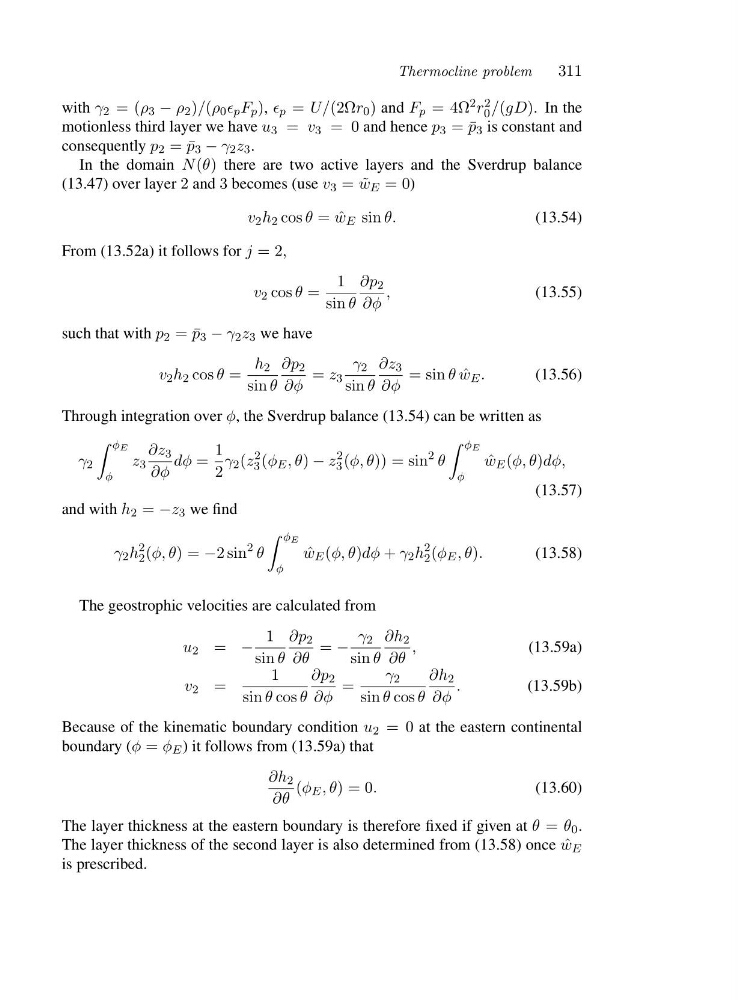
with γ 2 =( ρ 3 − ρ 2 )/(ρ 0 ǫ p F p ), ǫ p = U/(2Ωr 0 ) and F p =4 Ω 2 r 2
0 /(gD).I nt h e
motionless third layer we have u 3 = v 3 =0and hence p 3 =¯ p 3 is constant and
consequently p 2 =¯ p 3 − γ 2 z 3 .
In the domain N (θ) there are two active layers and the Sverdrup balance
(13.47) over layer 2 and 3 becomes (use v 3 =˜ w E =0)
v 2 h 2 cos θ =ˆ w E sin θ.
(13.54)
From (13.52a) it follows for j =2,
v 2 cos θ =
1
sin θ
∂p 2
∂φ
,
(13.55)
such that with p 2 =¯ p 3 − γ 2 z 3 we have
v 2 h 2 cos θ =
h 2
sin θ
∂p 2
∂φ
= z 3
γ 2
sin θ
∂z 3
∂φ
=sinθ ˆ
w E .
(13.56)
Through integration over φ, the Sverdrup balance (13.54) can be written as
γ 2
φ E
φ
z 3
∂z 3
∂φ
dφ =
1
2
γ 2 (z
2
3 (φ E ,θ) − z
2
3 (φ, θ)) = sin
2 θ
φ E
φ
ˆ
w E (φ, θ)dφ,
(13.57)
and with h 2 = −z 3 we find
γ 2 h
2
2 (φ, θ)=−2sin
2 θ
φ E
φ
ˆ
w E (φ, θ)dφ + γ 2 h
2
2 (φ E ,θ).
(13.58)
The geostrophic velocities are calculated from
u 2 = −
1
sin θ
∂p 2
∂θ
= −
γ 2
sin θ
∂h 2
∂θ
,
(13.59a)
v 2 =
1
sin θ cos θ
∂p 2
∂φ
=
γ 2
sin θ cos θ
∂h 2
∂φ
.
(13.59b)
Because of the kinematic boundary condition u 2 =0at the eastern continental
boundary (φ = φ E ) it follows from (13.59a) that
∂h 2
∂θ
(φ E ,θ)=0.
(13.60)
The layer thickness at the eastern boundary is therefore fixed if given at θ = θ 0 .
The layer thickness of the second layer is also determined from (13.58) once ˆ
w E
is prescribed.
311
with γ 2 =( ρ 3 − ρ 2 )/(ρ 0 ǫ p F p ), ǫ p = U/(2Ωr 0 ) and F p =4 Ω 2 r 2
0 /(gD).I nt h e
motionless third layer we have u 3 = v 3 =0and hence p 3 =¯ p 3 is constant and
consequently p 2 =¯ p 3 − γ 2 z 3 .
In the domain N (θ) there are two active layers and the Sverdrup balance
(13.47) over layer 2 and 3 becomes (use v 3 =˜ w E =0)
v 2 h 2 cos θ =ˆ w E sin θ.
(13.54)
From (13.52a) it follows for j =2,
v 2 cos θ =
1
sin θ
∂p 2
∂φ
,
(13.55)
such that with p 2 =¯ p 3 − γ 2 z 3 we have
v 2 h 2 cos θ =
h 2
sin θ
∂p 2
∂φ
= z 3
γ 2
sin θ
∂z 3
∂φ
=sinθ ˆ
w E .
(13.56)
Through integration over φ, the Sverdrup balance (13.54) can be written as
γ 2
φ E
φ
z 3
∂z 3
∂φ
dφ =
1
2
γ 2 (z
2
3 (φ E ,θ) − z
2
3 (φ, θ)) = sin
2 θ
φ E
φ
ˆ
w E (φ, θ)dφ,
(13.57)
and with h 2 = −z 3 we find
γ 2 h
2
2 (φ, θ)=−2sin
2 θ
φ E
φ
ˆ
w E (φ, θ)dφ + γ 2 h
2
2 (φ E ,θ).
(13.58)
The geostrophic velocities are calculated from
u 2 = −
1
sin θ
∂p 2
∂θ
= −
γ 2
sin θ
∂h 2
∂θ
,
(13.59a)
v 2 =
1
sin θ cos θ
∂p 2
∂φ
=
γ 2
sin θ cos θ
∂h 2
∂φ
.
(13.59b)
Because of the kinematic boundary condition u 2 =0at the eastern continental
boundary (φ = φ E ) it follows from (13.59a) that
∂h 2
∂θ
(φ E ,θ)=0.
(13.60)
The layer thickness at the eastern boundary is therefore fixed if given at θ = θ 0 .
The layer thickness of the second layer is also determined from (13.58) once ˆ
w E
is prescribed.