

308
DYNAMICAL OCEANOGRAPHY
θ
z
ρ
1
ρ
ρ
ρ
2
3
4
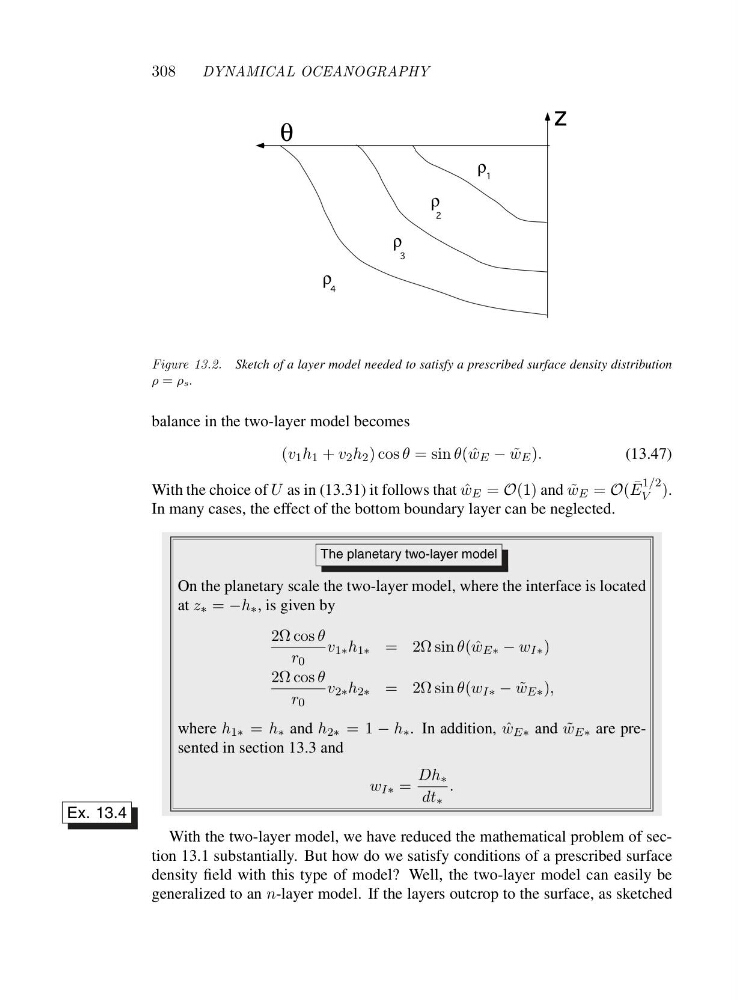
Figure 13.2. Sketch of a layer model needed to satisfy a prescribed surface density distribution
ρ = ρs.
balance in the two-layer model becomes
(v 1 h 1 + v 2 h 2 )cosθ =sinθ(ˆ w E − ˜
w E ).
(13.47)
With the choice of U as in (13.31) it follows that ˆ
w E = O(1) and ˜
w E = O( ¯
E
1/2
V ).
In many cases, the effect of the bottom boundary layer can be neglected.
The planetary two-layer model
On the planetary scale the two-layer model, where the interface is located
at z ∗ = −h ∗ ,isgivenby
2Ω cos θ
r 0
v 1∗ h 1∗ =2 Ω s i n θ(ˆ w E∗ − w I∗ )
2Ω cos θ
r 0
v 2∗ h 2∗ =2 Ω s i n θ(w I∗ − ˜
w E∗ ),
where h 1∗ = h ∗ and h 2∗ =1− h ∗ . In addition, ˆ
w E∗ and ˜
w E∗ are presented in section 13.3 and
w I∗ =
Dh ∗
dt ∗
.
Ex. 13.4
With the two-layer model, we have reduced the mathematical problem of section 13.1 substantially. But how do we satisfy conditions of a prescribed surface
density field with this type of model? Well, the two-layer model can easily be
generalized to an n-layer model. If the layers outcrop to the surface, as sketched
DYNAMICAL OCEANOGRAPHY
θ
z
ρ
1
ρ
ρ
ρ
2
3
4
Figure 13.2. Sketch of a layer model needed to satisfy a prescribed surface density distribution
ρ = ρs.
balance in the two-layer model becomes
(v 1 h 1 + v 2 h 2 )cosθ =sinθ(ˆ w E − ˜
w E ).
(13.47)
With the choice of U as in (13.31) it follows that ˆ
w E = O(1) and ˜
w E = O( ¯
E
1/2
V ).
In many cases, the effect of the bottom boundary layer can be neglected.
The planetary two-layer model
On the planetary scale the two-layer model, where the interface is located
at z ∗ = −h ∗ ,isgivenby
2Ω cos θ
r 0
v 1∗ h 1∗ =2 Ω s i n θ(ˆ w E∗ − w I∗ )
2Ω cos θ
r 0
v 2∗ h 2∗ =2 Ω s i n θ(w I∗ − ˜
w E∗ ),
where h 1∗ = h ∗ and h 2∗ =1− h ∗ . In addition, ˆ
w E∗ and ˜
w E∗ are presented in section 13.3 and
w I∗ =
Dh ∗
dt ∗
.
Ex. 13.4
With the two-layer model, we have reduced the mathematical problem of section 13.1 substantially. But how do we satisfy conditions of a prescribed surface
density field with this type of model? Well, the two-layer model can easily be
generalized to an n-layer model. If the layers outcrop to the surface, as sketched