

278
DYNAMICAL OCEANOGRAPHY
give, through local heating, a lower-level wind anomaly. The resulting wind-stress
anomaly on the ocean-atmosphere surface will (i) change the thermocline slope
through horizontal pressure differences in the upper ocean, will (ii) change the
strength of the upwelling through the Ekman divergences in the upper layer and
will (iii) affect the upper ocean currents (u, v) in the mixed layer. The change in
velocity field and thermocline field will affect the sea surface temperature.
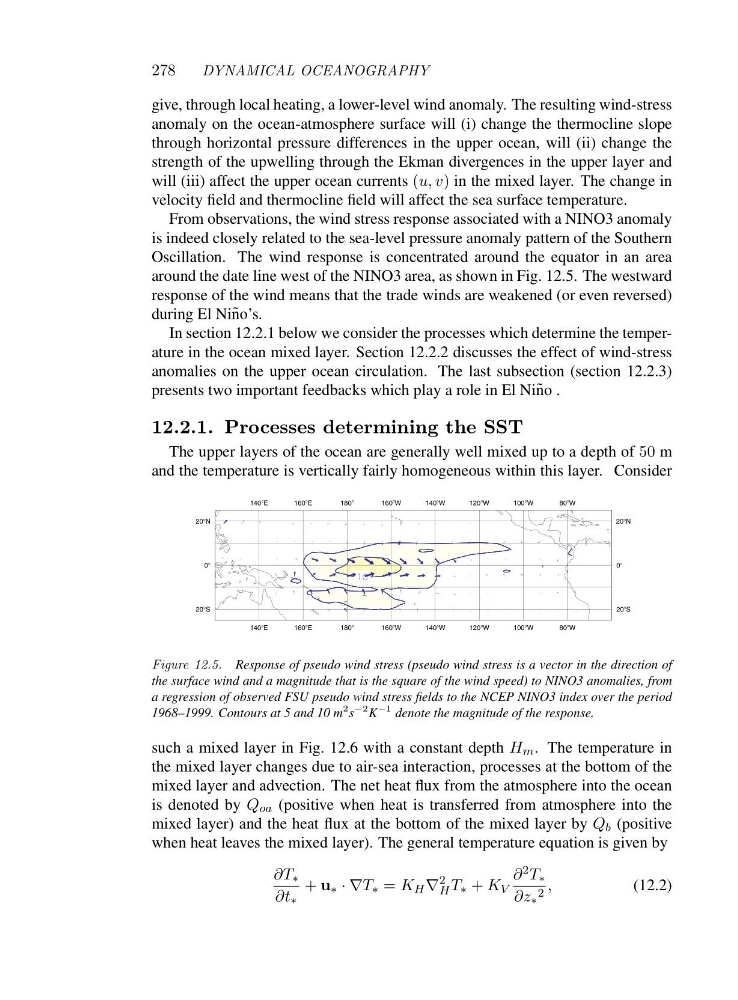
From observations, the wind stress response associated with a NINO3 anomaly
is indeed closely related to the sea-level pressure anomaly pattern of the Southern
Oscillation. The wind response is concentrated around the equator in an area
around the date line west of the NINO3 area, as shown in Fig. 12.5. The westward
response of the wind means that the trade winds are weakened (or even reversed)
during El Ni˜ no’s.
In section 12.2.1 below we consider the processes which determine the temperature in the ocean mixed layer. Section 12.2.2 discusses the effect of wind-stress
anomalies on the upper ocean circulation. The last subsection (section 12.2.3)
presents two important feedbacks which play a role in El Ni˜ no .
12.2.1. Processes determining the SST
The upper layers of the ocean are generally well mixed up to a depth of 50 m
and the temperature is vertically fairly homogeneous within this layer. Consider
20 O S
20 O S
0 O
0 O
20 O N
20 O N
140 O E
140 O E
160 O E
160 O E
180 O
180 O
160 O W
160 O W
140 O W
140 O W
120 O W
120 O W
100 O W
100 O W8 0 O W
80 O W
Figure 12.5. Response of pseudo wind stress (pseudo wind stress is a vector in the direction of
the surface wind and a magnitude that is the square of the wind speed) to NINO3 anomalies, from
a regression of observed FSU pseudo wind stress fields to the NCEP NINO3 index over the period
1968–1999. Contours at 5 and 10 m
2 s
−2 K
−1 denote the magnitude of the response.
such a mixed layer in Fig. 12.6 with a constant depth H m . The temperature in
the mixed layer changes due to air-sea interaction, processes at the bottom of the
mixed layer and advection. The net heat flux from the atmosphere into the ocean
is denoted by Q oa (positive when heat is transferred from atmosphere into the
mixed layer) and the heat flux at the bottom of the mixed layer by Q b (positive
when heat leaves the mixed layer). The general temperature equation is given by
∂T ∗
∂t ∗
+ u ∗ ·∇T ∗ = K H ∇
2
H T ∗ + K V
∂ 2 T ∗
∂z ∗
2
,
(12.2)
DYNAMICAL OCEANOGRAPHY
give, through local heating, a lower-level wind anomaly. The resulting wind-stress
anomaly on the ocean-atmosphere surface will (i) change the thermocline slope
through horizontal pressure differences in the upper ocean, will (ii) change the
strength of the upwelling through the Ekman divergences in the upper layer and
will (iii) affect the upper ocean currents (u, v) in the mixed layer. The change in
velocity field and thermocline field will affect the sea surface temperature.
From observations, the wind stress response associated with a NINO3 anomaly
is indeed closely related to the sea-level pressure anomaly pattern of the Southern
Oscillation. The wind response is concentrated around the equator in an area
around the date line west of the NINO3 area, as shown in Fig. 12.5. The westward
response of the wind means that the trade winds are weakened (or even reversed)
during El Ni˜ no’s.
In section 12.2.1 below we consider the processes which determine the temperature in the ocean mixed layer. Section 12.2.2 discusses the effect of wind-stress
anomalies on the upper ocean circulation. The last subsection (section 12.2.3)
presents two important feedbacks which play a role in El Ni˜ no .
12.2.1. Processes determining the SST
The upper layers of the ocean are generally well mixed up to a depth of 50 m
and the temperature is vertically fairly homogeneous within this layer. Consider
20 O S
20 O S
0 O
0 O
20 O N
20 O N
140 O E
140 O E
160 O E
160 O E
180 O
180 O
160 O W
160 O W
140 O W
140 O W
120 O W
120 O W
100 O W
100 O W8 0 O W
80 O W
Figure 12.5. Response of pseudo wind stress (pseudo wind stress is a vector in the direction of
the surface wind and a magnitude that is the square of the wind speed) to NINO3 anomalies, from
a regression of observed FSU pseudo wind stress fields to the NCEP NINO3 index over the period
1968–1999. Contours at 5 and 10 m
2 s
−2 K
−1 denote the magnitude of the response.
such a mixed layer in Fig. 12.6 with a constant depth H m . The temperature in
the mixed layer changes due to air-sea interaction, processes at the bottom of the
mixed layer and advection. The net heat flux from the atmosphere into the ocean
is denoted by Q oa (positive when heat is transferred from atmosphere into the
mixed layer) and the heat flux at the bottom of the mixed layer by Q b (positive
when heat leaves the mixed layer). The general temperature equation is given by
∂T ∗
∂t ∗
+ u ∗ ·∇T ∗ = K H ∇
2
H T ∗ + K V
∂ 2 T ∗
∂z ∗
2
,
(12.2)