

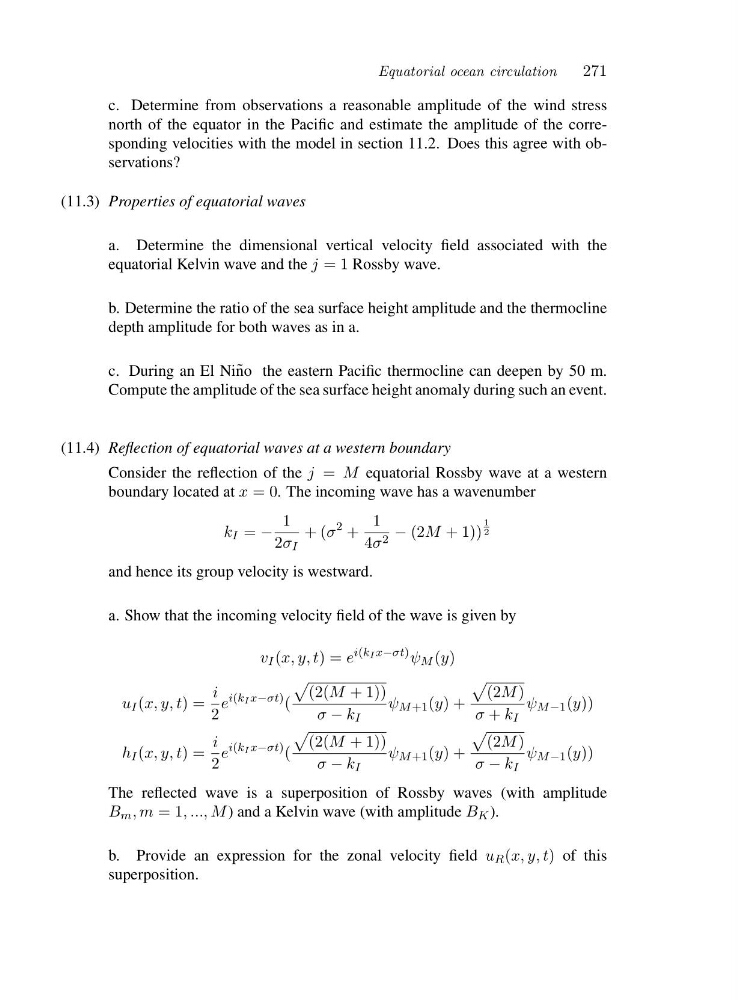
Equatorial ocean circulation
271
c. Determine from observations a reasonable amplitude of the wind stress
north of the equator in the Pacific and estimate the amplitude of the corresponding velocities with the model in section 11.2. Does this agree with observations?
(11.3) Properties of equatorial waves
a. Determine the dimensional vertical velocity field associated with the
equatorial Kelvin wave and the j =1Rossby wave.
b. Determine the ratio of the sea surface height amplitude and the thermocline
depth amplitude for both waves as in a.
c. During an El Ni˜ no the eastern Pacific thermocline can deepen by 50 m.
Compute the amplitude of the sea surface height anomaly during such an event.
(11.4) Reflection of equatorial waves at a western boundary
Consider the reflection of the j = M equatorial Rossby wave at a western
boundary located at x =0. The incoming wave has a wavenumber
k I = −
1
2σ I
+(σ
2 +
1
4σ 2 − (2M +1))
1
2
and hence its group velocity is westward.
a. Show that the incoming velocity field of the wave is given by
v I (x, y, t)=e
i(k I x−σt) ψ M (y)
u I (x, y, t)=
i
2
e
i(k I x−σt) (
(2(M +1))
σ − k I
ψ M +1 (y)+
(2M )
σ + k I
ψ M −1 (y))
h I (x, y, t)=
i
2
e
i(k I x−σt) (
(2(M +1))
σ − k I
ψ M +1 (y)+
(2M )
σ − k I
ψ M −1 (y))
The reflected wave is a superposition of Rossby waves (with amplitude
B m ,m =1, ..., M ) and a Kelvin wave (with amplitude B K ).
b. Provide an expression for the zonal velocity field u R (x, y, t) of this
superposition.
271
c. Determine from observations a reasonable amplitude of the wind stress
north of the equator in the Pacific and estimate the amplitude of the corresponding velocities with the model in section 11.2. Does this agree with observations?
(11.3) Properties of equatorial waves
a. Determine the dimensional vertical velocity field associated with the
equatorial Kelvin wave and the j =1Rossby wave.
b. Determine the ratio of the sea surface height amplitude and the thermocline
depth amplitude for both waves as in a.
c. During an El Ni˜ no the eastern Pacific thermocline can deepen by 50 m.
Compute the amplitude of the sea surface height anomaly during such an event.
(11.4) Reflection of equatorial waves at a western boundary
Consider the reflection of the j = M equatorial Rossby wave at a western
boundary located at x =0. The incoming wave has a wavenumber
k I = −
1
2σ I
+(σ
2 +
1
4σ 2 − (2M +1))
1
2
and hence its group velocity is westward.
a. Show that the incoming velocity field of the wave is given by
v I (x, y, t)=e
i(k I x−σt) ψ M (y)
u I (x, y, t)=
i
2
e
i(k I x−σt) (
(2(M +1))
σ − k I
ψ M +1 (y)+
(2M )
σ + k I
ψ M −1 (y))
h I (x, y, t)=
i
2
e
i(k I x−σt) (
(2(M +1))
σ − k I
ψ M +1 (y)+
(2M )
σ − k I
ψ M −1 (y))
The reflected wave is a superposition of Rossby waves (with amplitude
B m ,m =1, ..., M ) and a Kelvin wave (with amplitude B K ).
b. Provide an expression for the zonal velocity field u R (x, y, t) of this
superposition.