

258
DYNAMICAL OCEANOGRAPHY
is therefore called the long wave limit. The first long Rossby wave (j =1)travels
westward with a phase velocity which is 1/3 of that of the Kelvin wave. From the
expressions of the Hermite functions in (11.27), one can see that the amplitude is
restricted to a relatively small meridional interval around the equator; these waves
are therefore called ‘equatorially trapped’.
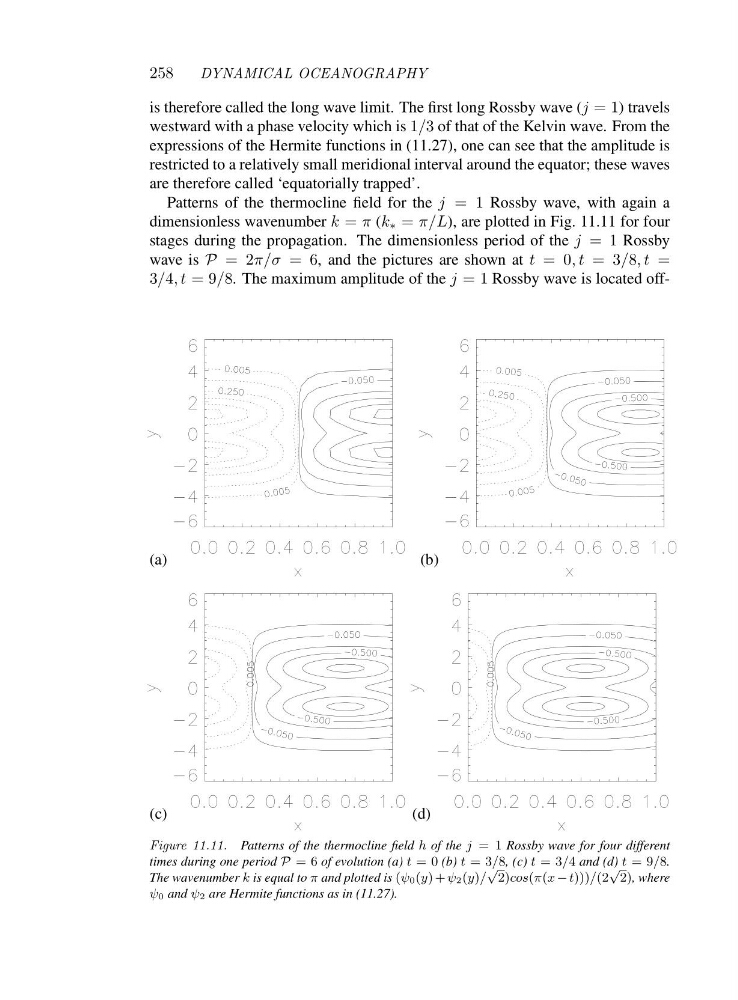
Patterns of the thermocline field for the j =1Rossby wave, with again a
dimensionless wavenumber k = π (k ∗ = π/L), are plotted in Fig. 11.11 for four
stages during the propagation. The dimensionless period of the j =1Rossby
wave is P =2 π/σ =6 , and the pictures are shown at t =0 ,t =3 /8,t =
3/4,t =9 /8. The maximum amplitude of the j =1Rossby wave is located off(a)
(b)
(c)
(d)
Figure 11.11. Patterns of the thermocline field h of the j =1Rossby wave for four different
times during one period P =6of evolution (a) t =0(b) t =3 /8,(c)t =3 /4 and (d) t =9 /8.
The wavenumber k is equal to π and plotted is (ψ0(y)+ψ2(y)/
√
2)cos(π(x − t)))/(2
√
2),where
ψ0 and ψ2 are Hermite functions as in (11.27).
DYNAMICAL OCEANOGRAPHY
is therefore called the long wave limit. The first long Rossby wave (j =1)travels
westward with a phase velocity which is 1/3 of that of the Kelvin wave. From the
expressions of the Hermite functions in (11.27), one can see that the amplitude is
restricted to a relatively small meridional interval around the equator; these waves
are therefore called ‘equatorially trapped’.
Patterns of the thermocline field for the j =1Rossby wave, with again a
dimensionless wavenumber k = π (k ∗ = π/L), are plotted in Fig. 11.11 for four
stages during the propagation. The dimensionless period of the j =1Rossby
wave is P =2 π/σ =6 , and the pictures are shown at t =0 ,t =3 /8,t =
3/4,t =9 /8. The maximum amplitude of the j =1Rossby wave is located off(a)
(b)
(c)
(d)
Figure 11.11. Patterns of the thermocline field h of the j =1Rossby wave for four different
times during one period P =6of evolution (a) t =0(b) t =3 /8,(c)t =3 /4 and (d) t =9 /8.
The wavenumber k is equal to π and plotted is (ψ0(y)+ψ2(y)/
√
2)cos(π(x − t)))/(2
√
2),where
ψ0 and ψ2 are Hermite functions as in (11.27).