

Stability of zonal flows
223
be stable. Note that the dimensional form of the Kuo criterium is based on the
quantity U ′′
∗ − β 0 .
◮
Example 10.1: Barotropic instability
As an example we consider U (y)=
a
2 (1+cos πy) with a>0 (Fig. 10.2) where
the parameter a is a measure of the horizontal shear in the flow. The zonal velocity
is maximal in the center of the channel and zero on the boundaries y = ±1.I n
this case,
U
′′ − β = −
1
2
π
2 a cos πy − β.
(10.24)
If 2β/(π 2 a) > 1 then U ′′ − β does not change sign and hence the zonal flow
is stable. We can take b = β/(aπ 2 ) as a control parameter for the stability
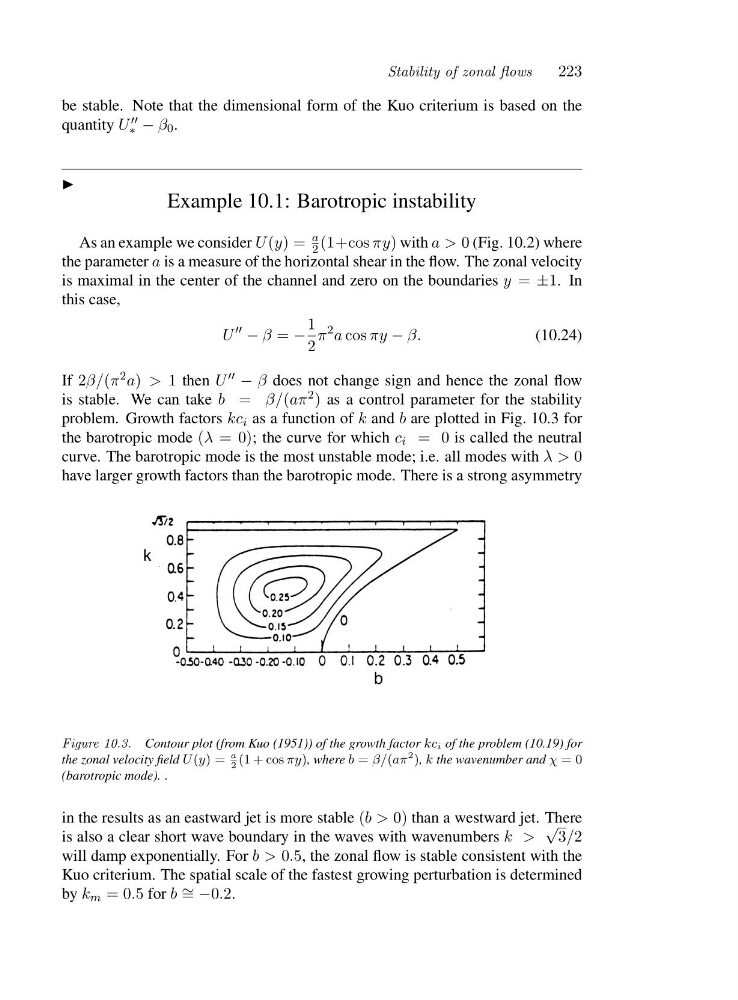
problem. Growth factors kc i as a function of k and b are plotted in Fig. 10.3 for
the barotropic mode (λ =0 ) ; the curve for which c i =0 is called the neutral
curve. The barotropic mode is the most unstable mode; i.e. all modes with λ>0
have larger growth factors than the barotropic mode. There is a strong asymmetry
Figure 10.3. Contour plot (from Kuo (1951)) of the growth factor kci of the problem (10.19) for
the zonal velocity field U (y)=
a
2
(1 + cos πy),whereb = β/(aπ
2 ), k the wavenumber and χ =0
(barotropic mode). .
in the results as an eastward jet is more stable (b>0) than a westward jet. There
is also a clear short wave boundary in the waves with wavenumbers k>
√
3/2
will damp exponentially. For b>0.5, the zonal flow is stable consistent with the
Kuo criterium. The spatial scale of the fastest growing perturbation is determined
by k m =0.5 for b ∼ = −0.2.
223
be stable. Note that the dimensional form of the Kuo criterium is based on the
quantity U ′′
∗ − β 0 .
◮
Example 10.1: Barotropic instability
As an example we consider U (y)=
a
2 (1+cos πy) with a>0 (Fig. 10.2) where
the parameter a is a measure of the horizontal shear in the flow. The zonal velocity
is maximal in the center of the channel and zero on the boundaries y = ±1.I n
this case,
U
′′ − β = −
1
2
π
2 a cos πy − β.
(10.24)
If 2β/(π 2 a) > 1 then U ′′ − β does not change sign and hence the zonal flow
is stable. We can take b = β/(aπ 2 ) as a control parameter for the stability
problem. Growth factors kc i as a function of k and b are plotted in Fig. 10.3 for
the barotropic mode (λ =0 ) ; the curve for which c i =0 is called the neutral
curve. The barotropic mode is the most unstable mode; i.e. all modes with λ>0
have larger growth factors than the barotropic mode. There is a strong asymmetry
Figure 10.3. Contour plot (from Kuo (1951)) of the growth factor kci of the problem (10.19) for
the zonal velocity field U (y)=
a
2
(1 + cos πy),whereb = β/(aπ
2 ), k the wavenumber and χ =0
(barotropic mode). .
in the results as an eastward jet is more stable (b>0) than a westward jet. There
is also a clear short wave boundary in the waves with wavenumbers k>
√
3/2
will damp exponentially. For b>0.5, the zonal flow is stable consistent with the
Kuo criterium. The spatial scale of the fastest growing perturbation is determined
by k m =0.5 for b ∼ = −0.2.