

10
DYNAMICAL OCEANOGRAPHY
Additional Material
B: A brief but interesting overview of the history of oceanography can be read
in the Prologue of Duxbury et al. (2000). Chapter 1.3 of WOCE (2001) provides a good impression on the origin, development and conduct of WOCE. A
historical overview of the developments in physical oceanography since 1950
can be found in (Jochum and Murtugudde, 2006).
1.3. Characteristics of seawater
Many of the unique features of the oceans can be attributed to the special properties of water itself. The water molecule (H 2 O) is composed of two hydrogen
atoms which are connected through an oxygen atom. The water molecule has a
clear asymmetric structure because the axes between the H atoms and O atom intersect at an angle of 105 ◦ . As a consequence, the electric charge in the H 2 Oi s
anisotropic providing the water molecule with an electric dipole moment. Water
can dissolve more substances than any other liquid on Earth which explains the
presence of many ions in the ocean and the high salinity of ocean water.
Because of its large electric dipole moment, water molecules form chains
through hydrogen bonds. This means that water has an extremely high surface
tension compared to other liquids. One of the effects of this high surface tension
is the occurrence of capillary waves on the ocean surface. These waves play an
important role in transferring momentum between the atmosphere and the ocean.
Another consequence of the chain formation is the high specific heat and large
latent heat of evaporation of water. The heat absorbing capacity is increased by
the transparency of water to sunlight; only a small part of the solar radiation is
reflected at the sea surface. The oceans therefore have a large thermal inertia and
play an important role in the storage and transport of heat in the climate system.
1.3.1. Salinity
Sea water consists of a dilute solution of ions, such as Cl − and Mg 2+ .I na
certain volume element, let there be n − 1 of these ion types with masses m i ,i =
1, ···,n− 1 and indicate the mass of the water by m n . The total mass m and the
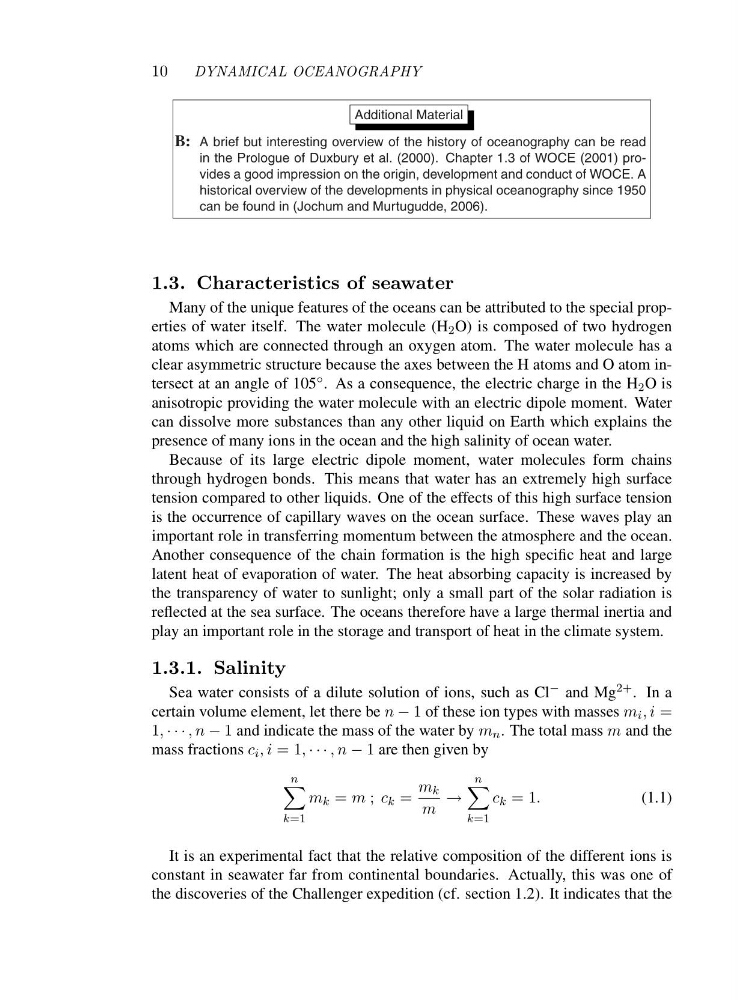
mass fractions c i ,i =1, ···,n− 1 are then given by
n
k=1
m k = m ; c k =
m k
m
→
n
k=1
c k =1.
(1.1)
It is an experimental fact that the relative composition of the different ions is
constant in seawater far from continental boundaries. Actually, this was one of
the discoveries of the Challenger expedition (cf. section 1.2). It indicates that the
DYNAMICAL OCEANOGRAPHY
Additional Material
B: A brief but interesting overview of the history of oceanography can be read
in the Prologue of Duxbury et al. (2000). Chapter 1.3 of WOCE (2001) provides a good impression on the origin, development and conduct of WOCE. A
historical overview of the developments in physical oceanography since 1950
can be found in (Jochum and Murtugudde, 2006).
1.3. Characteristics of seawater
Many of the unique features of the oceans can be attributed to the special properties of water itself. The water molecule (H 2 O) is composed of two hydrogen
atoms which are connected through an oxygen atom. The water molecule has a
clear asymmetric structure because the axes between the H atoms and O atom intersect at an angle of 105 ◦ . As a consequence, the electric charge in the H 2 Oi s
anisotropic providing the water molecule with an electric dipole moment. Water
can dissolve more substances than any other liquid on Earth which explains the
presence of many ions in the ocean and the high salinity of ocean water.
Because of its large electric dipole moment, water molecules form chains
through hydrogen bonds. This means that water has an extremely high surface
tension compared to other liquids. One of the effects of this high surface tension
is the occurrence of capillary waves on the ocean surface. These waves play an
important role in transferring momentum between the atmosphere and the ocean.
Another consequence of the chain formation is the high specific heat and large
latent heat of evaporation of water. The heat absorbing capacity is increased by
the transparency of water to sunlight; only a small part of the solar radiation is
reflected at the sea surface. The oceans therefore have a large thermal inertia and
play an important role in the storage and transport of heat in the climate system.
1.3.1. Salinity
Sea water consists of a dilute solution of ions, such as Cl − and Mg 2+ .I na
certain volume element, let there be n − 1 of these ion types with masses m i ,i =
1, ···,n− 1 and indicate the mass of the water by m n . The total mass m and the
mass fractions c i ,i =1, ···,n− 1 are then given by
n
k=1
m k = m ; c k =
m k
m
→
n
k=1
c k =1.
(1.1)
It is an experimental fact that the relative composition of the different ions is
constant in seawater far from continental boundaries. Actually, this was one of
the discoveries of the Challenger expedition (cf. section 1.2). It indicates that the