

194
DYNAMICAL OCEANOGRAPHY
As a next step, α ∗ is decomposed as
α ∗ (S ∗ ,T ∗ ,p ∗ )=α ∗ (35, 0,p ∗ )+δ ∗
where δ ∗ is the specific volume anomaly. It directly follows that
Φ ∗ (p 1∗,A ) − Φ ∗ (p 2∗,A )=
p 2∗,A
p 1∗,A
α ∗ (35, 0,p ∗ ) dp ∗ +ΔΦ A∗
where ΔΦ A∗ is the geopotential anomaly between the isobaric surfaces.
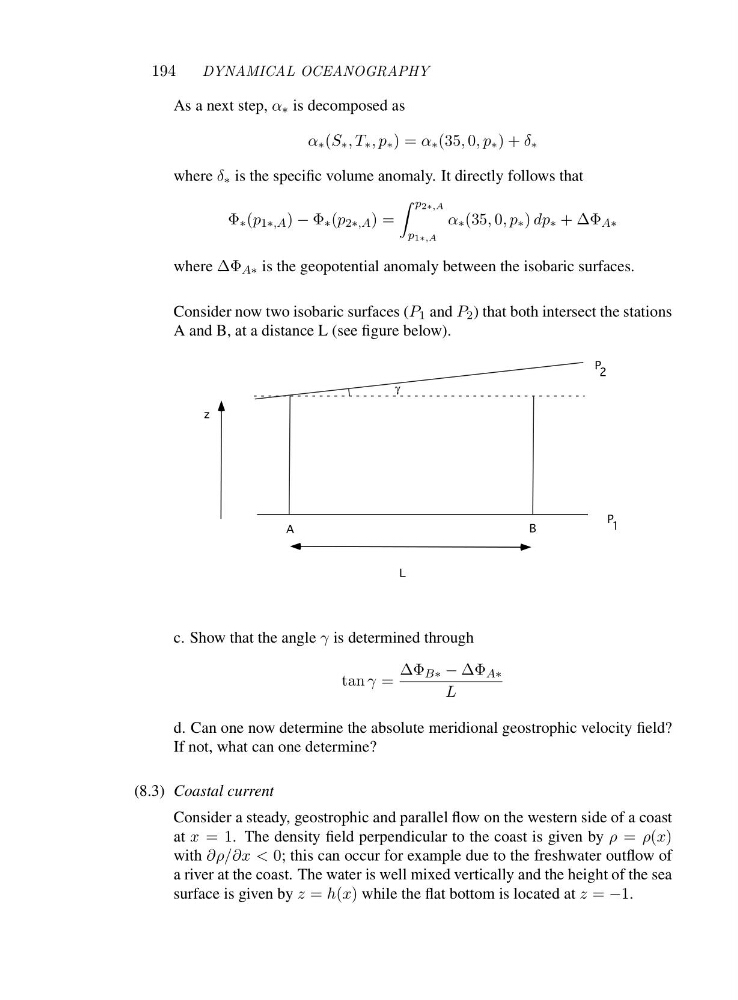
Consider now two isobaric surfaces (P 1 and P 2 ) that both intersect the stations
A and B, at a distance L (see figure below).
A
P
1
P
2
B
γ
z
L
c. Show that the angle γ is determined through
tan γ =
ΔΦ B∗ − ΔΦ A∗
L
d. Can one now determine the absolute meridional geostrophic velocity field?
If not, what can one determine?
(8.3) Coastal current
Consider a steady, geostrophic and parallel flow on the western side of a coast
at x =1 . The density field perpendicular to the coast is given by ρ = ρ(x)
with ∂ρ/∂x < 0; this can occur for example due to the freshwater outflow of
a river at the coast. The water is well mixed vertically and the height of the sea
surface is given by z = h(x) while the flat bottom is located at z = −1.
DYNAMICAL OCEANOGRAPHY
As a next step, α ∗ is decomposed as
α ∗ (S ∗ ,T ∗ ,p ∗ )=α ∗ (35, 0,p ∗ )+δ ∗
where δ ∗ is the specific volume anomaly. It directly follows that
Φ ∗ (p 1∗,A ) − Φ ∗ (p 2∗,A )=
p 2∗,A
p 1∗,A
α ∗ (35, 0,p ∗ ) dp ∗ +ΔΦ A∗
where ΔΦ A∗ is the geopotential anomaly between the isobaric surfaces.
Consider now two isobaric surfaces (P 1 and P 2 ) that both intersect the stations
A and B, at a distance L (see figure below).
A
P
1
P
2
B
γ
z
L
c. Show that the angle γ is determined through
tan γ =
ΔΦ B∗ − ΔΦ A∗
L
d. Can one now determine the absolute meridional geostrophic velocity field?
If not, what can one determine?
(8.3) Coastal current
Consider a steady, geostrophic and parallel flow on the western side of a coast
at x =1 . The density field perpendicular to the coast is given by ρ = ρ(x)
with ∂ρ/∂x < 0; this can occur for example due to the freshwater outflow of
a river at the coast. The water is well mixed vertically and the height of the sea
surface is given by z = h(x) while the flat bottom is located at z = −1.